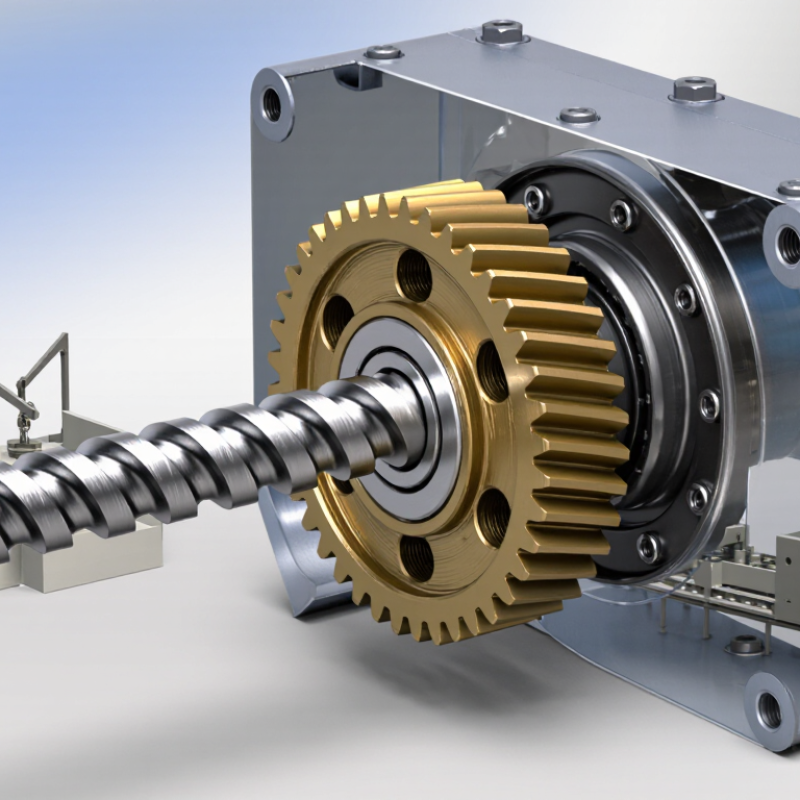
| High reduction in one stage | A worm with a small number of starts can drive a worm wheel with many teeth, producing a substantial speed reduction in a single gear stage. | Compact drives that need low output speed and increased output torque, such as lifts, conveyors, and positioning equipment. | The resulting output torque is also affected by input power, gear geometry, lubrication, and efficiency. |
| Right-angle shaft arrangement | Worm gears commonly transmit motion between shafts arranged at right angles, allowing the drive layout to turn through 90 degrees. | Machinery where the motor and driven shaft need to be positioned perpendicular to each other. | Check shaft alignment, mounting space, and the required direction of rotation when selecting the arrangement. |
| Compact drive packaging | A large speed reduction can often be achieved without several successive gear stages, which can simplify the overall drive package. | Enclosed gearboxes and installations with limited space for a multi-stage transmission. | Compactness depends on the required ratio, torque rating, thermal limits, and gearbox design. |
| Smooth, quiet operation | The worm’s thread engages progressively with the wheel teeth, generally producing smooth motion and low noise when the gears are properly designed and lubricated. | Equipment where operating noise and vibration are important considerations. | Noise and vibration also depend on manufacturing accuracy, mounting stiffness, wear, and operating conditions. |
| Potential resistance to back-driving | Friction and a low lead angle can make some worm gear sets difficult to drive from the wheel side. | Applications that benefit from reduced tendency for a load to move the drive backward when power is removed. | Self-locking is not guaranteed. It depends on the gear geometry, friction, lubrication, wear, and load; use a suitable brake when load holding is safety-critical. |
| Useful for controlled motion | The reduction ratio lowers output speed and can provide fine movement when the input is driven in a controlled manner. | Adjustment mechanisms, indexing equipment, and other low-speed positioning tasks. | Backlash, torsional compliance, and load variation should be considered where precise positioning is required. |
| Trade-off: efficiency and heat | Sliding contact between the worm and wheel creates friction. Worm gear efficiency varies with design and operating conditions and may be lower than that of comparable spur or helical gear drives. | Suitable when compact reduction, shaft layout, or resistance to back-driving matters more than maximum efficiency. | Account for lubrication, heat dissipation, duty cycle, and the manufacturer’s rated operating limits. |