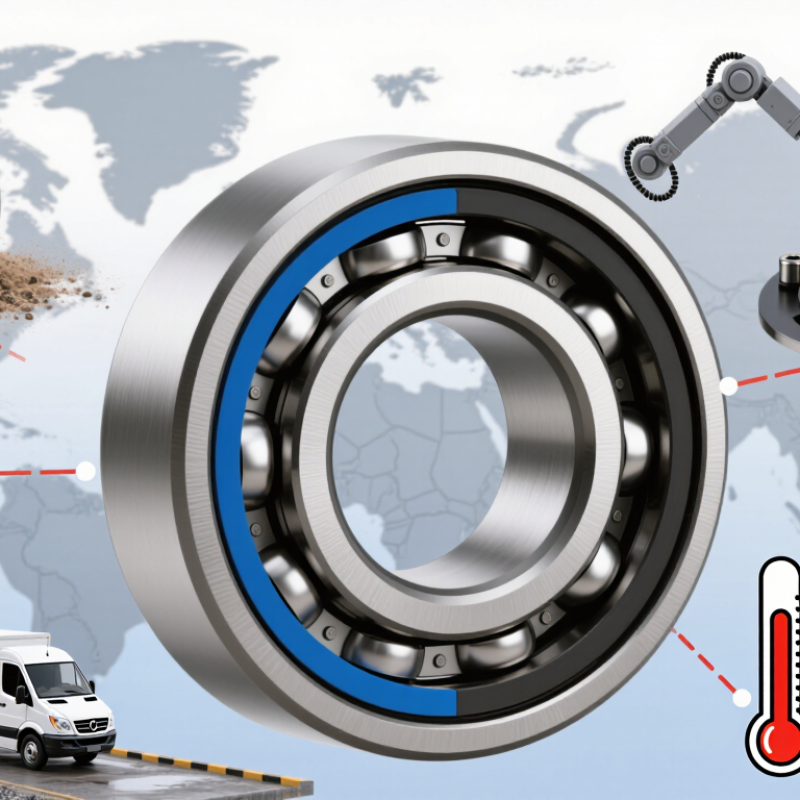
| Construction | Main Components | A sealed wheel bearing normally combines inner and outer rings, rolling elements, a cage, lubricant, and integrated seals. | 5 core component groups | A complete unit can simplify assembly, inventory planning, and replacement procedures. |
| Sealing System | Common Seal Configuration | Two contact seals, commonly identified by the suffix 2RS, help retain grease and restrict the entry of water and solid contaminants. | 2 integrated seals | The seal configuration should match the expected moisture, dust, temperature, and speed conditions. |
| Sealing System | Non-Contact Shield Configuration | Metal shields, commonly identified by the suffix ZZ or 2Z, reduce contamination entry without contacting the inner ring. | 2 metal shields | Shielded designs can be suitable for cleaner environments and applications where lower friction is important. |
| Lubrication | Factory Grease Filling | Sealed bearings are generally supplied with grease placed between the rolling elements, raceways, and seals during manufacture. | Pre-lubricated | Pre-lubrication reduces the need for immediate maintenance and supports standardized installation workflows. |
| Operating Principle | Load Transmission | Rolling elements move between the inner and outer raceways, converting most sliding motion into rolling motion. | Rolling contact | Lower rolling resistance than plain sliding contact can support energy-efficient operation when correctly selected. |
| Load Capability | Radial Load | Deep-groove ball bearings are widely used for radial wheel loads and can also accommodate limited axial loads. | Radial + limited axial | The required dynamic and static load ratings should be checked against vehicle weight, shock loads, and duty cycle. |
| Performance | Friction and Speed Balance | Contact seals normally provide stronger contamination protection than non-contact shields, but their seal contact may increase friction and temperature. | Protection–friction trade-off | Selection should prioritize environmental protection for dirty or wet service and speed capability for high-speed service. |
| Environment | Contamination Protection | Seals help protect the internal grease and raceways from dust, water spray, and particles, although they are not intended for unlimited immersion. | Improved protection | Request application-specific sealing tests or specifications when the bearing will face mud, salt water, or frequent washing. |
| Temperature | Temperature Compatibility | The practical operating temperature depends on the seal material, grease, bearing steel, clearance, rotational speed, and heat dissipation. | Application-dependent | Confirm the minimum and maximum operating temperatures rather than relying only on the bearing size designation. |
| Installation | Maintenance Requirement | Most sealed-for-life wheel bearings do not require routine relubrication during their intended service period. | Normally maintenance-free | This can reduce service labor and lubricant handling, but damaged or worn bearings must still be replaced. |
| Dimensional Control | Critical Fit Parameters | Bore diameter, outside diameter, width, internal clearance, tolerance class, and mounting interference are key selection parameters. | 6+ critical parameters | Dimensional inspection records help prevent interchangeability problems across international production sites. |
| Quality Control | Recommended Inspection Items | Incoming inspection may include dimensions, radial clearance, rotation smoothness, seal condition, noise, grease condition, and packaging integrity. | 7 inspection areas | A documented inspection plan improves consistency between production batches and shipment lots. |
| Traceability | Batch Documentation | Lot identification, production date, material records, inspection results, and packing details support product traceability. | Batch-level records | Traceability is valuable for warranty analysis, corrective actions, customs documentation, and repeat purchasing. |
| Packaging | Storage Protection | Bearings should be protected from moisture, dust, impact, corrosion, and excessive vibration during storage and transportation. | Dry, clean, vibration-limited storage | Packaging specifications should address long-distance sea, air, rail, or road transportation conditions. |
| Sourcing Decision | Best-Fit Application | Sealed wheel bearings are especially practical where compact construction, pre-lubrication, contamination resistance, and reduced maintenance are priorities. | High suitability | Use a technical specification sheet to compare seal type, load rating, temperature range, tolerance, testing, and packaging requirements. |