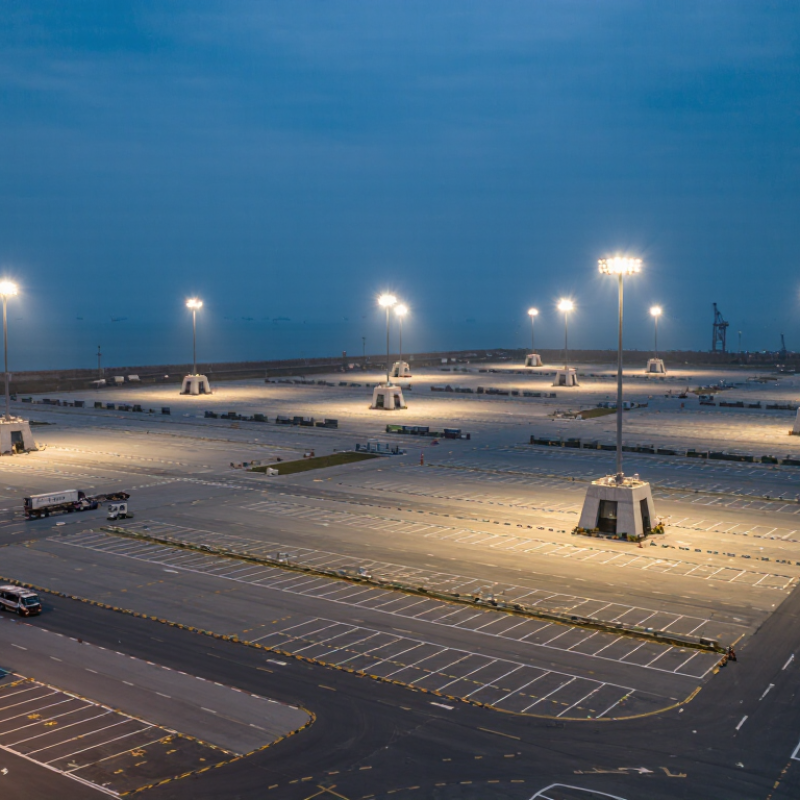
| Mast Height | Typically 20–50 m, depending on site size, required illuminance, wind conditions, and local regulations. | Fixtures are mounted at a high elevation so light can be distributed over a broad area from fewer points. | Reduces the number of obstructions on the ground and can provide more uniform coverage across large sites. |
| Typical Applications | Ports, airports, container yards, logistics parks, highways, rail yards, sports fields, and large parking areas. | Multiple luminaires on one mast direct light toward separate zones, lanes, work areas, or circulation routes. | One lighting strategy can serve vehicle movement, pedestrian safety, loading operations, and perimeter visibility. |
| Number of Luminaires per Mast | Commonly 4–12 luminaires per mast; the actual quantity depends on optical distribution and target illuminance. | Each luminaire uses a selected beam angle and aiming direction to cover a defined part of the site. | Allows large areas to be divided into controllable lighting zones without installing a separate pole for every area. |
| Typical LED Luminaire Power | Approximately 100–400 W per luminaire for many outdoor applications; higher or lower ratings may be required by the design. | Electrical power is converted into light, and optics shape the output toward the working surface. | Provides substantial light output while allowing energy use to be matched to the task and operating schedule. |
| LED System Efficacy | Approximately 120–180 lm/W is a common planning range for modern outdoor LED systems, including luminaire-level performance variations. | Higher efficacy produces more useful light from each watt of electrical power. | Can reduce energy consumption compared with older high-intensity discharge systems when equivalent lighting levels are achieved. |
| Illuminance Planning Range | About 20–50 lux for many general parking, storage, and circulation areas; 50–100 lux or more may be needed for active work zones. | Light levels are calculated on the ground or working plane using mounting height, lumen output, beam distribution, spacing, and surface reflectance. | Supports task visibility and safer movement while avoiding unnecessary over-lighting. |
| Coverage and Spacing | Approximate mast spacing may range from 100–300 m in large sites, but it must be verified through photometric calculations. | Higher mounting positions and wide distributions allow neighboring light patterns to overlap across broad areas. | Fewer foundations, access roads, and electrical connection points may be required than with closely spaced low poles. |
| Light Distribution | Asymmetric, symmetric, narrow-beam, medium-beam, or wide-beam optics are selected according to the site layout. | Optical lenses and reflectors control where the light travels and help limit unwanted spill light. | Improves uniformity and helps direct light toward roads, yards, platforms, or work surfaces instead of nearby properties or the sky. |
| Glare Control | Requires correct aiming, shielding where necessary, appropriate beam selection, and compliance with local outdoor-lighting requirements. | High mounting positions and carefully adjusted optics can lower the direct line of sight to the light source for people at ground level. | Helps protect drivers, operators, nearby residents, and aircraft or marine users from excessive glare. |
| Maintenance Access | Lowering systems are commonly used on high mast installations; maintenance intervals depend on failure rates, environment, and operating hours. | A winch, carriage, or lowering ring brings the luminaire assembly down to a serviceable height without requiring routine work at the mast top. | Can reduce the need for frequent crane hire and improve maintenance safety and planning. |
| LED Service-Life Reference | Many LED products are designed around an L70 rating of approximately 50,000–100,000 operating hours, subject to temperature and operating conditions. | L70 indicates the time at which the light output is expected to reach about 70% of its initial level for the rated population. | Long operating life can reduce relamping frequency, service interruptions, and maintenance labor. |
| Control and Dimming | Common options include photocells, astronomical timers, motion detection, programmable dimming, and centralized monitoring. | Controls adjust switching and output according to daylight, schedules, traffic, occupancy, or operational requirements. | Enables lower energy use during low-activity periods while maintaining required safety and security lighting. |
| Wind and Structural Design | Mast diameter, wall thickness, foundation, luminaire area, and allowable deflection must be designed for the local wind environment. | The mast and foundation transfer wind loads from the luminaires and structure into the ground. | Proper structural engineering supports stability, aiming accuracy, and long-term reliability in exposed locations. |
| Energy-Use Example | Eight 250 W luminaires operate at full output for 12 hours per night: 8 × 0.25 kW × 12 h = 24 kWh per mast per night, excluding control gear losses. | The calculation combines the number of luminaires, rated power, and operating time. | Provides a transparent basis for comparing operating schedules, dimming strategies, and different lighting designs. |
| Key Design Verification | Photometric calculations should confirm average illuminance, minimum illuminance, uniformity, glare, spill light, power demand, and structural compliance. | Computer-based lighting models evaluate the interaction of mast locations, luminaire output, optics, aiming angles, and surface conditions. | Helps ensure that the installation meets safety objectives and applicable local standards before construction. |