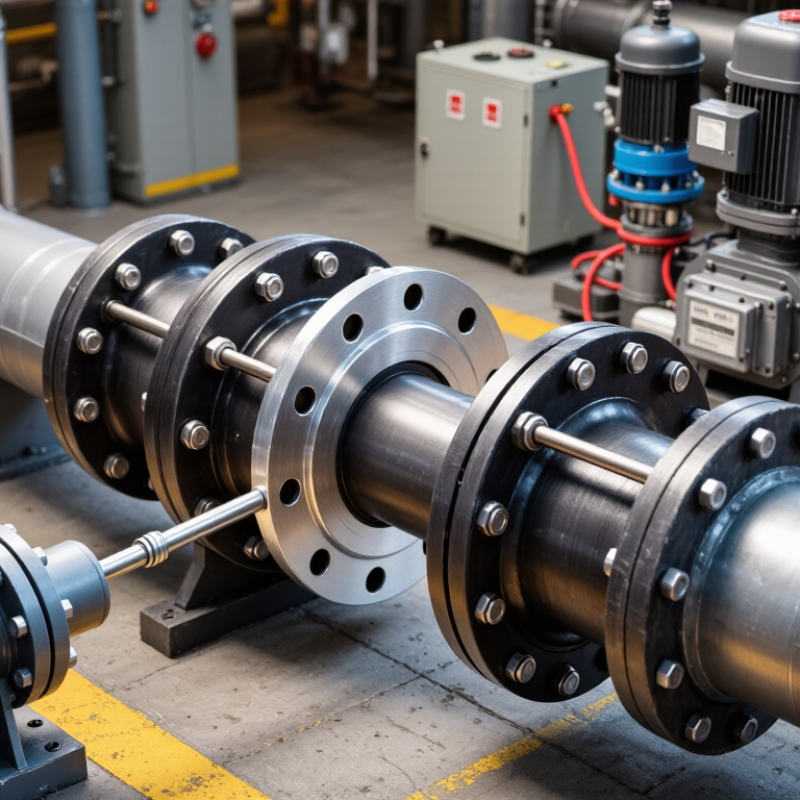
| Primary function | Temporary axial separation and controlled movement between flanged pipeline components | Allows valves, pumps, meters and other flanged equipment to be removed without cutting the pipeline | Confirm that the joint is designed for dismantling service rather than only for permanent pipe connection |
| Nominal diameter | Common water and industrial pipeline sizes: DN50 to DN2000; larger sizes may require project-specific design | Correct sizing ensures alignment with the pipe, valve or fitting and avoids flow restrictions | Match nominal size, internal bore, flange outside diameter and bolt-hole pattern |
| Axial adjustment | A commonly specified adjustment allowance is approximately 50–100 mm, depending on size and design | Provides installation tolerance and creates clearance for equipment removal | Check the required dismantling gap, adjustment range and permitted installation position |
| Pressure rating | Typical nominal pressure classes include PN10, PN16, PN25 and PN40 | The pressure class must withstand the operating pressure, surge pressure and test pressure of the system | Select the rating from the pipeline design pressure and verify pressure-temperature limits |
| Temperature range | Elastomer seals are commonly selected for service ranges such as approximately −20°C to +80°C; compound limits vary | Temperature affects seal elasticity, service life and pressure capability | Specify the actual minimum, maximum and cyclic operating temperatures |
| Pipeline fluid | Clean water, wastewater, seawater, air, chemicals and hydrocarbons require different material and seal selections | Chemical compatibility prevents swelling, cracking, corrosion and premature leakage | Identify fluid composition, concentration, pH, solids content and disinfection chemicals |
| Body material | Common options include ductile iron, carbon steel and stainless steel, subject to the application | Material selection affects strength, corrosion resistance, weight and total service life | Consider fluid chemistry, external environment, coating system and design loads |
| Seal material | EPDM is widely used for water service; NBR is commonly selected where oil resistance is required; other compounds may be used for special fluids | The seal is the primary barrier against leakage at the telescopic connection | Verify compatibility with temperature, fluid, pressure and applicable potable-water requirements |
| Flange standard | Common drilling systems include EN 1092-2 for cast-iron flanges and EN 1092-1 for steel flanges; other regional standards may apply | Matching flange dimensions are essential for bolt installation, gasket seating and leak prevention | Confirm standard, pressure class, number of bolts, bolt-circle diameter and bolt size |
| Axial restraint | Standard dismantling joints generally provide adjustment; they do not automatically replace a dedicated restrained joint or thrust restraint system | Uncontrolled axial movement can damage joints, supports and connected equipment | Review thrust blocks, pipe anchors, support spacing and whether a restrained design is required |
| Installation space | Requires sufficient longitudinal clearance for retraction and removal of the connected valve or fitting | Adequate clearance is necessary to obtain the maintenance benefit of the joint | Check chamber dimensions, access route, lifting capacity and equipment removal path |
| Corrosion protection | Typical systems include fusion-bonded epoxy, liquid epoxy, galvanizing or stainless-steel construction, depending on exposure | Protection reduces external corrosion in wet chambers, buried installations and aggressive environments | Specify coating thickness, surface preparation, holiday testing and field-repair requirements where applicable |
| Maintenance benefit | Allows easier removal and replacement of flanged components without extensive pipe cutting or hot work | Can reduce shutdown duration, excavation work and maintenance complexity | Evaluate accessibility, expected maintenance frequency and the cost of system downtime |
| Testing and inspection | Hydrostatic testing, dimensional inspection and visual coating checks are commonly included in quality-control procedures | Testing helps identify leakage, dimensional errors and coating defects before commissioning | Define test pressure, hold time, inspection records and documentation requirements in the purchase specification |
| Installation torque | Bolt torque must follow the joint design, bolt grade, gasket arrangement and manufacturer’s installation instructions | Incorrect tightening can cause gasket extrusion, flange distortion or leakage | Use a calibrated torque wrench and tighten bolts progressively in a cross-pattern |