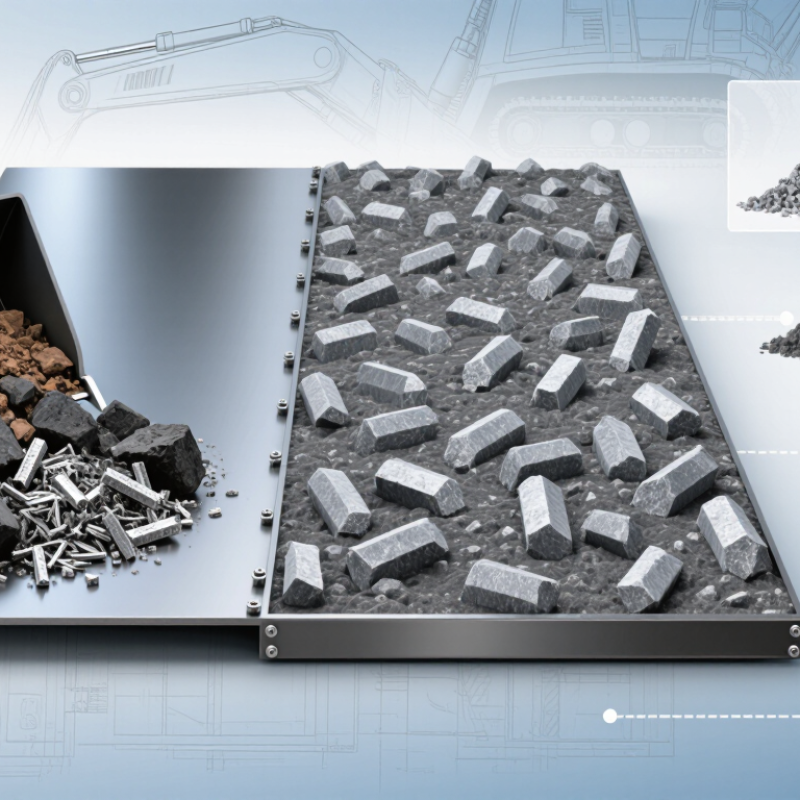
| Overlay composition | Typically about 20–40% chromium and 4–5% carbon by mass | Supports the formation of hard chromium-rich carbides in a wear-resistant metallic matrix | Exact chemistry depends on the welding consumable and product specification |
| Primary hard phase | Chromium carbides, commonly described as M7C3-type carbides | Improves resistance to cutting, gouging, sliding abrasion, and mineral wear | The carbide morphology and distribution affect actual service life |
| Overlay hardness | Approximately 55–65 HRC; many deposits measure about 600–800 HV | Provides a hard working surface for abrasive applications | Hardness varies with alloy chemistry, dilution, welding process, and test method |
| Typical overlay thickness | Commonly about 3–15 mm; heavier deposits may be available | Allows designers to match wear allowance to the severity of the application | Thickness should be selected according to wear rate, impact level, and plate support |
| Base plate material | Usually a weldable low-carbon or low-alloy steel backing plate | Provides structural strength, support, and practical attachment options | The backing grade and thickness should be confirmed before fabrication or welding |
| Abrasion resistance | High resistance to mineral, sand, coal, clinker, and other abrasive particles | Helps reduce component replacement frequency and maintenance downtime | Actual performance depends on particle size, hardness, pressure, impact, and material flow |
| Impact resistance | Moderate; generally lower than that of conventional structural steel or impact-focused wear plate | Suitable for abrasion with limited to moderate impact | Severe repeated impact may require a tougher wear-resistant grade or a different design |
| Resistance to sliding wear | Very good when hard particles slide across the surface under suitable loading conditions | Useful for chutes, hoppers, liners, conveyors, and material-handling equipment | Performance decreases when the application is dominated by impact, corrosion, or high temperature |
| Corrosion resistance | Limited to moderate; not equivalent to stainless or dedicated corrosion-resistant alloys | Can tolerate some mildly corrosive service, but abrasion remains its primary design purpose | A separate corrosion-resistant overlay may be more appropriate for aggressive chemical environments |
| Operating temperature | Often used in applications up to approximately 500–600 °C, subject to product design | Retains useful wear performance in many elevated-temperature material-handling systems | High-temperature exposure can reduce hardness; always verify the specified service limit |
| Fabrication method | Can commonly be cut by plasma or abrasive methods and formed within defined limits | Supports production of liners, wear strips, chutes, elbows, and custom components | Conventional drilling and cold forming may be difficult because of the hard overlay |
| Repair and joining | The steel backing can usually be welded with suitable procedures; overlay welding is possible with compatible consumables | Enables attachment to equipment and localized repair in many plant environments | Preheating, interpass control, and compatible filler selection may be required |
| Common applications | Mining, cement, steel, power generation, recycling, quarrying, and bulk-material handling | Protects high-wear areas such as chutes, hoppers, crusher parts, liners, and conveyor components | Selection should consider abrasion type, impact energy, temperature, corrosion, and maintenance access |