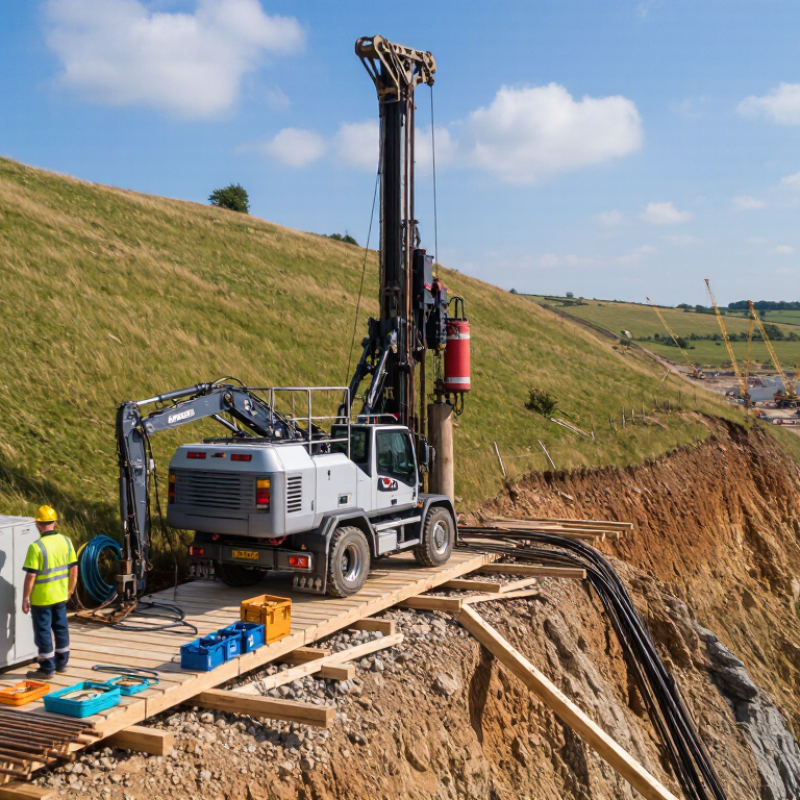
| Retaining walls and deep excavations | Drills inclined or horizontal holes through the retaining structure and into the ground for ground-anchor installation. | Anchors transfer part of the wall load into stable ground beyond the potential failure zone, helping limit wall movement. | Confirm anchor layout, inclination, bond-zone location, ground conditions, and the design loads before drilling. |
| Slopes and cut faces | Provides controlled drilling for soil nails or anchors, including work on steep faces when the rig and access system are suitable. | Reinforcement can improve resistance to sliding and help control movement when installed as part of an engineered slope-support system. | Check the geotechnical design, drainage conditions, drilling sequence, and face protection requirements. |
| Variable ground conditions | Can be configured for different drilling methods, such as rotary or percussion drilling, depending on the rig, tooling, and ground. | Matching the method to soil or rock can help maintain hole quality and reduce the risk of unstable or obstructed boreholes. | Review soil and rock records, groundwater, expected obstructions, and the need for casing or flushing methods. |
| Restricted or congested work areas | Some rigs are available with compact dimensions, adjustable masts, or positioning systems suited to limited access. | Suitable access and accurate positioning help crews install anchors at the designed locations and orientations. | Measure access routes and working clearances; assess overhead hazards, ground bearing capacity, and equipment setup space. |
| Consistent anchor installation | Supports repeatable control of drilling position, angle, depth, and drilling parameters when properly operated. | More consistent boreholes help the installation team place anchor components and grout according to the design. | Record hole depth and inclination, inspect drilling returns, and follow the approved installation and grouting procedures. |
| Anchor load verification | Creates the boreholes needed for anchors that can later be tested with suitable stressing and load-testing equipment. | Testing helps verify that installed anchors meet specified performance requirements; drilling alone does not confirm capacity. | Follow the project testing plan, specified proof or performance loads, acceptance criteria, and applicable standards. |
| Worker and site safety | Mechanized drilling can reduce some manual drilling tasks, provided the rig is operated by trained personnel. | Proper setup and operation support controlled installation and reduce exposure to avoidable equipment and ground hazards. | Use site-specific risk assessments, equipment inspections, exclusion zones, and appropriate personal protective equipment. |