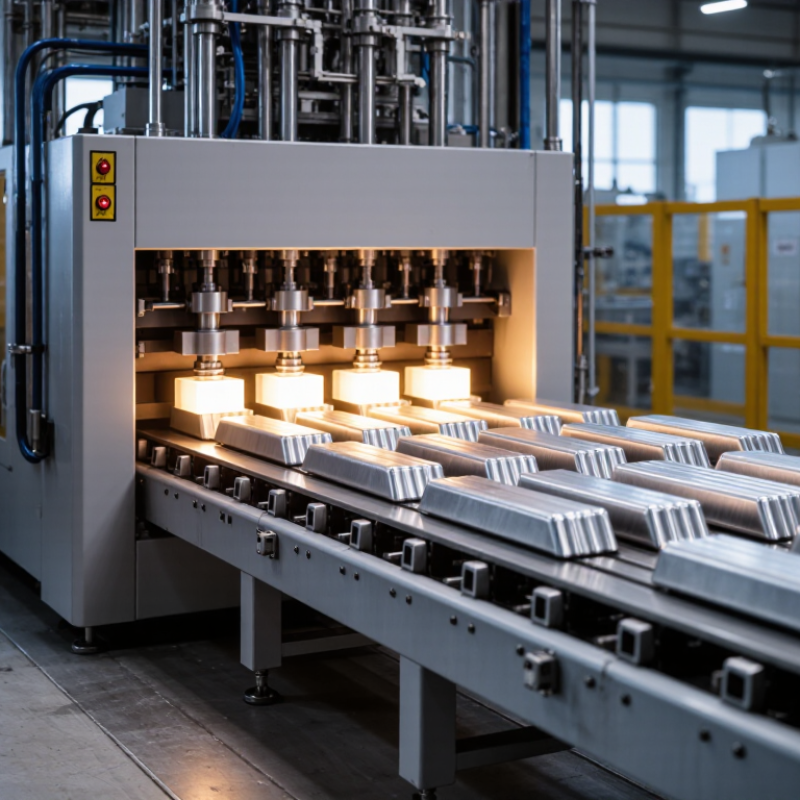
| Machine Definition | Automated equipment for melting, metering, molding, cooling, and releasing tin bars | A tin bar casting machine converts molten tin into bars with controlled dimensions, weight, and surface quality. |
| Primary Material | Commercially pure tin or tin-based alloys | The machine can be configured according to the required tin grade, alloy composition, bar size, and end-use application. |
| Melting Point of Pure Tin | Approximately 231.9°C | The heating system must raise the material above its melting point while maintaining stable temperature control during casting. |
| Typical Casting Temperature | Approximately 250–350°C | The actual setting depends on tin purity, alloy composition, bar dimensions, mold design, and required casting speed. |
| Heating Method | Electric resistance or induction heating | Both methods can provide controlled heating; the selected system should match the required capacity, energy efficiency, and temperature stability. |
| Bar Weight Range | Commonly 0.5–25 kg per bar | Mold dimensions, filling volume, and handling equipment determine the final bar weight. Custom sizes may be possible. |
| Production Capacity | Typically 50–1,000 kg per hour | Capacity varies with furnace size, mold count, cooling time, bar weight, automation level, and operating cycle. |
| Casting Mold Material | Heat-resistant steel or other suitable metal alloys | The mold should withstand repeated thermal cycling and provide consistent bar shape, dimensions, and release performance. |
| Mold Configuration | Single-cavity, multi-cavity, or continuous casting layout | Multi-cavity and continuous configurations can improve throughput when large quantities of uniform tin bars are required. |
| Temperature Control Accuracy | Often within approximately ±2–5°C | Stable temperature control helps reduce incomplete filling, excessive oxidation, inconsistent weight, and surface defects. |
| Cooling System | Natural cooling, air cooling, or water-assisted cooling | The cooling method affects cycle time, solidification behavior, bar appearance, and overall production capacity. |
| Automation Level | Manual, semi-automatic, or fully automatic | Automatic systems can coordinate material feeding, mold movement, cooling, bar ejection, counting, and collection. |
| Weight Consistency | Controlled through metering and mold-volume accuracy | Consistent bar weight supports inventory control, packaging, pricing, alloy traceability, and downstream processing. |
| Surface Quality | Smooth, uniform, and visually consistent bar surfaces | Correct temperature, mold condition, filling speed, and cooling control help minimize cracks, voids, oxidation, and uneven surfaces. |
| Operational Advantages | Repeatability, reduced manual handling, and improved productivity | Compared with manual pouring, mechanized casting can improve process consistency and reduce operator exposure to molten metal. |
| Safety Features | Thermal insulation, guards, emergency stop, alarms, and temperature monitoring | Safety functions help control risks related to molten metal, hot surfaces, moving molds, electrical systems, and abnormal operating conditions. |
| Energy Considerations | Depends on furnace size, insulation, heating method, and operating cycle | Good insulation, correct batch sizing, and stable process control can reduce heat loss and improve energy efficiency. |
| Quality Inspection Points | Bar weight, dimensions, surface condition, alloy composition, and internal defects | Inspection requirements should be defined according to the intended application and applicable material or customer specifications. |
| Best-Fit Applications | Metal trading, solder production, alloy preparation, chemical processing, and industrial manufacturing | The equipment is suitable when repeatable tin bar production is required at a higher consistency or output than manual casting can provide. |
| Key Selection Factors | Bar size, required capacity, tin grade, temperature range, automation, and available workspace | Selecting the machine according to actual production requirements helps avoid insufficient capacity, excessive energy use, and unnecessary equipment cost. |