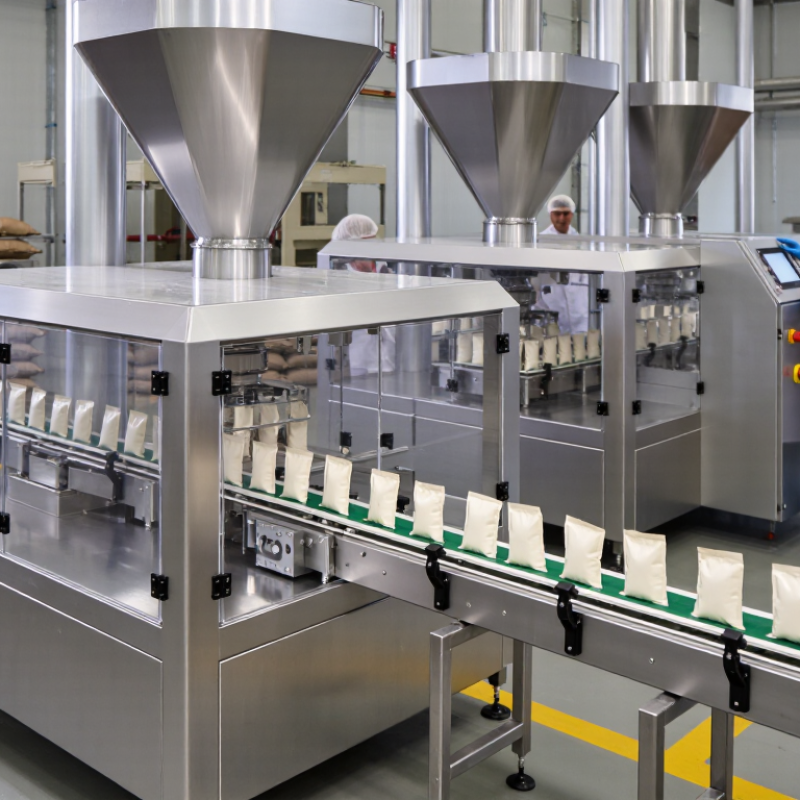
| Typical number of lanes | 1 | 2–12, depending on machine layout and sachet width | More lanes increase output without requiring a proportional increase in machine footprint. |
| Common powder dose range | Approximately 10 g–1 kg with suitable auger tooling | Approximately 10 g–1 kg per lane with suitable auger tooling | Auger screws can be selected for both low-dose sachets and larger pouches or containers. |
| Dose adjustment method | Auger revolutions, fill time, and product calibration | Independent or coordinated auger control for each lane | Fine control supports recipe changes and compensates for variations in bulk density. |
| Typical dosing accuracy | Often within approximately ±1% to ±3% after calibration | Often within approximately ±1% to ±3% per lane after calibration | Accuracy depends on powder flowability, dose size, screw design, vibration, and weighing or checkweighing controls. |
| Best-suited powder characteristics | Free-flowing, cohesive, fine, or mildly aerated powders | The same powder categories, provided feeding and de-aeration are properly designed | The rotating screw provides controlled volumetric feeding for powders that may not feed consistently by gravity alone. |
| Typical cycle speed | Approximately 20–60 cycles per minute | Approximately 20–60 cycles per minute per lane | Actual speed is limited by dose weight, filling accuracy, sealing time, film properties, and product dust. |
| Illustrative output at 40 cycles/minute | 40 packs/minute | 80 packs/minute with 2 lanes; 160 packs/minute with 4 lanes | Nominal output scales with lane count when all lanes run at the same cycle rate. |
| Suitable package formats | Sachets, stick packs, pouches, bags, bottles, and jars | Primarily sachets, stick packs, and small pouches arranged in parallel lanes | The packaging film and sealing system must be matched to the number of lanes and pack dimensions. |
| Changeover requirements | Usually simpler and faster for one product or pack format | Requires coordinated adjustment of augers, feeders, forming parts, and sealing components | Multi-lane systems provide higher capacity but benefit from standardized product and film specifications. |
| Dust-control considerations | Extraction near the filling point may be required | Extraction, enclosed transfer, and dust-resistant sealing are more important as lane count increases | Fine powders can create airborne dust, contamination risks, and seal-area defects if not controlled. |
| Primary benefit | Flexible and economical for lower or variable production volumes | Higher throughput, consistent dosing, and better use of production-floor space | The best choice depends on required output, dose range, product behavior, labor cost, and available floor space. |