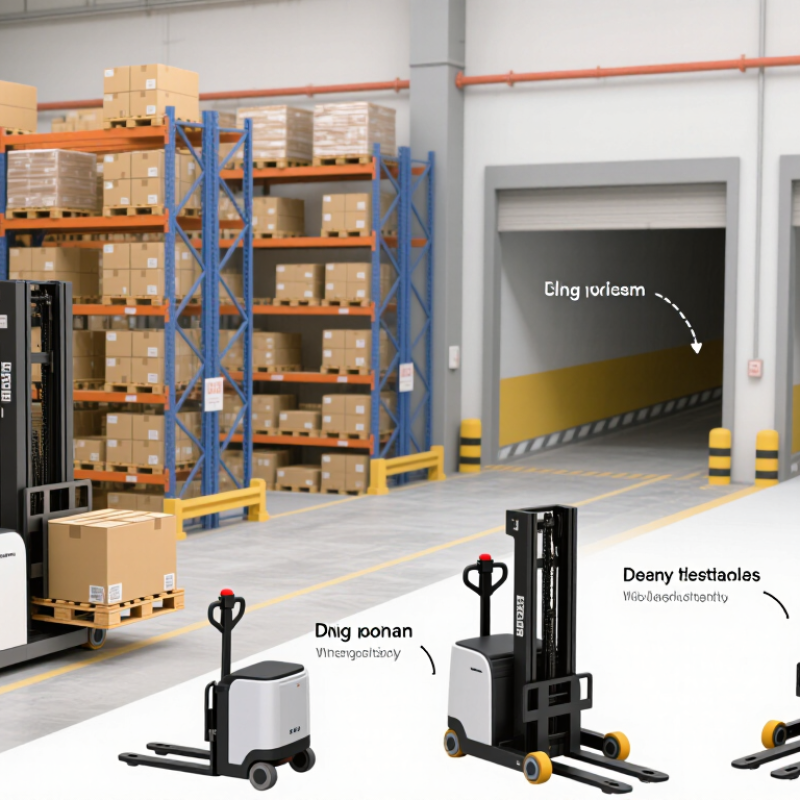
| Pedestrian electric stacker | About 1,000–2,000 kg, depending on load center and lift height | Commonly about 1.6–5.5 m | Operator walks behind or beside the machine; suitable for short-to-medium travel distances and moderate task frequency. | Needs a clear pedestrian route and a floor suitable for the loaded machine; turning space varies with chassis and mast design. | Usually low without added navigation and controls; some models can be integrated into a guided material-flow system. | Small warehouses, stockrooms, loading areas, and occasional pallet stacking. | Confirm residual capacity at the required lift height, mast clearance, pallet dimensions, gradient limits, and battery runtime. |
| Platform or ride-on electric stacker | Often about 1,200–2,000 kg | Commonly about 1.6–5.5 m | Operator rides on a platform or stands on a platform, reducing walking during longer horizontal moves. | Requires adequate aisle width, turning clearance, and floor condition for the chosen travel speed and load. | Can support repeatable workflows, but autonomous operation requires compatible navigation, safety systems, and facility integration. | Higher-throughput pallet movement over longer distances than typical walk-behind use. | Compare travel distance per shift, braking performance, visibility, operator protection, charging needs, and turning radius. |
| Straddle stacker | Often about 1,000–1,500 kg | Commonly about 1.6–5.5 m | Straddle legs support the load, allowing handling of pallet types that may not suit a standard support-leg layout. | Check whether straddle legs can pass around the pallet and whether the pallet, floor, and aisle layout provide sufficient clearance. | Typically operator-controlled; repeatability can be improved through standardized routes and process controls. | Facilities handling open-bottom pallets or loads that need the added stability of straddle legs. | Verify pallet entry dimensions, leg spacing, load stability, turning space, and capacity at the intended lift height. |
| Counterbalanced electric stacker | Often about 1,000–2,000 kg | Commonly about 1.6–5.5 m | Counterweight design avoids front support legs, which can help when approaching closed-bottom pallets or certain loads. | May need more turning room than a comparable support-leg design; confirm floor capacity and route clearance. | Generally manual or operator-controlled; automation depends on the specific vehicle architecture and site system. | Handling varied pallet designs, including loads that cannot accommodate support legs. | Check stability, load center, turning radius, overhead clearance, and rated capacity at the required elevation. |
| Automated stacker crane for an AS/RS | Application-specific; commonly engineered for unit loads from several hundred kilograms to around 1,500 kg | System-specific; installations can reach tens of metres | Travels on a dedicated aisle rail and transfers loads to storage locations or conveyor interfaces; throughput depends on layout and cycle design. | Requires engineered rails, suitable floor and building structure, controlled access, and precise interface alignment. | High when integrated with warehouse control or management software, conveyors, identification, and safety systems. | High-density storage with frequent, repetitive pallet movements and predictable inventory flows. | Model single- and dual-command cycle times, storage density, peak throughput, uptime, recovery procedures, and integration costs. |
| Automated guided pallet stacker | Set by the base vehicle and attachment; verify the rated capacity for the complete configuration | Limited by the lift mechanism, mast, and approved automated operating envelope | Can perform repeatable pickup, transport, and drop-off tasks along mapped or guided routes; real output depends on traffic and charging cycles. | Needs mapped routes, suitable floor conditions, defined crossing rules, and protected operating zones. | High for stable, repetitive routes when fleet control, obstacle detection, and facility interfaces are properly configured. | Repetitive pallet transfers between production, staging, and storage areas. | Assess route variability, pedestrian interaction, payload detection, safety validation, fleet dispatch, and manual recovery options. |
| Selection benchmark | Choose capacity above the heaviest expected load, including attachments and any offset load center. | Match maximum lift height and required free lift to rack beam levels and building clearance. | Measure actual moves per hour, travel distance, load presentation time, and operator or system availability. | Measure the narrowest operating aisle, turning points, floor slope, surface condition, and overhead obstructions. | Compare the level of automation with task repeatability, integration readiness, and required human oversight. | Select for the full material-flow task rather than rated capacity alone. | Request load charts, duty-cycle guidance, battery data, safety documentation, maintenance requirements, and a site-specific trial. |