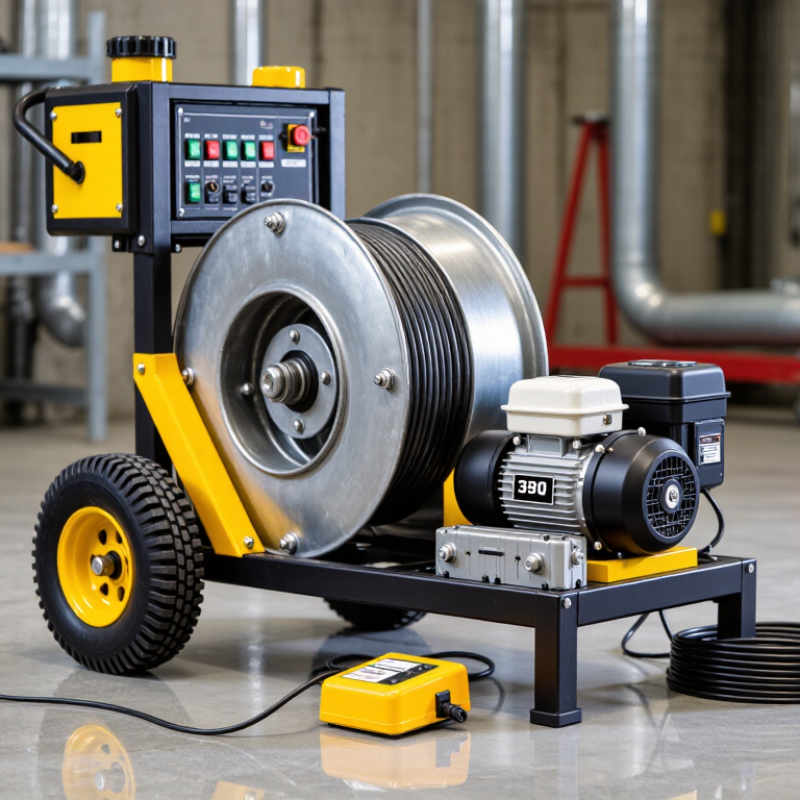
Drum Cable Machine
Cables | A rotating flexible cable carries a cutting, boring, or retrieving tool through the blockage. | Approximately 50–150 mm (2–6 in), depending on the cable and tool configuration. | Commonly 15–30 m (50–100 ft); larger professional systems may reach farther. | Electric motor, commonly powered by a standard commercial electrical supply. | Household drains, kitchen lines, bathroom drains, floor drains, and short branch lines. | - Compact and relatively easy to transport
- Effective against soft blockages and many root intrusions
- Usually lower water consumption than jetting systems
| - May scratch or damage fragile pipes if used incorrectly
- Does not flush loosened debris as effectively as high-pressure water
- Cables require inspection and regular replacement
| Cable diameter, drum capacity, rotation control, ground-fault protection, tool selection, and operator safety features. |
Sectional Cable Machine
Cables | Uses detachable cable sections connected together to reach deep sewer lines. | Approximately 75–300 mm (3–12 in), depending on the model and cutting tools. | Often 30–90 m (100–300 ft) with additional cable sections. | Electric motor; some heavy-duty units use hydraulic drive systems. | Long commercial drains, main sewer lines, municipal maintenance, and large facilities. | - Suitable for long-distance cleaning
- Flexible cable length based on the job
- Can handle heavy obstructions with appropriate cutters
| - Heavier and less convenient for small indoor jobs
- Requires careful handling of exposed cable sections
- Cleaning and transport can be more labor-intensive
| Cable strength, coupling design, torque control, transport wheels, protective guards, and compatibility with sectional tools. |
High-Pressure Water Jetter
Jetters | A pump forces water through a specialized nozzle to cut, scour, and flush deposits from the pipe wall. | Approximately 50–600 mm (2–24 in), depending on pressure, flow, hose, and nozzle selection. | Commonly 30–150 m (100–500 ft), subject to pipe condition and hose diameter. | Electric motor, gasoline engine, diesel engine, or vehicle-mounted hydraulic power. | Grease, sludge, silt, scale, accumulated sediment, and recurring sewer maintenance. | - Flushes loosened material out of the pipe
- Provides thorough cleaning of pipe walls
- Available in portable, trailer-mounted, and vehicle-mounted formats
| - Requires a reliable water supply or onboard tank
- Can create splash, wastewater, and environmental handling requirements
- Incorrect pressure or nozzle selection may damage weak pipes
| Working pressure, water flow rate, hose length, pump material, nozzle compatibility, filtration, water recovery, and safety relief systems. |
Compact Electric Jetter
Jetters | Uses an electric pump and flexible hose to deliver pressurized water through small or medium-sized drains. | Approximately 40–150 mm (1.5–6 in). | Commonly 15–60 m (50–200 ft). | Electric motor, generally suitable for indoor or urban service locations. | Apartments, restaurants, commercial kitchens, hotels, and indoor maintenance work. | - Lower exhaust and noise than combustion-powered equipment
- Suitable for locations with electrical access
- More effective than a cable machine for grease and sludge flushing
| - Performance depends on available electrical power and water supply
- Usually less powerful than large trailer or truck-mounted units
- Not ideal for very large or severely collapsed lines
| Electrical rating, pump flow, pressure regulation, hose flexibility, water inlet filtration, portability, and leakage protection. |
Trailer or Vehicle-Mounted Jetter
Jetters | A high-capacity pump, water tank, hose reel, and engine are integrated into a trailer or service vehicle. | Approximately 100–900 mm (4–36 in), depending on system capacity and nozzle design. | Commonly 60–300 m (200–1,000 ft). | Gasoline or diesel engine; hydraulic systems may be used in specialized installations. | Municipal sewers, industrial drains, long laterals, stormwater lines, and large commercial networks. | - High water capacity and extended operating time
- Suitable for demanding professional service work
- Can clean large pipes over long distances
| - Higher purchase, transport, and maintenance costs
- Requires trained operators and adequate work-site access
- Produces engine exhaust and requires fuel management
| Pump flow and pressure, tank capacity, hose reel design, engine cooling, nozzle range, service access, and transport regulations. |
Push-Rod Inspection Camera
Inspection Systems | A waterproof camera mounted on a semi-rigid push cable transmits live images to a monitor. | Approximately 40–200 mm (1.5–8 in), depending on camera head size and pipe layout. | Commonly 30–60 m (100–200 ft). | Rechargeable battery or mains-powered control unit. | Residential branches, commercial drains, blockage location, pipe condition checks, and post-cleaning verification. | - Locates blockages without unnecessary excavation
- Shows cracks, root intrusion, offsets, and deposits
- Supports before-and-after cleaning documentation
| - Limited reach compared with crawler systems
- May not pass severe bends or heavily blocked sections
- Image quality can be affected by water, grease, or poor lighting
| Camera diameter, image resolution, cable length, self-leveling function, sonde frequency, recording capability, and waterproof rating. |
Crawler Inspection System
Inspection Systems | A remotely controlled camera vehicle travels through larger pipes and sends video and measurement data to the operator. | Approximately 150–2,000 mm (6–80 in), depending on crawler size and wheel configuration. | Commonly 100–500 m (330–1,640 ft) with a powered inspection cable. | Mains power, generator, or a dedicated inspection control system. | Municipal sewers, industrial pipelines, stormwater systems, large-diameter infrastructure, and asset surveys. | - Provides stable, detailed inspection of large pipes
- Can record video, distance, and defect information
- Reduces the need for personnel to enter confined spaces
| - Higher equipment and training costs
- Requires sufficient pipe diameter and access points
- May need prior cleaning before inspection
| Crawler traction, camera pan-and-tilt range, cable length, measurement accuracy, data export, lighting, and pipe-diameter adjustment. |
Locator and Sonde System
Inspection Systems | A transmitter installed near a camera or cable emits a detectable signal to identify underground equipment location and depth. | Used with compatible camera systems and drain lines of various sizes. | Locating range depends on signal strength, soil conditions, depth, and interference. | Rechargeable battery or integrated camera-system power. | Marking blockage locations, identifying pipe routes, and reducing unnecessary digging. | - Helps determine the surface position of underground problems
- May provide approximate depth information
- Useful for targeted excavation and repair planning
| - Accuracy can be affected by reinforced concrete, utilities, and electromagnetic interference
- Requires trained operation and calibration
- Does not clean the pipe by itself
| Transmitter frequency, locating depth, signal stability, display readability, battery life, and compatibility with inspection cameras. |