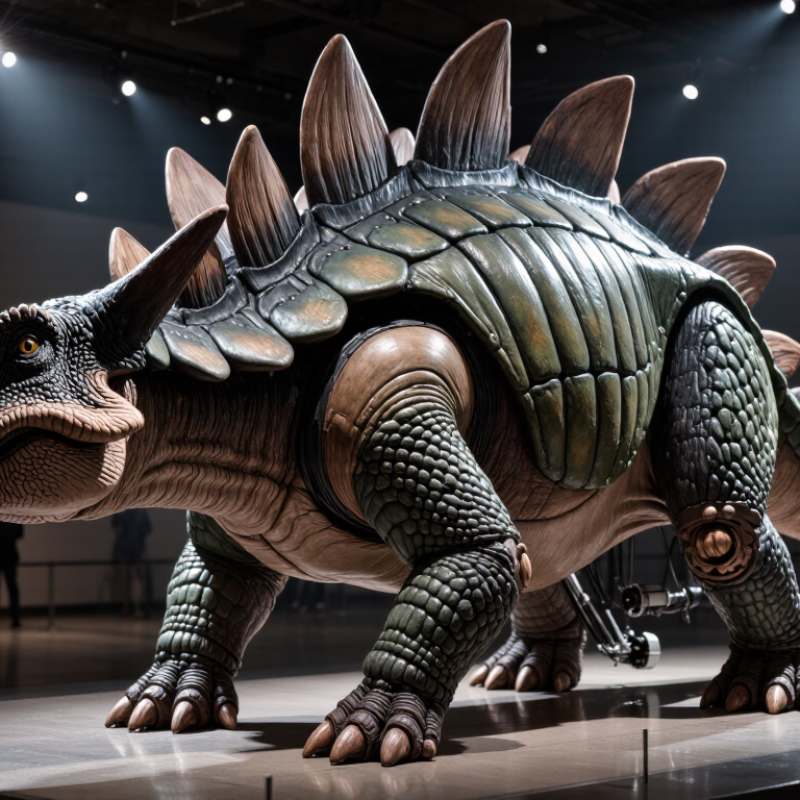
What Is an Animatronic Ankylosaurus?

An Animatronic Ankylosaurus is a life-sized robotic dinosaur designed to imitate the movement, sound, and presence of Ankylosaurus magniventris. It usually features armored plates, a heavy body, short legs, and a reinforced tail club. Hydraulic systems, electric motors, sensors, and programmable controllers bring these fossil-based features to life. The effect can feel surprisingly physical: the head turns slowly, the skin flexes, and the tail shifts with controlled weight.

This technology serves museums, theme parks, educational centers, and traveling exhibitions. The TEA/AECOM Theme Index and Museum Index 2023 reports continued global demand for immersive visitor experiences. Grand View Research also identifies animatronics as a growing market, supported by entertainment, retail, and educational applications. These reports do not measure Ankylosaurus figures specifically. However, they show why institutions invest in realistic, interactive displays rather than static replicas.

Scientific accuracy still matters. Paleontological references, including museum research on ankylosaur anatomy, guide body proportions, armor placement, and defensive behavior. A credible model should separate fossil evidence from creative interpretation. Its colors, vocalizations, and exact movements remain uncertain. That limitation deserves honesty.

It is not a living dinosaur.

A well-built Animatronic Ankylosaurus combines engineering, anatomy, storytelling, and visitor safety. Operators must inspect joints, cables, sensors, sound levels, and emergency controls regularly. Even impressive machines can move unnaturally when rushed. The best designs accept that imperfection, then refine it through testing, observation, and expert review.

What Is an Animatronic Ankylosaurus?

Definition and Core Features of an Animatronic Ankylosaurus

What Is an Animatronic Ankylosaurus?

Definition and Core Features of an Animatronic Ankylosaurus

An animatronic Ankylosaurus is a lifelike robotic model based on the armored dinosaur. It combines mechanical movement, sculpted surfaces, lighting, and sound. The design usually reflects Ankylosaurus as a low-slung herbivore with bony armor and a heavy tail club. Scientists can study fossils, but no one knows its exact living behavior. That uncertainty should guide the design.

Its core features include a reinforced internal frame and programmable motors. These systems may move the head, jaw, legs, body, and tail. Some models use sensors to react when visitors approach. Artificial skin adds wrinkles, scales, and subtle color changes. Layered textures can make the surface appear dusty or weathered. The tail should move with controlled weight, not swing like a simple machine. It feels alive.

Sound design also shapes the experience. Low calls, breathing effects, and small body noises can support believable motion. Safety controls are essential in public spaces. Emergency stops, limited movement ranges, and regular inspections reduce mechanical risks. Technicians should check loose panels, exposed wiring, unusual sounds, and motor heat before operation.

Accuracy remains imperfect. Fossil evidence cannot reveal every muscle or vocalization. Some theatrical movements may look impressive but feel biologically unlikely. A careful designer should separate confirmed anatomy from creative interpretation. That distinction builds trust. It also leaves room for improvement after observing how visitors respond.

How Its Mechanical Body Recreates Ankylosaurus Movement

What Is an Animatronic Ankylosaurus?

How Its Mechanical Body Recreates Ankylosaurus Movement

An animatronic ankylosaurus is a life-sized mechanical reconstruction inspired by fossil evidence. Its internal frame uses articulated joints, electric actuators, and carefully balanced supports. Engineers study ankylosaurus bones to estimate leg angles, body height, and tail structure. These findings guide the machine’s walking pattern. The result is interpretive.

Each leg moves through a programmed sequence rather than a simple forward swing. Motors lift the foot slightly, shift the body’s weight, and lower the foot with controlled pressure. Sensors can detect resistance beneath each foot, helping the system adjust on uneven ground. This creates a slower, heavier gait that suits the dinosaur’s broad body and low center of gravity.

The tail requires special attention. Ankylosaurus likely used strong muscles and flexible joints near its base, while the club moved as a powerful extension. A mechanical version can reproduce the rising motion and delayed swing through linked segments. Its armored back may remain mostly stable, while the hips and shoulders move subtly beneath the surface. That contrast makes the creature feel heavier and more believable.

Some movements remain approximate. Fossils reveal structure, not every muscle action or walking habit. I would not treat the machine as a perfect historical copy. Small timing errors can even expose the reconstruction process, especially when one foot pauses too long or the tail follows late. Those flaws encourage better testing, clearer assumptions, and more honest prehistoric modeling.

Key Materials and Technology Used in Its Construction

What Is an Animatronic Ankylosaurus?

Key Materials and Technology Used in Its Construction

An animatronic ankylosaurus combines structural engineering, soft robotics, and theatrical fabrication. Its internal frame commonly uses welded steel for load-bearing joints, with aluminum panels reducing weight near the tail and head. Fiberglass shells provide a rigid body surface, while silicone or flexible polyurethane creates skin, folds, and muscular contours. These materials must tolerate repeated motion, dust, humidity, and constant visitor contact. Keep it light.

The 2024 World Robotics report recorded 541,302 industrial robot installations worldwide in 2023. That figure reflects the growing reliability of servo motors, motion controllers, and compact sensors. A dinosaur replica may use servo actuators for precise jaw and eye movements, plus pneumatic cylinders for heavier tail or neck actions. Encoders monitor joint position, while pressure sensors help detect resistance. Infrared or depth sensors can trigger breathing, blinking, and defensive gestures when people approach.

A layered control system usually connects programmable logic controllers, motor drivers, audio equipment, and emergency stops. The outer skin needs concealed seams, replaceable panels, and fire-conscious material selection. ASTM performance guidance and documented risk assessments can support safer public operation, although they do not replace site-specific testing. The design is not perfect. Silicone can tear, and realistic movement often increases maintenance demands. In practical builds, slower motion may look more convincing than fast mechanical action. That detail is easy to overlook.

What Is an Animatronic Ankylosaurus?

An animatronic ankylosaurus combines a lightweight structural frame, flexible exterior materials, electric actuators, sensors, and programmed control systems to reproduce the movement and appearance of the prehistoric animal.

Chart explanation: The chart compares representative densities of materials commonly suitable for animatronic dinosaur construction. Steel provides strength for joints and load-bearing parts, aluminum reduces structural weight, fiberglass composite supports rigid body panels, silicone rubber forms flexible skin details, and polyurethane foam creates lightweight volume.

Educational, Entertainment, and Museum Applications

What Is an Animatronic Ankylosaurus?

An animatronic ankylosaurus is a life-sized mechanical reconstruction of a heavily armored dinosaur. Its moving head, tail, legs, and breathing body can turn fossil evidence into a physical learning experience. In classrooms and museums, educators can explain armor plates, feeding habits, and defensive behavior beside the model. Visitors see scale more clearly when the dinosaur stands several meters away.

Educational value depends on accuracy, not movement alone. Paleontology specialists should review the skeleton, posture, skin texture, and scientific labels. Engineers also need to control speed, sound, and visitor distance. A clear display should separate confirmed evidence from artistic interpretation. That honesty builds trust. The illusion is never perfect.

Museums may use the dinosaur during guided programs, family workshops, or accessible sensory sessions. Adjustable lighting and quieter motion can help visitors with different needs. Entertainment venues can create dramatic scenes, but the animal should remain recognizable and responsibly presented. Sudden roars may attract attention, yet they can also overwhelm young children. Staff training, regular inspections, and documented maintenance support safer operation. Motion sensors can reduce unnecessary movement and energy use. Some mechanical sounds may still be noticeable. That imperfection invites discussion about how science becomes public storytelling.

What Is an Animatronic Ankylosaurus? - Educational, Entertainment, and Museum Applications
Data Dimension Typical Information Educational Relevance Entertainment Application Museum Application
Definition A life-size or near-life-size robotic reconstruction of an Ankylosaurus, designed to imitate selected movements, sounds, and behaviors. Helps learners connect fossil evidence with the appearance and possible behavior of a living dinosaur. Creates an interactive prehistoric character for themed attractions, performances, and public events. Provides a visually engaging interpretation of a fossil animal within an exhibition.
Animal Represented Ankylosaurus, a heavily armored herbivorous dinosaur that lived during the Late Cretaceous Period. Supports lessons about dinosaur diversity, adaptation, herbivory, and the Cretaceous ecosystem. Offers a recognizable armored dinosaur with strong visual appeal for family audiences. Can illustrate how paleontologists reconstruct extinct animals from incomplete fossil evidence.
Approximate Geological Age About 68–66 million years ago, near the end of the Cretaceous Period. Provides a chronological reference for geological time and mass-extinction studies. Allows storytelling to be set in a scientifically appropriate prehistoric period. Can be paired with Late Cretaceous fossils, maps, timelines, and extinction explanations.
Approximate Animal Length Common scientific estimates place Ankylosaurus at approximately 6–8 meters long, depending on the specimen and reconstruction method. Gives students a practical scale comparison with people, vehicles, and classrooms. Large body proportions create a strong visual presence without requiring a real animal. Supports a clear understanding of dinosaur scale when displayed beside human-height markers.
Body Design Features Broad low-slung body, bony armor plates, defensive spikes, a beaked mouth, and a tail club in traditional reconstructions. Demonstrates how body structures may relate to defense, feeding, and movement. Distinctive armor and tail movement make the figure immediately identifiable to visitors. Creates opportunities to distinguish fossil-supported features from interpretive reconstruction.
Typical Mechanical Functions Head movement, jaw motion, blinking, breathing simulation, tail movement, body rotation, and selected limb movement. Can demonstrate anatomy and movement while emphasizing that motion is an interpretation. Improves immersion during shows, walk-through experiences, and guided activities. Allows timed demonstrations or programmed movement sequences during exhibition hours.
Movement System Usually combines electric motors, geared actuators, pneumatic components, programmable controls, and flexible outer coverings. Introduces basic concepts in robotics, mechanical engineering, sensors, and control systems. Enables repeatable movements and controlled performance timing. Supports reliable operation when movement cycles are adjusted for visitor flow and safety.
Sound Design May use recorded or synthesized vocalizations, environmental sounds, and synchronized audio effects. Encourages discussion about the limited direct evidence for dinosaur vocalizations. Adds drama and emotional impact to staged presentations. Can provide multilingual narration, accessibility cues, or low-volume exhibit ambience.
Control Method May be operated through a wired controller, wireless controller, automated program, or supervised operator system. Demonstrates how programmed sequences and human control produce coordinated motion. Allows performers or technicians to respond to audience reactions and timing. Enables scheduled activation while maintaining staff oversight and operational consistency.
Common Educational Topics Fossil interpretation, adaptation, food webs, locomotion, extinction, robotics, and scientific uncertainty. Supports cross-curricular learning in science, technology, engineering, and history. Transforms factual content into memorable demonstrations and guided storytelling. Connects mechanical interpretation with authentic specimens and research-based labels.
Visitor Interaction May include observation, guided demonstrations, question-and-answer sessions, motion triggers, and supervised close viewing. Encourages active learning and inquiry rather than passive observation. Increases audience engagement through movement, sound, and proximity. Can be integrated into family programs, school visits, and temporary exhibitions.
Safety Considerations Requires controlled movement zones, emergency stopping procedures, stable flooring, protected mechanisms, and trained operators. Provides a practical example of risk assessment in engineering and public demonstrations. Helps protect performers, visitors, technicians, and the animatronic structure. Supports responsible operation in crowded indoor or outdoor public spaces.
Maintenance Requirements Routine inspection of motors, cables, joints, coverings, control systems, batteries or power supplies, and safety devices. Illustrates the importance of preventive maintenance in complex machines. Reduces downtime and helps preserve consistent performance quality. Protects the exhibit investment and supports dependable long-term public access.
Display Environment Suitable environments depend on structure, power, weather protection, floor loading, access routes, and operating temperature. Encourages consideration of how scientific displays are designed for real-world settings. Can be adapted for indoor attractions, supervised outdoor events, or stage environments. Requires coordination with gallery dimensions, lighting, visitor circulation, and conservation policies.
Scientific Limitation Movement, skin texture, coloration, posture, and sounds are partly interpretive because the complete soft-tissue anatomy of Ankylosaurus is not preserved. Teaches the difference between fossil evidence, informed inference, and creative reconstruction. Allows engaging storytelling while avoiding the claim that every visual detail is certain. Encourages transparent labels that identify evidence-based and speculative elements.
Primary Value Combines paleontology, robotics, visual communication, and public engagement in one interactive object. Makes complex scientific ideas easier to visualize and discuss. Creates memorable experiences through scale, movement, and narrative. Extends the interpretive reach of fossils and strengthens visitor participation.
Note: Size ranges and anatomical descriptions are approximate because fossil specimens are incomplete and scientific reconstructions can differ. An animatronic display should clearly distinguish established fossil evidence from interpretive design choices.

Safety, Maintenance, and Realism Considerations

What Is an Animatronic Ankylosaurus?

An animatronic ankylosaurus is a life-sized robotic dinosaur with moving joints, sound systems, and a sculpted outer skin. Its tail, head, jaw, and feet may move through programmed motors or controlled mechanisms. The display looks impressive, but safety must guide every design decision.

Keep visitors away from moving joints, especially beneath the tail and near the feet. Use stable flooring, visible barriers, and a clearly marked emergency stop. Operators should inspect cables, fasteners, sensors, and unusual noises before each session. A daily checklist helps, although busy teams may still miss small problems. That weakness deserves honest attention.

Maintenance includes removing dust from vents, checking skin seams, and testing motion limits. Moisture can damage electrical parts and reduce reliable performance. Record repairs with dates, symptoms, and replacement details. Qualified technicians should handle internal electrical work and structural repairs. Never hide a temporary fix.

Realism depends on restraint. Slow weight shifts, blinking eyes, and uneven breathing sounds often appear more convincing than constant movement. The skin should flex naturally without exposing dangerous gaps. Excessive noise can frighten children and hide mechanical warnings. I have seen displays focus too heavily on dramatic motion, while the feet looked strangely weightless. A convincing ankylosaurus needs believable balance, controlled movement, and safe pauses. Safety testing should happen again after software or mechanical changes.

Find the Right Repair Product for Your Project

Need to find the most appropriate product for the needs of your project? We can help because we have over 70 years of experience servicing the industry with every kind of project, from Do-it-yourself projects to large skyscrapers. Package Pavement has the experience, the knowledge and the products to help every project succeed.

Quikrete Repair Products
Legend
Package Pavement has two convenient locations in Stormville, NY (Dutchess County) and Ravena, NY (Greene County) to serve the Northeastern Region with bagged concrete, blacktop, mortar, and repair products. This map gives a general idea of where we service and the product lines we offer.
Package Pavement Products
Quikrete Products
Spec Mix Products
map

Our Brands Websites