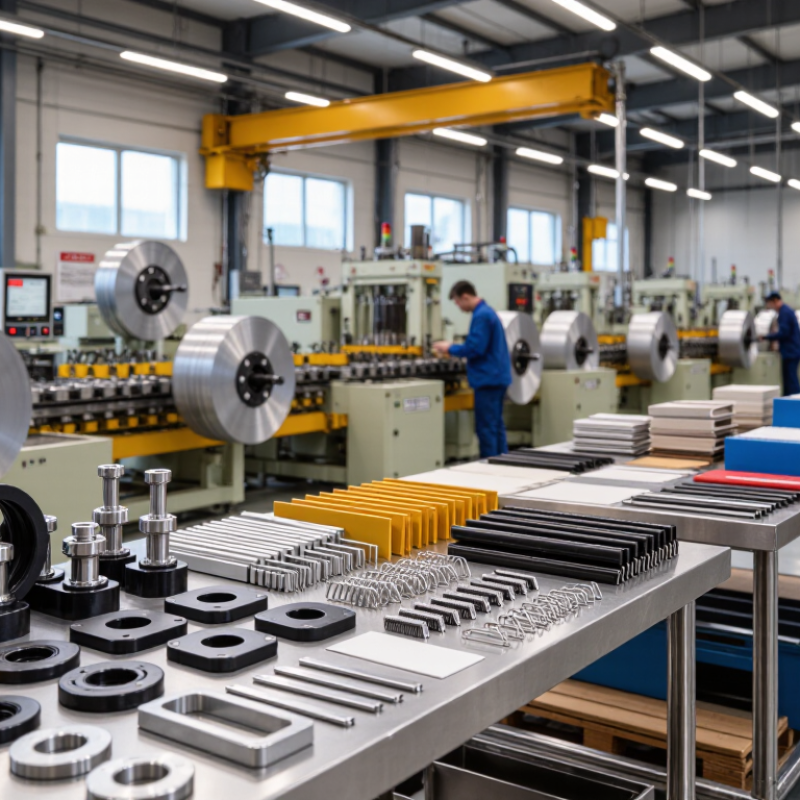
| Core Definition | A stationery hardware manufacturer designs, produces, assembles, and supplies physical components used in stationery, office-supply, school-supply, and paper-converting products. | The manufacturer may produce individual parts, complete mechanisms, finished stationery items, or a combination of these. Its work generally involves engineering, material processing, assembly, inspection, packaging, and supply-chain management. |
| Product Scope | Hardware used to join, hold, cut, protect, organize, or operate stationery products. | - Binder rings, lever-arch mechanisms, and file fittings
- Paper clips, bulldog clips, binder clips, and spring clips
- Stapler components, staples, and staple-removal parts
- Ruler edges, cutting blades, pencil-sharpener parts, and paper-cutter components
- Eyelets, rivets, grommets, book corners, and reinforcing washers
- Notebook spirals, wire-o binding elements, clasps, buckles, and closures
|
| Materials | Materials are selected according to strength, corrosion resistance, weight, appearance, cost, and intended use. | - Carbon steel and stainless steel for springs, clips, rings, blades, and structural parts
- Aluminum for lightweight fittings and decorative components
- Brass and copper alloys for corrosion-resistant or decorative hardware
- Engineering plastics such as nylon, polycarbonate, ABS, and polypropylene for housings, handles, and molded components
- Elastomers and rubber-like materials for grips, pads, seals, and protective elements
|
| Manufacturing Processes | Processes convert raw materials into precise, functional stationery hardware. | - Stamping and progressive die forming for high-volume sheet-metal parts
- Wire forming and coiling for rings, springs, and binding elements
- CNC machining, turning, drilling, and milling for precision parts
- Plastic injection molding for handles, covers, housings, and molded fittings
- Cutting, bending, riveting, welding, and mechanical fastening for assembly
- Deburring, polishing, cleaning, and surface finishing before inspection
|
| Surface Finishing | Finishing improves appearance, wear resistance, corrosion resistance, or surface safety. | - Electroplating with finishes such as nickel, zinc, or chromium where appropriate
- Powder coating and liquid painting for colored or protective surfaces
- Black oxide, passivation, polishing, brushing, and tumbling
- Protective coatings designed to reduce corrosion or surface scratching
|
| Engineering and Design | Design work ensures that hardware fits the stationery product and performs reliably during repeated use. | - Dimensional design using drawings, specifications, and three-dimensional CAD models
- Tolerance analysis for moving, mating, and assembled components
- Spring-force, opening-force, load, wear, and fatigue considerations
- Prototype development through samples, pilot tooling, or additive manufacturing
- Design-for-manufacturing and design-for-assembly reviews
|
| Quality Control | Quality control verifies that products meet dimensional, functional, visual, and material requirements. | - Incoming inspection of metal, plastic, coatings, and purchased components
- In-process checks for dimensions, forming accuracy, assembly position, and surface condition
- Functional tests such as opening and closing cycles, clamping force, cutting performance, and load resistance
- Final inspection, sampling plans, traceability records, and nonconformance management
|
| Customization | Manufacturers may adapt hardware to the required size, geometry, finish, color, packaging, or assembly method. | - Custom dimensions for different notebook, folder, binder, or filing formats
- Special hole patterns, mounting positions, spring characteristics, or closure designs
- Specified surface finishes, colors, textures, and corrosion-protection levels
- Customer-specific tooling, fixtures, labels, kits, and packaging configurations
|
| Assembly Services | Some manufacturers supply components only, while others deliver fully assembled stationery products. | - Riveting, screwing, snap-fitting, crimping, and press-fitting
- Installation of mechanisms into folders, binders, notebooks, or cases
- Application of adhesive labels, protective films, or cushioning parts
- Final kitting and packaging for retail, institutional, or industrial distribution
|
| End-Use Markets | Stationery hardware is used across consumer, educational, commercial, industrial, and archival applications. | - Schools, universities, offices, and administrative departments
- Retail stationery and office-supply distribution
- Printing, bookbinding, filing, archiving, and document-management operations
- Packaging, labeling, craft, hobby, and promotional-product production
|
| Compliance and Safety | Requirements depend on the product, destination market, materials, and intended user group. | - Material declarations and restricted-substance controls where applicable
- Sharp-edge, pinch-point, small-part, and mechanical-safety assessments
- Packaging, labeling, recycling, and product-information requirements
- Documented quality systems, supplier controls, and production traceability
|
| Supply-Chain Role | The manufacturer can operate as an original equipment supplier, contract manufacturer, component supplier, or finished-goods producer. | A typical supply-chain role includes material procurement, tooling management, production planning, quality assurance, inventory control, packaging, shipment preparation, and technical support for customers. |
| Key Performance Indicators | Performance is commonly evaluated through measurable manufacturing and product metrics. | - Dimensional accuracy and functional consistency
- Defect rate, first-pass yield, and corrective-action response time
- Tooling life, production capacity, delivery reliability, and lead time
- Corrosion resistance, cycle durability, load performance, and product safety
- Material utilization, packaging efficiency, and recyclability considerations
|