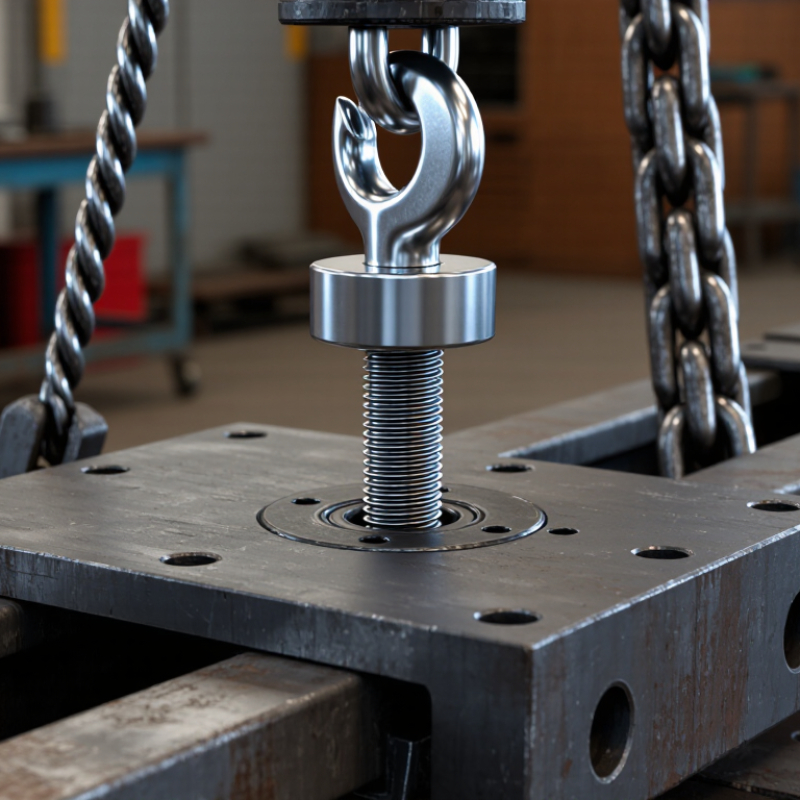
| Primary Purpose | Designed to connect to lifting equipment, such as shackles, hooks, or lifting slings, while securing a load. | Designed mainly to clamp or join components together in structural, mechanical, or general assembly applications. | A lifting bolt serves both as a fastening point and as part of a lifting system. |
| Typical Head Design | Usually includes an integral eye, ring, or lifting feature that provides a connection point. | Common head styles include hexagonal, socket, button, countersunk, and flange heads. | The lifting feature must be large and strong enough for the intended connector and load direction. |
| Load Direction | May be rated for axial tension and, for some designs, specified angular loading. The permitted angle must be stated by the manufacturer or standard. | Normally evaluated for clamp force, tension, shear, or a combination of these within a joint; not automatically rated for lifting. | A lifting bolt must not be assumed suitable for side loading or off-axis lifting without a documented rating. |
| Working Load Limit | A working load limit may be marked or specified for the complete lifting component, often with conditions for angle, installation, and inspection. | Usually supplied with mechanical property or proof-load information rather than a lifting working load limit. | The lowest rated component in the lifting arrangement determines the safe working capacity. |
| Safety Factor | Lifting hardware is commonly designed and tested with a safety factor specified by the applicable lifting standard or product documentation. | Mechanical fastener grades and proof loads address joint performance, not necessarily repeated overhead lifting. | A fastener grade alone does not establish that a bolt is safe for lifting personnel or loads. |
| Material and Strength | Often manufactured from alloy steel or other materials selected for controlled strength, toughness, and fatigue performance. | May be carbon steel, alloy steel, stainless steel, or other materials selected for the joint environment. | Material selection should account for load cycles, corrosion, temperature, and possible shock loading. |
| Thread Form | May use metric or inch threads, but the thread size, pitch, engagement length, and mounting arrangement must match the specified design. | Uses a defined thread system selected for the joint, with strength generally based on the bolt, nut, and engagement conditions. | A correctly sized thread does not compensate for an unsuitable lifting eye or an improperly prepared mounting hole. |
| Installation Requirement | Must be fully seated, correctly aligned, and installed according to the documented orientation and torque or tightening requirements. | Typically installed with a specified tightening method to achieve the required joint preload. | Misalignment, incomplete thread engagement, or contact with adjacent parts can reduce lifting capacity. |
| Rotation During Lifting | Some lifting designs are intended to rotate under load, while others must remain fixed. The product design determines this capability. | Generally not designed to rotate or swivel while carrying a suspended load. | A non-rotating lifting point should not be substituted for a swivel lifting point where load movement is expected. |
| Inspection | Required before use
Check for cracks, deformation, thread damage, corrosion, wear, illegible markings, and evidence of overload. | Joint inspection
Inspection usually focuses on preload, loosening, corrosion, damage, and overall joint condition. | Lifting hardware should be removed from service when damage or untraceable condition affects its rated use. |
| Use with Accessories | Can be used with compatible shackles, hooks, slings, or other rated lifting accessories. | Normally used with nuts, washers, spacers, and joint components rather than lifting accessories. | All connected accessories must be compatible in size, geometry, capacity, and load direction. |
| Marking and Traceability | May include rated capacity, size, material or grade, manufacturer identification, and traceability markings required by the applicable standard. | Often marked with nominal size, manufacturer identification, and strength or property class. | Missing or unreadable lifting markings make capacity verification difficult and may require removal from service. |
| Typical Applications | Lifting machinery, fixtures, molds, dies, access covers, equipment assemblies, and removable components. | Machine frames, structural joints, flanges, brackets, enclosures, and general mechanical assemblies. | The application must match the bolt’s documented rating and the applicable workplace lifting requirements. |
| Can It Replace the Other? | Not automatically
A lifting bolt should not replace a standard fastener unless its joint performance and installation requirements are suitable. | Not for lifting
A standard fastener should not be used as a lifting point unless it has a documented and applicable lifting design. | Selection must be based on the complete engineering and lifting requirements, not on appearance alone. |