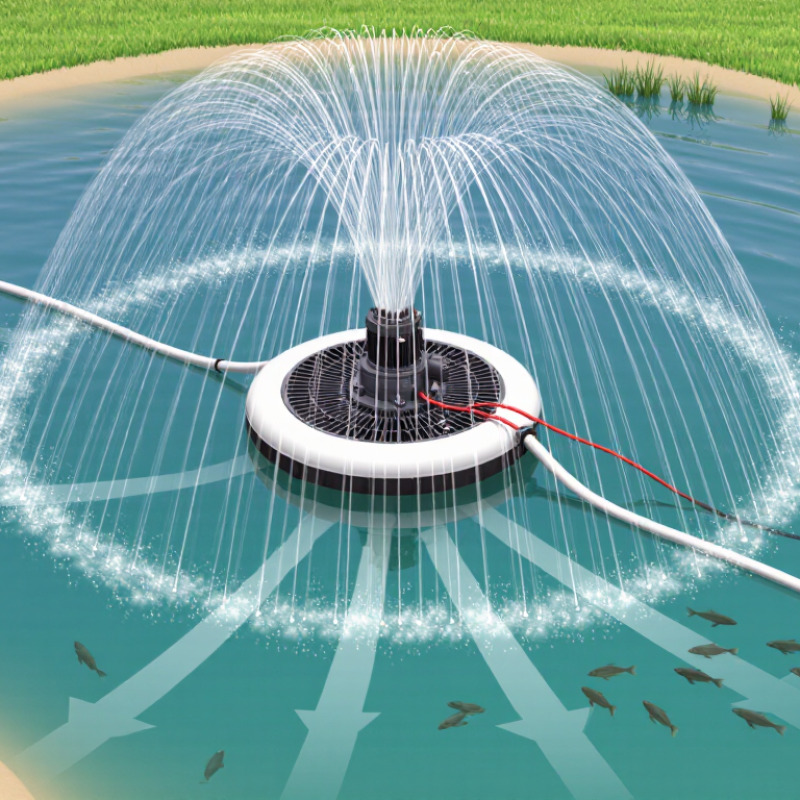
| Definition | A floating pump aerator is a water-treatment device mounted on a buoyant platform that pumps and disperses water at or near the surface. | It combines water circulation with aeration and operates without a permanent fixed structure in the water body. |
| Primary Function | To increase the transfer of atmospheric oxygen into water while improving circulation. | Higher dissolved oxygen can support aerobic biological activity and help reduce oxygen-depleted conditions. |
| Operating Principle | An electric motor drives an impeller or pump that draws in water and projects it through the surface. | Water droplets, splashes, and turbulence increase the water-to-air contact area, improving oxygen transfer. |
| Main Components | Floating platform, pump or impeller, electric motor, intake screen, discharge assembly, power cable, and anchoring system. | The intake screen helps limit the entry of large debris, while anchors or mooring lines keep the unit within its operating area. |
| Installation Position | Installed on the water surface and connected to shore-based electrical equipment or an approved floating power supply. | The unit should be positioned to promote circulation and kept clear of intake restrictions, heavy boat traffic, and unsafe electrical conditions. |
| Typical Applications | Ponds, aquaculture facilities, wastewater lagoons, stormwater basins, reservoirs, and decorative lakes. | The appropriate design depends on water depth, organic loading, required circulation, operating hours, and local environmental conditions. |
| Aeration Mechanism | Surface aeration is produced by splashing, spraying, or rapidly agitating water. | Performance is influenced by droplet size, turbulence, water temperature, dissolved oxygen deficit, and the residence time of water in contact with air. |
| Water-Circulation Effect | The discharge pattern moves water horizontally and vertically around the floating unit. | Circulation can help distribute oxygen and reduce localized stagnant zones, although complete-body mixing is not guaranteed. |
| Common Performance Measures | Dissolved oxygen concentration, oxygen transfer rate, standard oxygen transfer efficiency, water flow rate, and electrical power consumption. | Performance ratings should be compared under equivalent test conditions because temperature, water quality, salinity, and test depth affect results. |
| Advantages | Flexible placement, relatively simple installation, visible operation, and effective surface mixing. | Floating installation can be useful where permanent foundations are impractical or where seasonal relocation is required. |
| Limitations | Surface aeration may provide less direct oxygen delivery to deep water than submerged diffused-air systems. | Wind, waves, ice, algae, debris, electrical access, and insufficient mixing depth can reduce operating effectiveness. |
| Energy Requirement | Electricity is required to operate the motor and pump. | Actual energy use varies with motor size, pump head, flow rate, duty cycle, and site-specific water resistance. |
| Maintenance Needs | Routine inspection of the intake screen, impeller, motor, floats, cable, fasteners, and anchoring system. | Remove accumulated weeds and debris, check for abnormal vibration or noise, and follow electrical safety procedures before servicing. |