| High-Density Polyethylene (HDPE) | Lightweight thermoplastic with good impact resistance and corrosion resistance. | Many dilute acids, alkalis, salts, detergents, and water-based formulations. | Vertical open-top or closed-top tank; flat, cone, or dished bottom. | Does not rust, relatively easy to fabricate, and generally lower installation cost than metal tanks. | Operating temperature, chemical concentration, and ultraviolet exposure must be checked before selection. |
| Polypropylene (PP) | Thermoplastic material with good chemical resistance and a higher temperature range than many polyethylene grades. | Selected acids, alkalis, salts, and other corrosive aqueous chemicals. | Vertical process tank with top-entry agitator and bottom outlet. | Useful for applications where chemical resistance and moderately elevated temperatures are required. | Resistance varies by chemical and temperature; mechanical strength can decrease at higher temperatures. |
| Fiberglass-Reinforced Plastic (FRP) | Composite material consisting of resin reinforced with glass fibers; the resin determines much of the chemical resistance. | Many corrosive liquids, including certain acids, alkalis, and salt solutions, when the correct resin system is used. | Vertical tank, horizontal tank, or scrubber-style vessel with internal lining or corrosion barrier. | Good corrosion resistance with a favorable strength-to-weight ratio. | Resin selection, laminate construction, temperature, and inspection of the corrosion barrier are critical. |
| Stainless Steel | Metallic construction offering high mechanical strength, cleanability, and a smooth internal surface. | Many water-based chemicals, process fluids, and formulations where sanitation or durability is important. | Closed-top vertical tank with sanitary fittings, spray ball, or bottom-entry discharge. | Strong, durable, suitable for cleaning systems, and available in polished or sanitary finishes. | Not universally corrosion-proof; chlorides, strong acids, and other chemicals may cause pitting or stress corrosion. |
| Carbon Steel with Lining | Structural steel tank protected by a compatible internal lining such as rubber, polymer, or glass-based material. | Specific corrosive chemicals, provided the lining is compatible with the service conditions. | Large vertical storage or blending tank with lined interior and external structural shell. | High structural strength and practical for large-volume installations. | Lining damage can expose the steel; regular inspection is needed, especially around mixers and outlets. |
| Glass-Lined Steel | Steel vessel with a fused glass coating that separates the process liquid from the metal shell. | Many aggressive and high-purity chemical services, subject to the coating manufacturer's compatibility data. | Closed vessel with top-entry agitator, baffles, and specialized glass-lined fittings. | Strong corrosion resistance and a nonporous internal surface. | Glass surfaces are rigid and can be damaged by impact, thermal shock, or unsuitable solids handling. |
| Open-Top Blending Tank | Tank with an accessible upper opening for charging solids, liquids, or removable equipment. | Nonvolatile or low-hazard formulations that do not require full containment. | Tank with removable cover, top-entry mixer, and optional grate or platform. | Easy loading, visual inspection, cleaning, and equipment access. | May require ventilation, splash control, dust management, or a cover depending on the chemical. |
| Closed-Top Blending Tank | Sealed or covered vessel designed to limit emissions, contamination, and operator exposure. | Volatile, odorous, moisture-sensitive, or hazardous liquids, subject to process requirements. | Closed tank with vent, manway, level instrument, feed ports, and agitator seal. | Improved containment and better control of vapors and environmental exposure. | Requires suitable venting, pressure or vacuum protection, and compatible seals and fittings. |
| Vertical Tank with Top-Entry Agitator | Upright cylindrical vessel with a mixer mounted through the top head. | General-purpose liquid blending, suspension, dilution, and chemical formulation. | Flat-bottom, dished-bottom, or cone-bottom vessel with baffles and one or more impellers. | Efficient use of floor space and flexible mixer arrangement. | Agitator speed, impeller type, baffle design, viscosity, and liquid height must be matched to the process. |
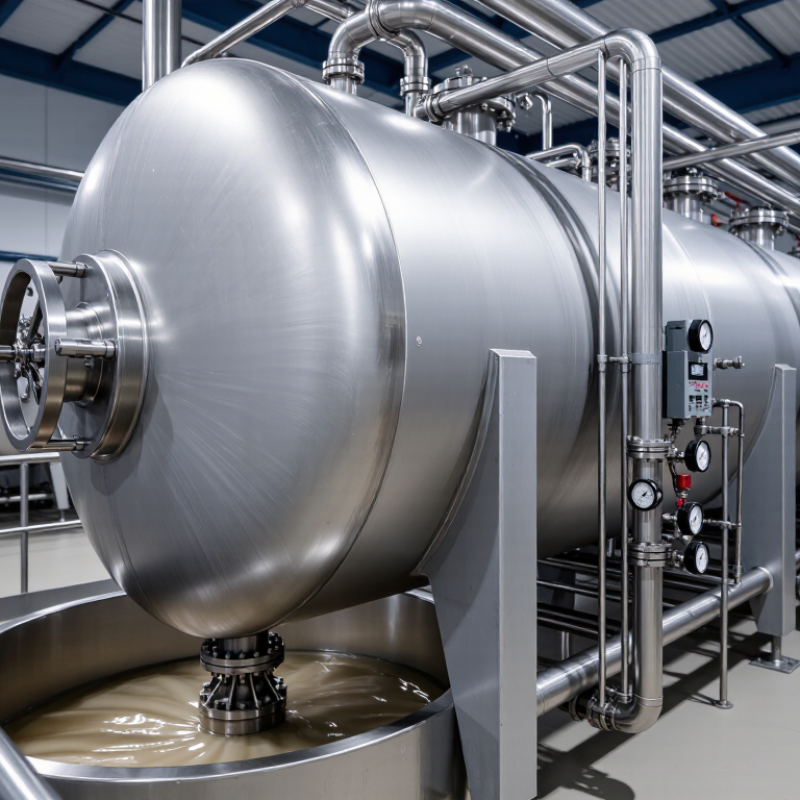
| Horizontal Blending Tank | Elongated vessel arranged horizontally, often supported on saddles or a frame. | Lower-viscosity liquids, mobile mixing processes, and applications with limited vertical clearance. | Horizontal cylindrical tank with side-entry or top-mounted mixer. | Suitable for low buildings and can provide a relatively low liquid working height. | May require careful mixer placement to prevent dead zones and uneven blending. |
| Cone-Bottom Tank | Tank with a sloped bottom that directs material toward a central or offset outlet. | Liquids containing suspended solids, powders, crystals, or materials requiring complete drainage. | Vertical tank with cone bottom, bottom outlet, and top-entry agitator. | Improves drainage, solids removal, and cleanout compared with a flat-bottom design. | Requires adequate support height and may need specialized mixer positioning for the cone area. |
| Jacketed Blending Tank | Tank fitted with an external jacket or heat-transfer surface for heating or cooling. | Temperature-sensitive formulations, viscous liquids, and processes requiring controlled thermal conditions. | Vertical or horizontal tank with jacket, insulation, agitator, and temperature sensor. | Provides controlled heat transfer without placing a heating element directly in the product. | Heat-transfer-fluid selection, jacket pressure, thermal expansion, and product mixing must be evaluated. |