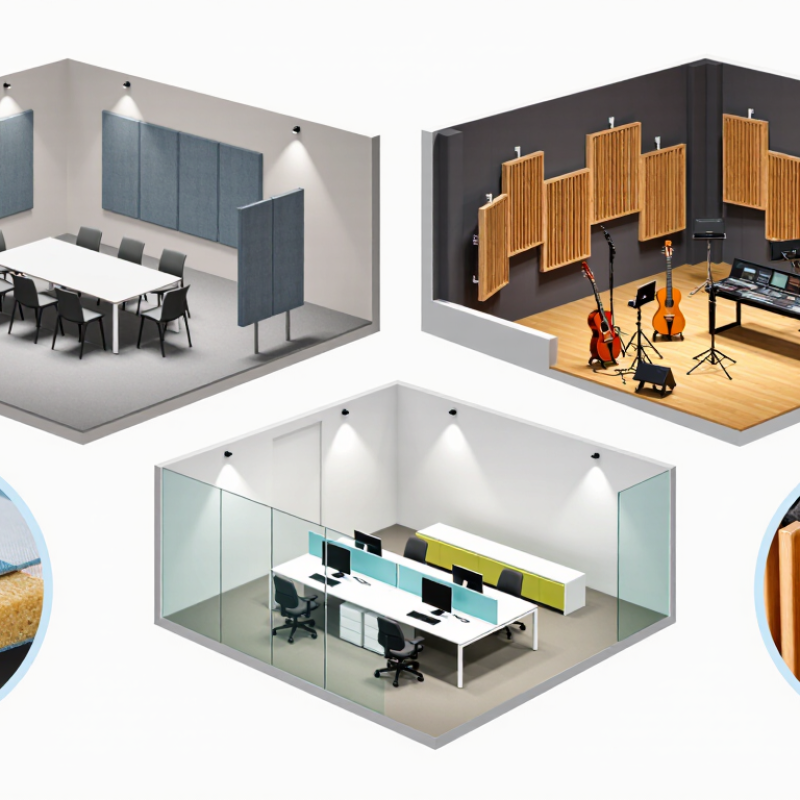
| Fabric-wrapped mineral wool or fiberglass | Reducing reflections and reverberation in studios, offices, classrooms, and listening rooms. | Broadband absorption; thicker panels and an air gap behind them generally improve lower-frequency absorption. | At first-reflection points on side walls, on the wall behind speakers, and at selected ceiling reflection points. | Begin with a few strategically placed panels, then add coverage according to listening tests or room measurements. | Performance depends on core material, thickness, mounting, and tested assembly. These panels absorb sound within a room; they do not by themselves soundproof a wall. |
| PET felt panels | Everyday speech environments such as meeting rooms, corridors, and shared work areas. | Typically most useful for mid- and high-frequency reflections; thicker or spaced installations can improve lower-frequency absorption. | On large, reflective wall areas near conversation zones, or as ceiling panels above occupied areas. | Cover selected reflective surfaces rather than placing panels only in one small cluster. | Absorption varies with panel thickness, density, mounting, and product construction. Check test data for the exact panel and installation method. |
| Acoustic foam | Reducing some flutter echo and high-frequency reflections in small rooms or equipment spaces. | Thin foam mainly absorbs higher frequencies; it is generally less effective at low frequencies than suitably thick porous panels. | Use at reflection points or on surfaces causing distinct flutter echo, while preserving an even room balance. | Use selectively and assess the room afterward; covering every surface with thin foam can make a room sound unnaturally dull. | Foam treatment is not a substitute for sound isolation. Fire-safety requirements and suitable product ratings matter, especially in public or commercial spaces. |
| Slatted wood over an absorptive backing | Rooms that need sound absorption with a decorative, less visibly upholstered finish. | Absorption depends on the backing and the open area between slats; the facing can affect how sound reaches the absorber. | On broad wall sections, including rear walls or meeting-room walls with strong reflections. | Plan coverage as part of the room’s overall absorptive area, not as a decorative strip alone. | Slats over an absorptive cavity can combine absorption with a more reflective finish. Results depend on slat spacing, backing, cavity depth, and installation. |
| Perforated panels over an absorptive cavity | Rooms where a durable, finished surface is preferred, such as halls, classrooms, or public interiors. | Frequency response depends on perforation pattern, panel construction, cavity depth, and the absorber behind the facing. | Across larger wall or ceiling areas; use acoustic drawings or tested assembly data to select locations and construction. | Determine coverage from room use, reverberation goals, and the assembly’s tested absorption data. | The perforated facing and cavity form part of the acoustic system. A solid panel without suitable openings or a designed cavity may reflect rather than absorb sound. |
| Ceiling clouds or suspended baffles | Rooms with hard ceilings, open-plan spaces, and areas where wall treatment is limited. | Porous clouds and baffles can reduce reflected sound; results vary with thickness, spacing, exposed sides, and suspension height. | Clouds can be positioned over seating or work areas; baffles are commonly suspended in rows across larger spaces. | Distribute units across the noisy or occupied area instead of concentrating them in one spot. | Suspension exposes additional panel surface to sound, but the effect depends on layout and room geometry. Maintain required clearances for lights, sprinklers, and ventilation. |