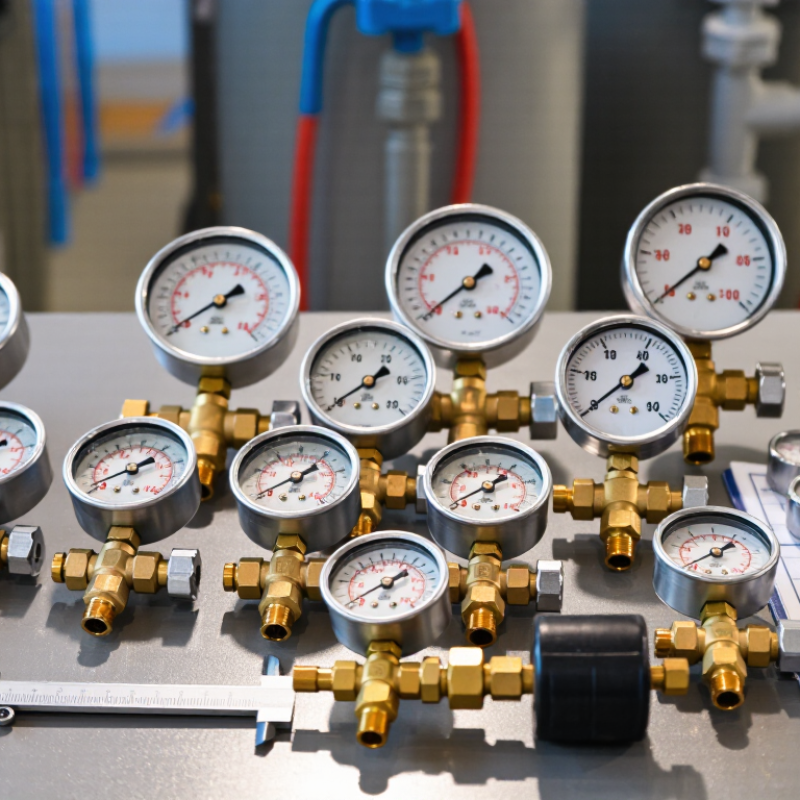
| Bourdon Tube Pressure Gauge | A curved elastic tube deforms under pressure and drives a mechanical pointer. | Approximately -1 to 1,600 bar, depending on tube design and model. | Typically ±0.5% to ±2.5% of full scale. | 1/8", 1/4", 3/8", or 1/2" BSP, NPT, or metric threads. | Water systems, compressed air, hydraulics, pneumatics, boilers, and general industrial equipment. | Simple construction, no power supply, broad availability, and good general-purpose performance. |
| Diaphragm Pressure Gauge | A flexible diaphragm moves in response to pressure and transfers displacement to the indication mechanism. | Approximately 0 to 25 bar for many standard designs; lower ranges are also available. | Typically ±1.0% to ±2.5% of full scale. | Commonly 1/4" or 1/2" process connections. | Low-pressure measurement, corrosive gases, viscous liquids, and media that may clog narrow passages. | Suitable for low pressures and can be manufactured with chemically resistant wetted materials. |
| Capsule Pressure Gauge | Two thin diaphragms are joined around their edges to form a capsule that expands or contracts with pressure. | Approximately 0 to 600 mbar for low-pressure measurement. | Typically ±1.0% to ±2.5% of full scale. | Usually 1/4" or 1/2" threaded connections. | Gas pressure, ventilation systems, air filters, clean rooms, and burner or combustion equipment. | High sensitivity at very low pressures and suitable for relatively clean, non-condensing gases. |
| Differential Pressure Gauge | Measures the difference between two pressure ports using a diaphragm, capsule, piston, or similar sensing element. | Approximately 0 to 600 bar differential pressure, depending on construction. | Typically ±1.0% to ±2.5% of full scale. | Often 1/8", 1/4", or 1/2" process connections. | Filter monitoring, flow measurement, liquid-level measurement, pumps, and process control. | Displays pressure loss or pressure difference directly without requiring two separate gauges. |
| Digital Pressure Gauge | A pressure sensor converts applied pressure into an electrical signal displayed on an electronic screen. | Commonly from -1 to 1,000 bar, with range depending on the sensor and application. | Typically ±0.25% to ±1.0% of full scale. | Commonly 1/4" or 1/2" BSP, NPT, or metric threads. | Calibration work, hydraulic testing, industrial maintenance, laboratories, and applications requiring easy data reading. | Clear numerical display, selectable units, peak-value functions, and reduced parallax error. |
| Electrical Contact Pressure Gauge | A mechanical pressure gauge incorporates electrical contacts that switch when the pointer reaches a preset value. | Approximately -1 to 1,000 bar, depending on the pressure element. | Typically ±1.0% to ±2.5% of full scale. | Usually 1/4" or 1/2" process connections. | Pump control, compressor protection, alarm systems, and automatic start-stop functions. | Combines local pressure indication with simple limit switching for control or alarm circuits. |
| Sanitary Pressure Gauge | Uses a diaphragm or other pressure element with hygienic process connections and cleanable surfaces. | Approximately 0 to 40 bar for many sanitary process applications. | Typically ±1.0% to ±2.5% of full scale. | Tri-clamp, hygienic threaded, or other sanitary connections. | Food and beverage processing, pharmaceutical production, biotechnology, and clean-process equipment. | Designed for cleanability, reduced contamination risk, and compatibility with hygienic installation practices. |
| Oxygen-Service Pressure Gauge | Usually uses a Bourdon tube or diaphragm sensing element prepared for oxygen-compatible service. | Commonly 0 to 400 bar, depending on the application and gauge design. | Typically ±1.0% to ±2.5% of full scale. | Commonly 1/4" or 1/2" connections. | Medical gas systems, welding equipment, oxygen distribution, and industrial gas installations. | Manufactured and cleaned to reduce the risk associated with oil, grease, and other combustible contaminants. |
| High-Temperature Pressure Gauge | A pressure-sensing mechanism is combined with a cooling element, siphon, or remote mounting arrangement. | Approximately 0 to 1,000 bar; the allowable process temperature depends on the configuration. | Typically ±1.0% to ±2.5% of full scale. | Commonly 1/4" or 1/2" process connections. | Steam lines, hot water systems, thermal oil equipment, and high-temperature industrial processes. | Helps protect the sensing element from excessive heat when correctly installed with suitable accessories. |
| Panel-Mount Pressure Gauge | May use a Bourdon tube, diaphragm, or digital sensor and is designed for installation through a control-panel opening. | Approximately -1 to 1,600 bar, depending on the selected sensing technology. | Typically ±0.5% to ±2.5% of full scale. | Rear-entry or lower-entry connections, commonly 1/8", 1/4", or 1/2". | Control cabinets, machinery panels, test benches, hydraulic power units, and OEM equipment. | Space-efficient installation and convenient front-panel visibility for operators. |