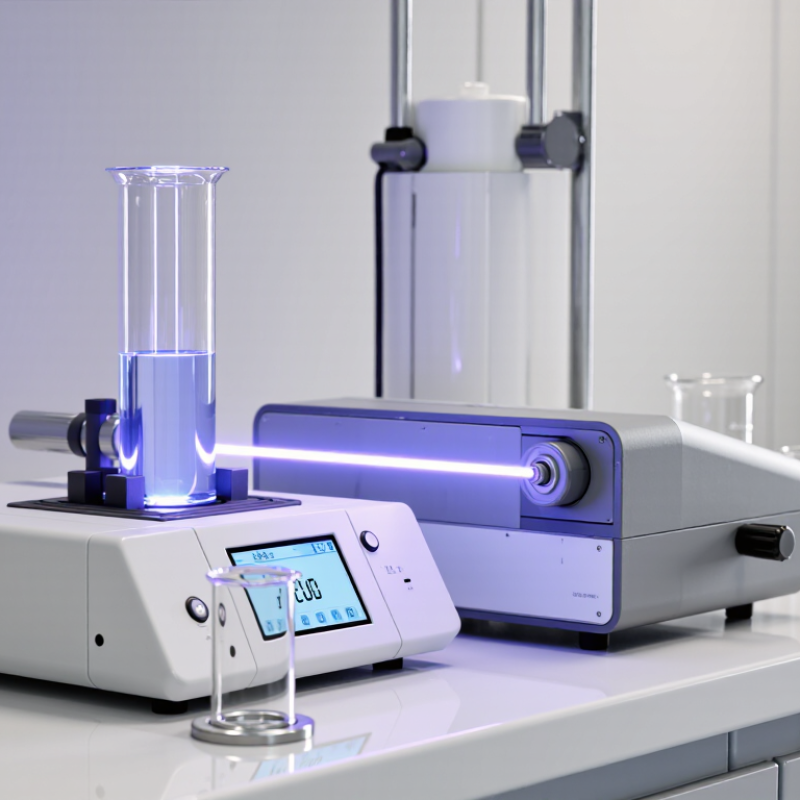
| Instrument Basics and Measurement |
| Instrument definition | UV-visible spectrophotometer | An analytical instrument that measures how much ultraviolet or visible light a sample absorbs or transmits at selected wavelengths. | Many instruments cover approximately 190–800 nm, though the usable range depends on the model, light source, detector, and optics. |
| Light path | Light source, wavelength selector, sample holder, detector | Light from a source is directed through a monochromator or filter, passed through the sample, and measured by a detector. | Deuterium lamps are commonly used for UV wavelengths; tungsten-halogen lamps are commonly used for visible wavelengths. |
| Measurement principle | Absorbance and transmittance | The instrument compares the light intensity through a sample (I) with the reference intensity (I₀). Absorbance is calculated as A = log₁₀(I₀/I). | Higher absorbance means less light reaches the detector at that wavelength. |
| Quantification | Beer–Lambert law | For suitable conditions, absorbance is proportional to concentration: A = εbc, where ε is molar absorptivity, b is path length, and c is concentration. | Use a calibration curve or a validated absorptivity value. Linearity can fail at high concentrations or when chemical conditions change. |
| Sample container | Cuvette and optical path length | A 10 mm path length is a common standard for conventional cuvettes. | Quartz or other UV-transparent cuvettes are generally required for UV measurements. Ordinary glass and many plastics absorb UV light; check the material’s transmission range. |
| Common Applications |
| Biochemistry | Nucleic acid concentration | DNA and RNA absorb strongly near 260 nm; absorbance can be used to estimate concentration when the sample and method are appropriate. | The A260/A280 ratio is often used as a purity check. Values near 1.8 for DNA and 2.0 for RNA are common reference points, not universal acceptance limits. |
| Biochemistry | Protein measurement | Proteins absorb near 280 nm mainly because of aromatic amino acids. Colorimetric protein assays are also measured at assay-specific wavelengths. | Common assay read wavelengths include about 562 nm for BCA and about 595 nm for Bradford; follow the assay protocol and reagent instructions. |
| Pharmaceutical analysis | Assay and quality control | Absorbance at a validated wavelength can be used to determine the concentration of an absorbing drug or compound. | The wavelength, solvent, calibration range, and sample preparation are method-specific and should be validated for the intended product. |
| Environmental testing | Nitrate screening in water | UV absorbance near 220 nm can be used in some methods to estimate nitrate in water samples. | Dissolved organic matter can also absorb UV. Some methods apply a correction near 275 nm; use the applicable standard method and account for interferences. |
| Chemistry and materials | Reaction monitoring and spectral characterization | Changes in absorbance or spectral shape can track the formation, consumption, or identity of light-absorbing species. | Choose wavelengths that are informative for the compound and control for solvent, pH, temperature, and reaction timing. |
| Factors That Affect Results |
| Wavelength selection | Wavelength accuracy and bandwidth | Measurements depend on selecting the intended wavelength and using an appropriate spectral bandwidth. | Wavelength errors or a bandwidth that is too broad can change measured absorbance, especially near sharp spectral peaks. |
| Instrument performance | Stray light, baseline, and detector condition | Stray light reaching the detector can make absorbance readings appear lower than expected, particularly for strongly absorbing samples. | Warm up and maintain the instrument as directed, run a suitable blank, and verify performance with appropriate quality-control checks. |
| Sample preparation | Concentration and dilution | Beer–Lambert behavior is most useful within a method’s validated linear range. | Samples that are too concentrated may give unreliable results. Dilute them appropriately and include dilution factors in calculations. |
| Reference measurement | Blank composition | A blank accounts for absorbance from the solvent, reagents, and cuvette when it is prepared to match the sample matrix. | A mismatched or contaminated blank can shift the baseline and bias the sample result. |
| Optical quality | Cuvette cleanliness and orientation | Fingerprints, scratches, droplets, or inconsistent cuvette placement can scatter or absorb light. | Use clean, matched cuvettes; handle optical faces by the edges and keep orientation consistent when required. |
| Sample condition | Turbidity, bubbles, and particulates | Suspended particles and bubbles scatter light, so apparent absorbance may not represent molecular absorption alone. | Prepare samples consistently and use an appropriate clarification or measurement method when scattering is present. |
| Chemical environment | Solvent, pH, and temperature | These conditions can alter a compound’s chemical form or absorption spectrum. | Match measurement conditions to the validated method and keep standards and samples under comparable conditions. |