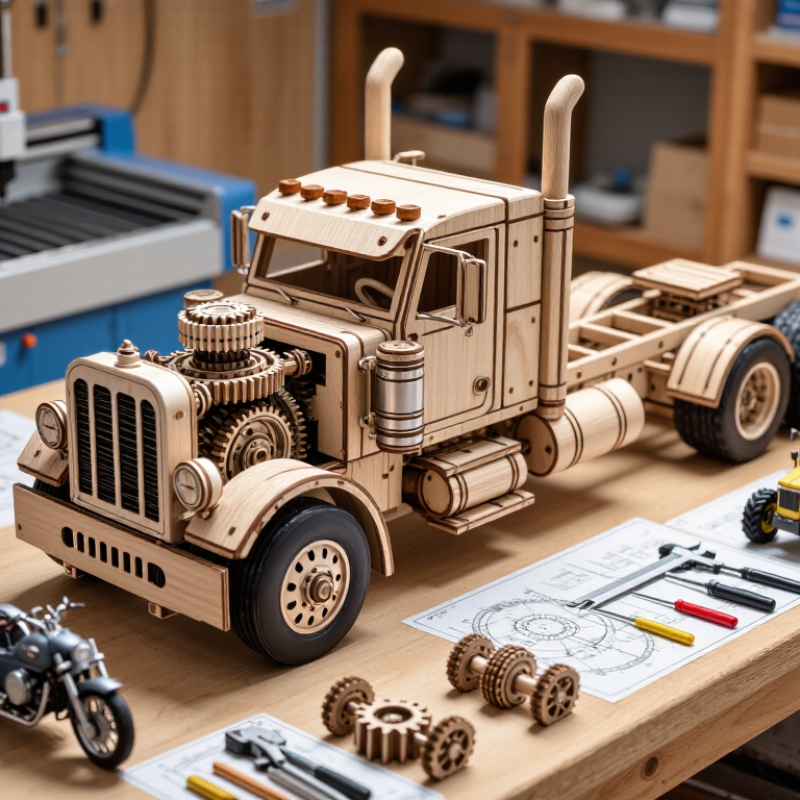
| Wood Material Quality | Use stable plywood, beech, birch, or other clearly specified wood suitable for precision assembly. | Wood species, thickness, moisture-control process, and material specification sheet. | Consistent wood reduces warping, splitting, and poor fit between moving parts. | 0–10 points |
| Mechanical Function | Gears, axles, steering, suspension, or other mechanisms should operate smoothly after correct assembly. | Working sample, assembly video, functional test procedure, and replacement-part policy. | Mechanical reliability is the core value of a wooden vehicle model. | 0–15 points |
| Dimensional Accuracy | Cutting and drilling should maintain repeatable tolerances appropriate to the model’s gear and axle design. | Technical drawings, inspection records, sample measurements, and quality-control checkpoints. | Accurate parts improve assembly fit and reduce friction or misalignment. | 0–15 points |
| Safety and Surface Finish | Edges should be sanded or otherwise finished; coatings should be identified and appropriate for the intended market. | Surface-finish description, coating information, edge-inspection records, and applicable test reports. | Smooth surfaces reduce splinters and improve perceived product quality. | 0–10 points |
| Design and Customization | Capability should cover custom vehicle shapes, engraved details, packaging artwork, and instruction manuals. | Previous anonymized samples, 2D/3D design workflow, prototype process, and revision terms. | Customization is important for educational kits, gifts, promotional products, and private-label projects. | 0–10 points |
| Minimum Order Quantity | The MOQ should match the buyer’s launch volume, with a clearly stated pilot-order option where available. | Written quotation showing sample quantity, pilot MOQ, mass-production MOQ, and mixed-model rules. | A suitable MOQ limits inventory risk and supports market testing. | 0–10 points |
| Sampling and Development | A pre-production sample should be available for approval before full production begins. | Sample lead time, prototype fee, approval procedure, and change-control process. | Sampling helps identify mechanical, packaging, and appearance problems early. | 0–10 points |
| Production Capacity | The supplier should demonstrate adequate cutting, engraving, assembly, packing, and inspection capacity for the planned order. | Production-flow description, capacity statement, anonymized facility photographs, and order-scheduling method. | Capacity visibility helps prevent delays during seasonal or large-volume orders. | 0–10 points |
| Quality-Control System | Quality checks should cover incoming wood, cutting accuracy, mechanism operation, appearance, packing, and final quantity. | Inspection checklist, defect classification, corrective-action process, and final inspection report format. | Documented controls are more reliable than visual claims about quality. | 0–10 points |
| Packaging and Instructions | Each kit should include organized parts, clear assembly instructions, and packaging suitable for international transport. | Packaging mock-up, instruction sample, carton dimensions, drop-test approach, and spare-parts policy. | Good packaging protects components and lowers customer assembly problems. | 0–5 points |
| Export and Compliance Support | The supplier should identify the destination-market requirements instead of offering unsupported compliance claims. | Applicable test reports, material declarations, labeling information, carton marks, and export-document samples. | Requirements differ by destination, product classification, age range, and intended use. | 0–5 points |
| Communication and After-Sales Service | Responses should be consistent, specifications should be documented, and claims should be supported with samples or records. | Response-time expectations, order-update procedure, complaint handling, warranty terms, and spare-part availability. | Reliable communication reduces misunderstandings during development and delivery. | 0–10 points |
| Recommended Decision Rule | Shortlist suppliers that achieve at least 75 out of 100 points and pass sample-function, material, and documentation checks. | Use written evidence and a physical sample rather than relying only on online listings or price quotations. | The lowest unit price does not necessarily represent the lowest total procurement cost. | Target: 75–100 points |