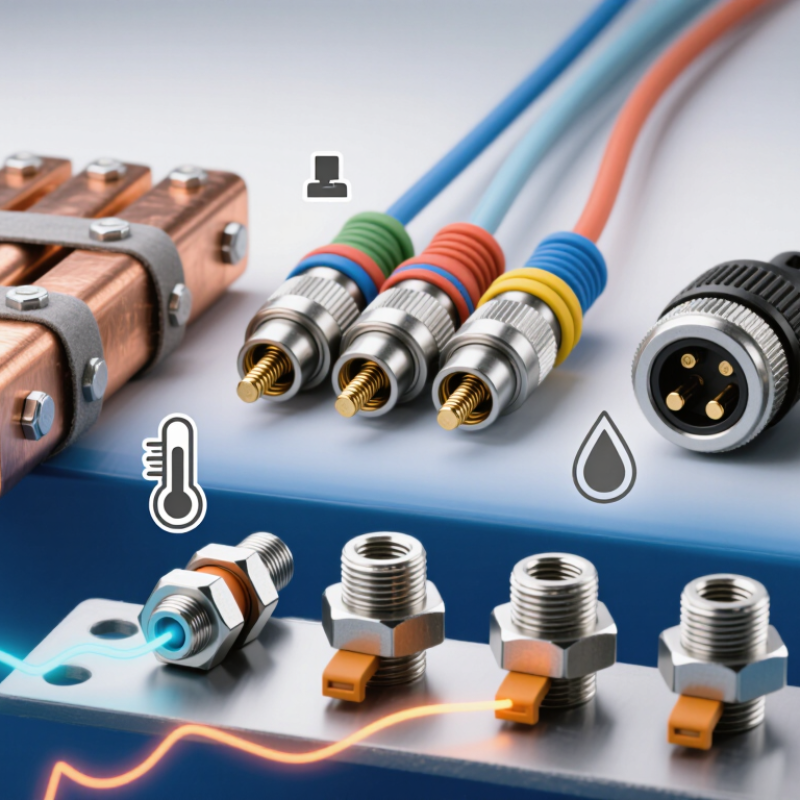
| Bolted cable lug connectors | Cable lug secured to a threaded stud or busbar with a nut and washer | Battery terminals, inverter connections, and DC distribution links | Simple, robust connection; suitable for large conductors when correctly assembled | Check conductor size, lug material, stud dimensions, tightening torque, and corrosion protection |
| Busbar connectors | Conductive bars joined by bolted or clamped interfaces | Battery racks, module interconnections, and power distribution assemblies | Provides a compact, low-resistance path for distributing current across multiple circuits | Consider current capacity, spacing, insulation, enclosure clearances, and fault-current requirements |
| Plug-in high-current connectors | Mating male and female contacts, often with a locking feature | Removable battery modules, service connections, and equipment interfaces | Enables faster connection and disconnection than a bolted joint; some designs include touch protection | Verify rated voltage and current, mating cycles, locking method, polarity, and whether live mating is permitted |
| Flexible laminated busbar connectors | Layers of conductive foil joined at terminal ends, with a flexible section between connection points | Connections between battery modules, busbars, and power electronics | Accommodates vibration and small movements while helping simplify tight layouts | Check bend radius, joint temperature, insulation, available space, and mechanical support |
| Battery post or terminal connectors | Clamp or terminal interface fitted directly to a battery post or terminal | Battery packs and smaller stationary storage systems | Provides a direct connection to battery terminals; designs vary by terminal shape and size | Match the terminal geometry and material; ensure secure contact and avoid excessive tightening |
| Protective earth connectors | Bolted lug, grounding stud, or dedicated bonding interface | Battery enclosures, cabinets, racks, and inverter chassis | Creates an electrical bonding path for exposed conductive parts as part of the protective grounding system | Follow applicable electrical codes and equipment instructions; verify continuity and corrosion resistance |
| Signal and communication connectors | Low-voltage contacts in a keyed or multipin connector | Battery management systems, temperature sensors, and monitoring links | Carries control or measurement signals rather than the main battery power current | Check pinout, signal type, shielding, environmental sealing, and separation from power wiring |