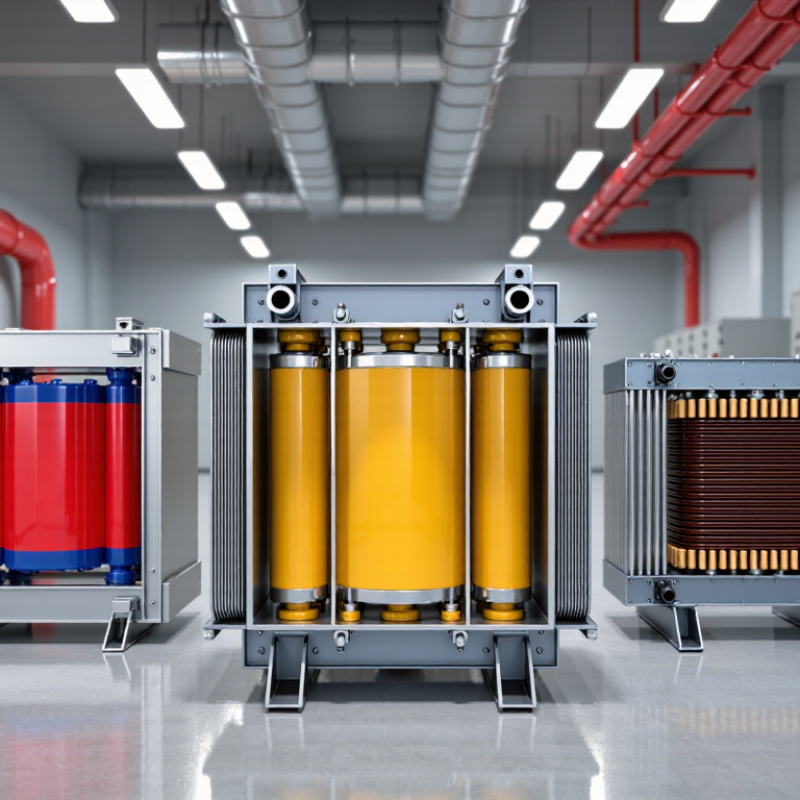
| Cast-resin transformer | Windings are encapsulated in solid resin, normally with a laminated magnetic core and cast or encapsulated high-voltage coils. | AN; optional AF with forced air | Good resistance to moisture, dust, and many industrial contaminants; reduced fire load compared with liquid-filled equipment; low routine maintenance. | Higher mass and cost than some open-wound designs; resin thermal performance depends on design, manufacturing quality, and installation conditions. | Indoor substations, commercial buildings, hospitals, tunnels, renewable-energy installations, and industrial facilities. | Commonly specified as a dry-type transformer under IEC 60076-11 and evaluated against the applicable IEEE C57.12.01 requirements. |
| VPI transformer | Windings are insulated with a resin system applied by vacuum-pressure impregnation; the winding is not normally a fully solid resin casting. | AN; optional AF | Good mechanical strength, effective heat transfer, repair-friendly winding construction, and suitability for a broad range of ratings. | The winding is more dependent on enclosure quality and environmental control than a fully encapsulated design; surface contamination may reduce insulation performance. | Industrial plants, motor-control systems, transportation infrastructure, data facilities, and medium-voltage distribution. | Classified and tested as dry-type equipment according to the selected edition and project requirements of IEC 60076-11 or IEEE C57.12.01. |
| Open-wound or varnish-impregnated transformer | Coils are wound on an insulated core structure and protected by varnish or another impregnation system without full resin encapsulation. | AN; optional AF | Straightforward construction, relatively easy inspection, and competitive cost for clean and controlled indoor environments. | Greater sensitivity to humidity, dust, chemicals, and condensation; usually requires a suitable enclosure and environmental protection. | Indoor distribution panels, commercial premises, general industrial loads, and controlled electrical rooms. | The design must satisfy the applicable dry-type transformer construction, dielectric, thermal, sound, and routine-test requirements. |
| Air-core transformer | The magnetic circuit does not use a ferromagnetic core; the winding is supported by an insulating structure and relies on air as the magnetic medium. | AN; forced-air cooling may be used | No core saturation, no core loss caused by magnetic hysteresis, and useful performance in high-frequency or current-limiting applications. | Larger physical size and higher leakage reactance are common; it is not generally the first choice for conventional utility-frequency distribution service. | Power-electronic systems, testing equipment, harmonic-filter circuits, current-limiting reactors, and specialized high-frequency applications. | Application-specific verification is important because the standard’s requirements must be interpreted for the transformer’s rating, frequency, insulation system, and intended service. |
| Enclosed dry-type transformer | An open-wound, VPI, or cast-resin transformer installed inside a ventilated or protective enclosure designed for the installation environment. | AN; optional AF | Improves protection against accidental contact, foreign objects, dust, and site-specific hazards when the enclosure is correctly selected. | Enclosures can restrict airflow, increase temperature rise, and reduce accessible maintenance space if poorly designed. | Public buildings, outdoor electrical rooms, industrial sites, compact substations, and locations requiring controlled access. | The enclosure does not replace transformer testing; the complete assembly must meet the specified insulation, temperature-rise, protection, and installation requirements. |
| Environmental class E0 | No significant condensation and negligible pollution expected at the installation location. | Typical of clean, dry indoor electrical rooms. The installation still requires adequate ventilation, clearances, and protection against accidental contact. |
| Environmental class E1 | Occasional condensation or limited pollution may occur. | Suitable for more demanding indoor or sheltered conditions when the transformer design and enclosure are specified for the expected moisture and pollution exposure. |
| Environmental class E2 | Frequent condensation and heavy pollution may occur. | Used where severe environmental exposure is expected; the complete transformer and enclosure arrangement must be verified for the specified service conditions. |
| Climatic class C1 | Transformer is suitable for operation, transport, and storage within the lower-temperature limits defined by the standard. | Generally selected for normal indoor or sheltered climatic conditions. The actual ambient-temperature limits must be confirmed from the project specification and manufacturer documentation. |
| Climatic class C2 | Designed for more severe low-temperature conditions than C1, subject to the limits defined by IEC 60076-11. | Relevant for cold climates and installations where low-temperature start-up, transport, or storage conditions are part of the design basis. |
| Fire behavior class F0 | No special limitation regarding fire risk is required by the service conditions. | The transformer remains a dry-type unit, but fire-protection requirements are governed by the installation, building, and local electrical rules. |
| Fire behavior class F1 | The transformer is designed to meet enhanced fire-resistance and reduced-fire-propagation requirements defined by the standard. | Often considered for buildings and sites where fire safety is critical. F1 classification must be supported by the applicable type-test evidence. |