| Portable Electric Water Jetter | High-pressure water jetting | 100–200 bar
(1,450–2,900 psi) | 15–30 L/min | 15–30 m hose | 50–150 mm | Approx. 2.2–5.5 kW electric motor; mains power required | Indoor drains, commercial buildings, restaurants, and light maintenance. Buyers should compare electrical compatibility, portability, noise, hose storage, and protection against dry running. |
| Petrol-Powered Portable Jetter | High-pressure water jetting | 140–275 bar
(2,000–4,000 psi) | 20–45 L/min | 30–60 m hose | 75–200 mm | Approx. 5–13 kW engine; open-frame or wheeled configuration | Outdoor maintenance, construction sites, and areas without dependable grid electricity. Compare fuel consumption, emissions compliance, cold-start performance, water supply requirements, and transport weight. |
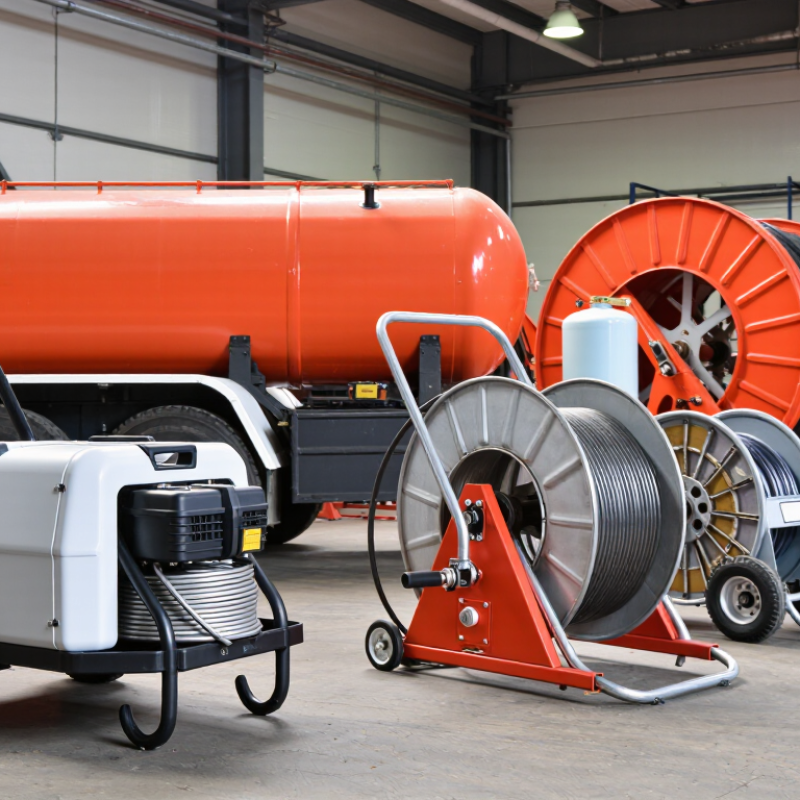
| Trailer-Mounted Sewer Jetter | High-pressure water jetting with long hose deployment | 140–280 bar
(2,000–4,060 psi) | 45–120 L/min | 60–150 m hose | 100–600 mm | Approx. 15–45 kW engine; commonly 500–2,000 L water tank | Municipal networks, industrial sites, and long-distance cleaning. Key comparisons include jetting thrust, tank refill time, trailer payload, braking regulations, hose reel speed, and regional road certification. |
| Truck-Mounted Sewer Jetter | Continuous high-pressure jetting from a vehicle platform | 140–300 bar
(2,000–4,350 psi) | 80–300 L/min | 120–300 m hose | 150–1,200 mm | Approx. 45–150 kW vehicle-mounted power; commonly 2,000–12,000 L water tank | Large municipal and industrial networks. Buyers should compare tank volume, gross vehicle weight, axle loading, pump duty cycle, operator controls, water recycling options, and service access. |
| Skid-Mounted Jetter | High-pressure water jetting on a removable frame | 140–280 bar
(2,000–4,060 psi) | 40–150 L/min | 60–180 m hose | 100–600 mm | Approx. 15–75 kW engine; commonly 500–5,000 L tank when integrated | Installation in trucks, vans, flatbeds, or work platforms. Compare frame dimensions, lifting points, center of gravity, vibration isolation, hydraulic requirements, and compatibility with the host vehicle. |
| Combination Jet-Vac Unit | High-pressure jetting plus vacuum extraction | 140–280 bar
(2,000–4,060 psi) | 80–300 L/min | 120–300 m hose | 150–1,500 mm | Commonly 4,000–15,000 L debris or water capacity; vacuum airflow often 3,000–8,000 m³/h | Silt removal, interceptor cleaning, wet wells, manholes, and heavy municipal work. Compare vacuum lift, debris tank unloading, water-to-debris capacity split, recycling capability, and vehicle payload. |
| Sectional Cable Drain Cleaner | Rotating mechanical cable with interchangeable tools | Not applicable | Not applicable | 15–30 m cable sections | 50–250 mm | Approx. 0.5–2.0 kW electric motor; cable sizes commonly 16–32 mm | Root cutting, localized blockages, grease, and short indoor or external runs. Compare torque, clutch protection, cable flexibility, tool compatibility, corrosion resistance, and operator guarding. |
| Drum Cable Drain Cleaner | Rotating continuous cable stored in a drum | Not applicable | Not applicable | 15–45 m cable | 50–200 mm | Approx. 0.4–1.5 kW electric motor; cable sizes commonly 8–22 mm | Building drains, floor drains, and routine maintenance. Compare drum capacity, cable-change speed, splash control, ground-fault protection, wheel design, and cleaning access. |
| Flex-Shaft Drain Cleaning Machine | High-speed rotating flexible shaft with chain or cutting heads | Not applicable | Not applicable | 15–30 m shaft | 50–150 mm | Approx. 0.5–1.5 kW electric motor; shaft sizes commonly 12–20 mm | Grease removal and light-to-medium deposits in small-diameter lines. Compare shaft speed, wet or dry operating capability, dust and splash control, head selection, and ease of shaft replacement. |
| Remote-Controlled Pipe Cleaning Robot | Powered cutting, milling, or inspection tools operated inside the pipe | Tool-dependent | Tool-dependent | Tethered reach commonly 50–300 m | 150–1,200 mm | Typically electric drive; modular cutters and camera systems | Large pipes, rehabilitation preparation, concrete or mineral deposits, and high-risk access areas. Compare traction, camera resolution, cutter torque, tether management, water resistance, and remote-control range. |