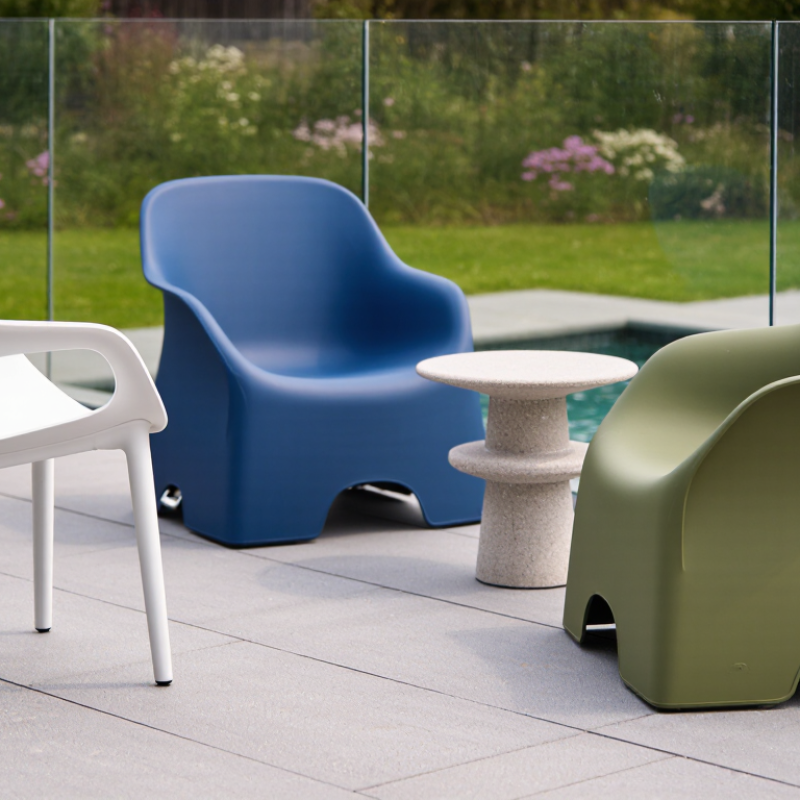
| One-Piece Shell Chair | Patios, cafés, waiting areas, and casual indoor seating | Seat, back, and often arms are formed as a hollow, single-piece polyethylene shell. | Few seams; weather-resistant polyethylene is generally resistant to moisture and corrosion. The shell is easy to wipe clean. | May feel rigid without a cushion; hollow construction can sound or flex differently from upholstered seating. | Seat dimensions, shell stiffness, drainage, surface texture, and whether the chair is stackable. |
| Armless Stackable Chair | Events, dining areas, classrooms, and other spaces that need flexible layouts | Compact molded seat and back, usually with an open base or separate legs. | Uses less storage space than many armchairs and can be quick to arrange for temporary seating. | Offers less support for users who prefer armrests; stacking height and stability vary by design. | Stacking limit, stacked stability, chair weight, floor-contact points, and rated load capacity. |
| Armchair | Lounges, restaurants, patios, and general-purpose seating | Molded shell includes integrated arms; legs or a supporting base may be separate components. | Armrests can make sitting down and standing up more comfortable; molded surfaces suit routine cleaning. | Typically wider and less space-efficient than an armless chair; arms may limit how closely chairs fit around a table. | Overall width, arm height, clearance under tables, stability, and ease of moving or stacking. |
| Low Lounge Chair | Relaxed seating in gardens, poolside areas, and outdoor lounges | Deep, low seat with a reclined or angled back; may have a broad molded shell. | Supports a laid-back posture and is well suited to informal outdoor settings when designed for exposure. | Low seat height can make entry and exit more difficult; not ideal for every dining or work setting. | Seat height, back angle, water drainage, UV-stabilized material specification, and cushion compatibility. |
| Rocking Chair | Porches, gardens, and informal indoor relaxation areas | Molded seat and back paired with curved rockers or a rocking base. | Provides a rocking motion without upholstered mechanisms; suitable for relaxed seating when the base is stable. | Needs a level surface and adequate rocking clearance; moving parts or base connections require inspection. | Rocker geometry, anti-tip behavior, base attachment, floor protection, and recommended user weight. |
| Heavy-Duty Utility Chair | Workshops, public facilities, outdoor service areas, and high-use locations | Reinforced molded shell or frame, sometimes with thicker sections or a more substantial base. | Designed for repeated handling and demanding use; nonporous plastic surfaces are generally simple to clean. | May be heavier and less portable; “heavy-duty” does not establish a standard load rating by itself. | Published load rating and test method, reinforcement design, base stability, and warranty conditions. |
| Children’s Chair | Playrooms, schools, family spaces, and child-sized activity areas | Scaled molded seat with a lower seat height and dimensions suited to children. | Lightweight designs are easy to reposition; smooth plastic surfaces can be wiped clean. | Must match the child’s size and setting; stability and supervision remain important. | Seat height, tip resistance, smooth edges, applicable safety requirements, and age or size guidance. |
| Dining-Height Chair | Indoor or outdoor dining tables and café seating | Upright molded seat intended to pair with standard dining-height tables. | Upright posture suits meals and conversation; outdoor-rated polyethylene can tolerate ordinary exposure to moisture. | Comfort depends on seat contour and table clearance; not all molded chairs include ventilation or cushioning. | Seat height, arm-to-table clearance, back support, drainage, and compatibility with the table height. |