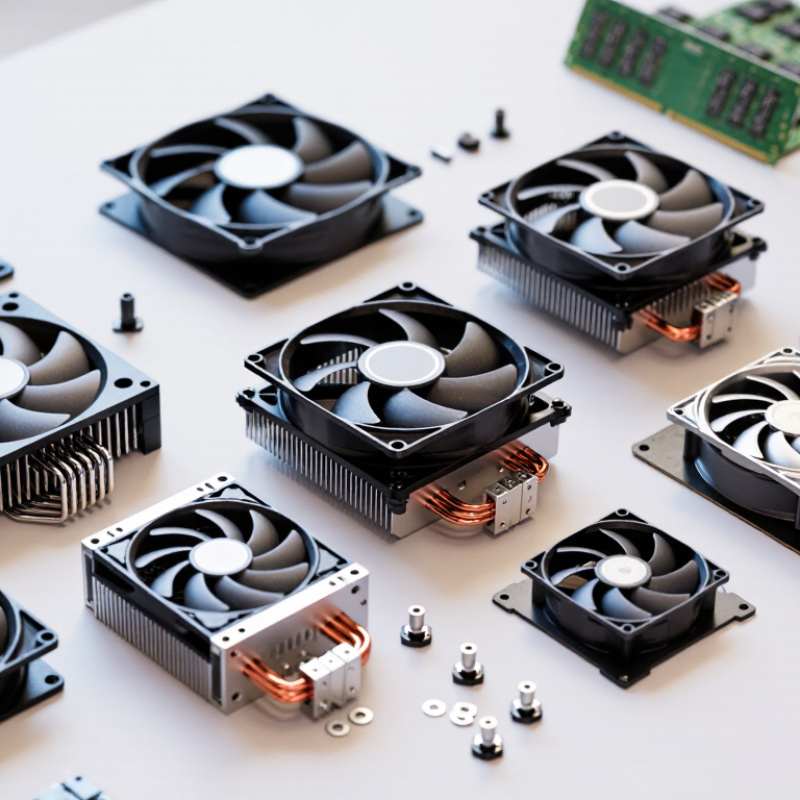
| Supplier structure | The supply chain includes finished-cooler manufacturers, OEM/ODM providers, and specialist component suppliers. | A supplier may design and assemble the complete cooler or source parts such as fans, heat pipes, and fasteners from partners. | Confirm which production steps are performed in-house and which are subcontracted. |
| Product architecture | Low-profile designs commonly use a top-down layout, with a fan positioned above a heatsink; heat pipes may be incorporated depending on the design. | Compact layouts can help meet restricted height and clearance requirements, but motherboard and case compatibility still need to be checked. | Request a dimensioned drawing, cooler height, socket mounting details, and a clearance check for nearby components. |
| Heatsink construction | Common construction approaches include stamped or formed fins, extruded aluminum sections, and copper or aluminum base components. The choice depends on design and cost targets. | Fin spacing, fin area, base contact, and airflow path influence cooling performance within a limited volume. | Check material specifications, construction drawings, surface finish, and sample consistency. |
| Heat-pipe integration | Some designs use heat pipes to move heat from the base into the fin stack; other compact designs rely on a simpler solid-metal heatsink. | Heat pipes can support heat spreading, but their presence alone does not establish the cooler’s thermal performance. | Ask for the test setup, operating conditions, and measured results for the specific cooler configuration. |
| Fan and acoustics | Compact axial fans are commonly used; size, speed range, bearing design, and control method vary by product. | The fan must balance airflow and noise while fitting the cooler’s height and surrounding enclosure. | Verify fan dimensions, connector, speed-control behavior, noise-test method, and replacement availability. |
| Manufacturing and quality control | Production may involve metal forming or machining, joining, fan assembly, mounting-hardware installation, and final inspection. | Dimensional variation, mounting pressure, fin damage, and assembly quality can affect fit and repeatability. | Review inspection criteria, sample approval procedures, traceability, and production-lot test records. |
| Customization and sourcing | OEM/ODM projects may cover dimensions, fan selection, mounting kits, packaging, and product documentation. | Custom changes can affect fit, tooling, thermal behavior, lead time, and qualification requirements. | Request a written specification, approved sample, change-control process, and production schedule. |
| Supplier evaluation | Supplier capability is best assessed through product documentation, samples, manufacturing evidence, and project-specific validation rather than a generic ranking. | Cooling results depend on the processor heat load, case airflow, ambient conditions, and installation—not just the cooler’s profile. | Compare like-for-like thermal and acoustic tests, compatibility evidence, warranty terms, and quality documentation. |