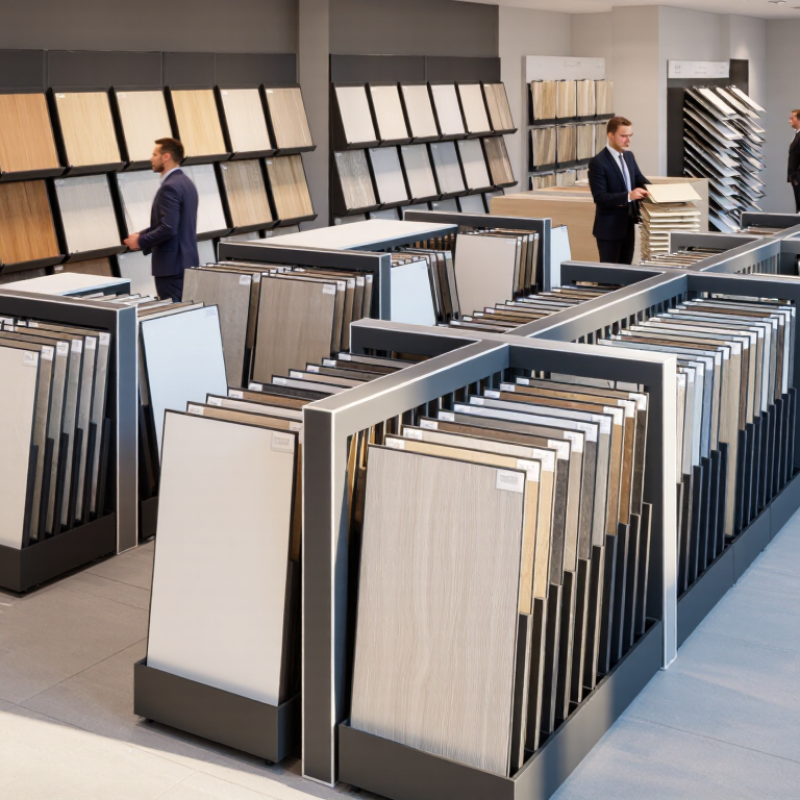
| Rack Design | Floor-standing panels, rotating displays, pull-out sample drawers, countertop stands, and modular wall systems. | Different formats help present loose samples, mounted tiles, or coordinated collections while making products easier to browse. | Panel layout, number of sample positions, display angle, mobility, and shelf or drawer arrangement. | Confirm the display format suits the tile size, sample weight, showroom space, and customer browsing pattern. |
| Frame Materials | Powder-coated steel, aluminum, and engineered wood are commonly used for display frames and structures. | Steel provides a rigid structure; aluminum is relatively lightweight; engineered wood can support a furniture-style appearance. | Material combinations, frame profile, color, surface finish, and visible trim. | Ask for material specifications, finish details, and information on corrosion protection where relevant. |
| Sample Supports | Metal rails, brackets, trays, shelves, clips, and removable sample holders. | Purpose-designed supports help keep samples organized and reduce movement during normal display use. | Holder dimensions, spacing, tilt, sample orientation, and removable or replaceable components. | Check sample fit and stability using actual tile samples, including their thickness and edge finish. |
| Surface Finish | Powder coating for metal parts, painted finishes, laminate surfaces, and clear protective coatings where suitable. | Finishes influence appearance and can make routine cleaning easier when matched to the substrate and use conditions. | Color matching, gloss level, texture, printed graphics, and finish combinations. | Request finish samples and care guidance; confirm that the finish is appropriate for the intended indoor environment. |
| Branding and Graphics | Header panels, product labels, category markers, printed boards, and replaceable information cards. | Clear labeling helps buyers identify collections, sizes, finishes, and product specifications. | Graphic dimensions, languages, label holders, artwork placement, and replaceable sign panels. | Provide final artwork requirements and confirm proof approval, language accuracy, and label replacement method. |
| Modularity | Interchangeable panels, add-on bays, detachable holders, and reconfigurable shelving. | Modular components can make it easier to update a display when product ranges or sample formats change. | Connection method, module width, expansion direction, and compatibility between components. | Verify that replacement parts and added modules are compatible with the original rack configuration. |
| Mobility and Assembly | Fixed feet or caster wheels; knock-down components or assembled delivery, depending on the design. | Wheels can help reposition suitable displays, while knock-down construction may simplify transport and storage. | Wheel type, locking features, assembly method, packaging format, and installation instructions. | Check access routes, floor conditions, packed dimensions, assembly tools, and whether installation support is needed. |
| Quality and Export Readiness | Dimensional checks, finish inspection, packaging review, and product-specific testing as agreed with the buyer. | Documented checks help buyers assess consistency and reduce avoidable damage or specification mismatches. | Inspection checkpoints, sample approval, packaging design, labeling, and shipment documentation. | Agree on drawings, tolerances, acceptance criteria, packaging requirements, and applicable destination-market rules before production. |