| Single-ball launcher | One ball is loaded and launched at a time. | Launch direction, elevation, speed, and interval, where supported. | Repetitive passing, first-touch practice, and goalkeeper reaction drills. | Check loading time, remote controls, ball compatibility, and operator safety guidance. |
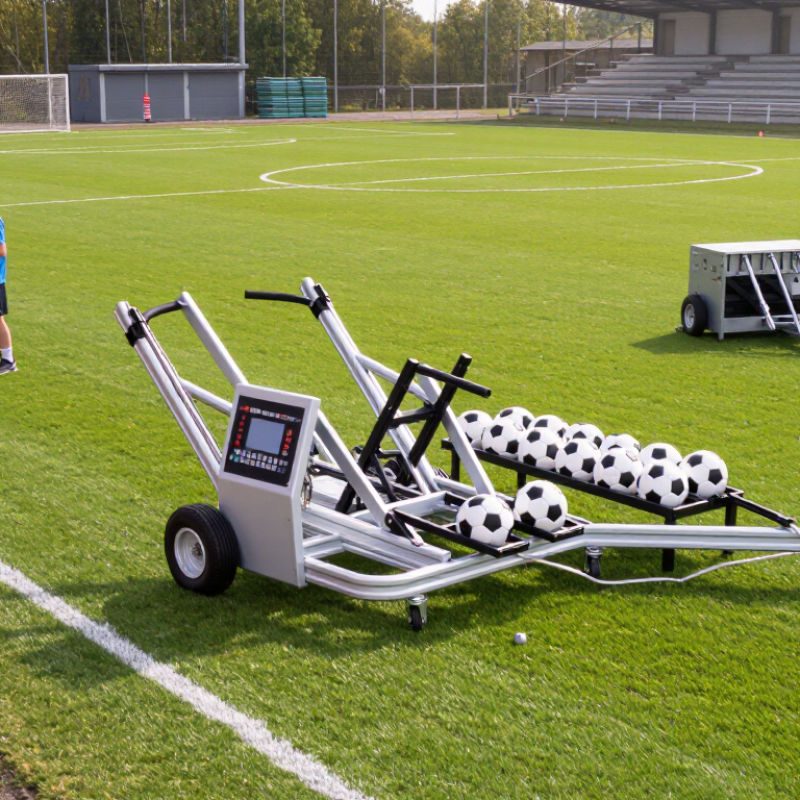
| Hopper-fed launcher | A hopper or feeder holds multiple balls for repeated delivery. | Feed rate, launch interval, trajectory, and direction, depending on the model. | High-repetition drills with fewer pauses to reload between launches. | Verify stated hopper capacity, feed reliability, ball spacing, and clearing procedure. |
| Adjustable-angle launcher | The launch angle can be changed to produce different ball trajectories. | Elevation and, if available, speed and spin. | Ground passes, driven balls, and aerial-ball control practice. | Ask for the documented adjustment range and whether settings are repeatable. |
| Oscillating or directional launcher | The launch direction changes across a fixed or adjustable sweep. | Sweep angle, direction sequence, and launch timing, if provided. | Movement, scanning, reaction, and receiving drills that require players to adjust to changing delivery directions. | Check sweep limits, cycle settings, stability, and whether the unit can be operated safely from the training area. |
| Programmable launcher | Controls may allow users to set or repeat delivery sequences. | Sequence, interval, speed, angle, or direction, according to the supplied controls. | Structured passing, finishing, and goalkeeper sessions with repeatable delivery patterns. | Request a demonstration of the programming interface, saved settings, and emergency-stop operation. |
| Portable training unit | A compact or wheeled unit intended to be moved between practice locations. | Setup position, launch direction, and available power options. | Flexible small-group or multi-station practice where equipment needs to be repositioned. | Check overall dimensions, transport method, power requirements, and setup time. |