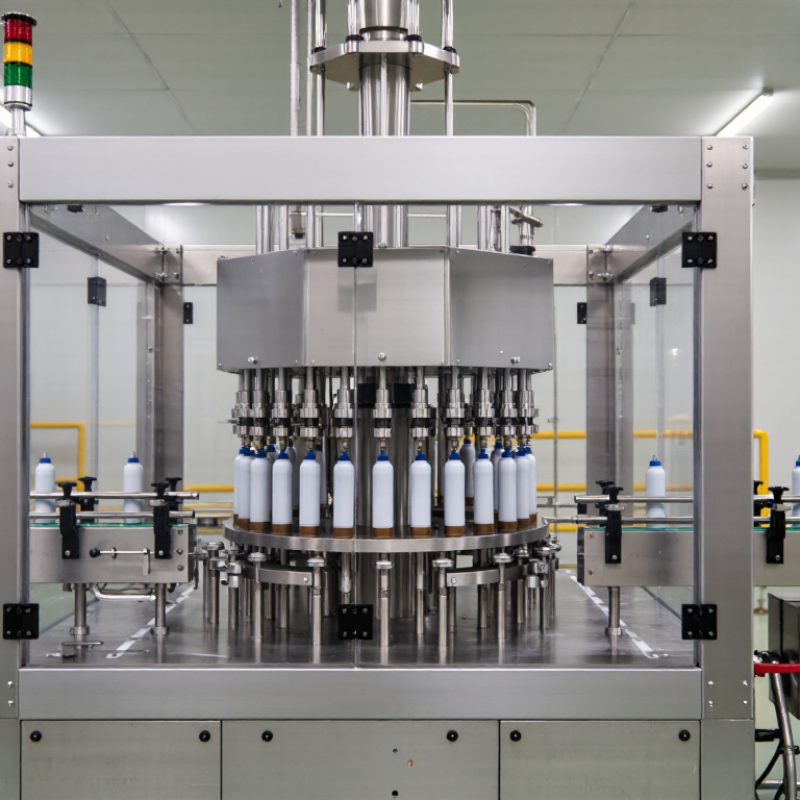
| Machine Type | Automatic bag-on-valve aerosol filling line | Designed to fill the product and propellant separately while keeping the formulation inside a sealed bag. |
| Operating Principle | Product is filled into the bag before or after valve crimping, followed by propellant charging through the valve. | The separated product and propellant system helps reduce direct contact between the formulation and the propellant. |
| Typical Production Speed | Approximately 30–120 containers per minute, depending on container size, product viscosity, and line configuration. | Production speed is a key factor when matching the equipment to required daily output. |
| Suitable Container Sizes | Commonly configured for aerosol cans from approximately 35 ml to 1,000 ml. | Container-size flexibility allows one filling line to support multiple product formats. |
| Product Viscosity Range | Suitable for liquids, lotions, gels, creams, foams, and other formulations; the practical range depends on the pump and filling system. | Viscosity affects filling accuracy, transfer stability, and the required pump design. |
| Product Filling Accuracy | Often specified at approximately ±1% under stable operating conditions, subject to product properties and calibration. | Accurate filling reduces product waste and helps maintain consistent net content. |
| Propellant Filling Method | Pressure-based propellant charging through the aerosol valve; compatible systems may use compressed air, nitrogen, or liquefied propellant. | The charging method determines filling control, safety requirements, and compatibility with the formulation. |
| Valve Crimping | Automatic valve placement and crimping with adjustable crimp diameter and crimp depth. | Correct crimping is essential for leak prevention and reliable product dispensing. |
| Bag-on-Valve Compatibility | Supports aerosol containers fitted with bag-on-valve assemblies, subject to valve dimensions and container specifications. | Compatibility must be confirmed before production because valve geometry varies by application. |
| Filling Stations | Typical stations include container feeding, product filling, valve placement, crimping, propellant filling, leak testing, and discharge. | Integrated stations reduce manual handling and improve process repeatability. |
| Leak Testing | May include water-bath testing, pressure decay testing, or other approved in-line leak detection methods. | Leak testing helps identify defective valves, crimps, containers, or seals before packaging. |
| Compressed Air Requirement | Commonly requires clean, dry compressed air at approximately 0.6–0.8 MPa, depending on the machine design. | Stable air pressure is necessary for pneumatic actuators, valves, and consistent filling performance. |
| Electrical Supply | Usually available in common industrial configurations such as 220–240 V or 380–415 V, with single-phase or three-phase options. | The required power supply should be confirmed according to the installation location and machine configuration. |
| Control System | PLC-based control with a touchscreen interface, recipe storage, alarm monitoring, and parameter adjustment. | Digital controls simplify changeovers, troubleshooting, and production record management. |
| Material of Product-Contact Parts | Commonly stainless steel, with 304 or 316L selected according to formulation chemistry and hygiene requirements. | Appropriate materials improve corrosion resistance, cleanability, and product compatibility. |
| Changeover Requirements | Changeover may involve replacing guides, filling nozzles, star wheels, crimping components, and control parameters. | Quick-change components reduce downtime when producing different container sizes or formulations. |
| Safety Features | Typical features include guards, emergency stops, door interlocks, pressure monitoring, overload protection, and fault alarms. | Safety systems help protect operators and control risks associated with pressurized containers and propellants. |
| Automation Level | Automatic feeding, filling, crimping, propellant charging, inspection, and container discharge can be integrated into one line. | Higher automation can reduce labor requirements and improve production consistency. |
| Common Applications | Medical sprays, wound-care products, personal-care formulations, household products, food products, and industrial liquids. | The sealed BOV format is useful where product purity, controlled dispensing, or reduced propellant contact is required. |
| Key Selection Criteria | Required output, formulation viscosity, container dimensions, valve type, propellant type, filling accuracy, cleaning method, and safety standards. | Evaluating these factors helps ensure that the automatic filling machine matches the complete production process. |