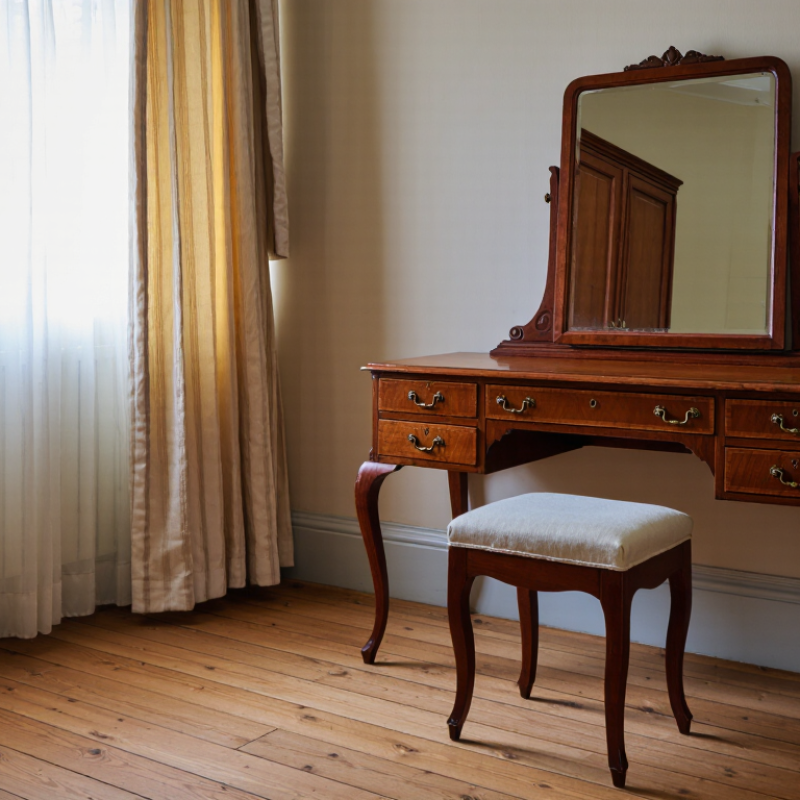
Georgian
1714–1830 | Often restrained and symmetrical, with straight lines or cabriole legs depending on the date and regional style. | Mahogany, walnut, and other locally available hardwoods; polished or veneered surfaces are common. | May have a separate adjustable mirror, sometimes set on a small table with drawers. | Look for hand-cut construction details, age-consistent wear, and hardware appropriate to the piece; later repairs are possible. |
Victorian
1837–1901 | Frequently larger and more ornate, with carved details, shaped fronts, or decorative legs. | Walnut, mahogany, rosewood, and oak appear in period furniture; veneers and contrasting inlays may be used. | Often features a large tilting mirror supported by uprights, along with several drawers. | Check that the mirror frame, supports, and table show compatible construction and wear rather than assuming they were originally together. |
Edwardian
1901–1910 | Generally lighter in appearance than many Victorian examples, with elegant proportions and comparatively restrained ornament. | Mahogany, satinwood, and other decorative hardwoods; pale finishes and fine inlay can be found. | May have a framed central mirror and smaller drawers or side compartments. | Style alone cannot confirm age; examine joinery, finish, hardware, and documented history where available. |
Art Nouveau
c.1890–1910 | May feature flowing lines, asymmetry, and plant-inspired decoration, reflecting the broader Art Nouveau movement. | Wood, glass, and occasionally metal accents; materials vary by maker and region. | Mirror shapes and frames may echo the curved, organic forms of the design. | A flowing silhouette can suggest the style, but does not by itself establish a precise date or authenticity. |
Art Deco
1920s–1930s | Often geometric, streamlined, and symmetrical, with bold shapes and a more modern profile. | May use hardwood veneers, lacquer, glass, or contrasting materials; combinations vary considerably. | Typically designed with a broad mirror and practical drawer storage; some designs have a built-in appearance. | Assess the construction and condition as well as the geometric styling, since later furniture may imitate the look. |