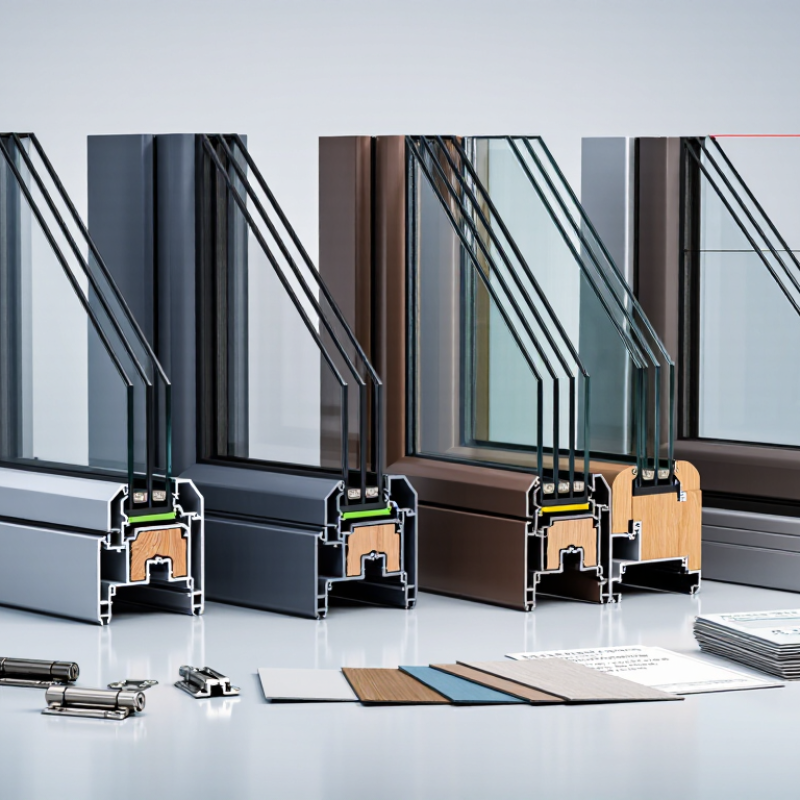
| Product construction | Confirm that the product has a wood interior and an exterior aluminum cladding, and review how the cladding is attached, drained, and finished. | Request section drawings, material specifications, finish options, and details for corners, joints, and drainage paths. | Compare the complete assembly rather than judging by the phrase “aluminum-clad” alone. Check that the proposed construction suits the project’s exposure and maintenance requirements. |
| Thermal performance | Review whole-window U-factor and solar heat gain coefficient (SHGC) for the specified size, glazing, spacer, and frame configuration. | In North America, NFRC-certified ratings provide a standardized basis for comparing labeled products. Lower U-factor means less heat transfer; suitable SHGC depends on climate, orientation, and shading. | Compare like-for-like configurations and use whole-window values, not center-of-glass figures. Confirm that the tested size and glazing match the project specification. |
| Air leakage | Ask for air-leakage results for the exact operating style and tested assembly. | North American ratings commonly report air leakage under AAMA/WDMA/CSA 101/I.S.2/A440 or related test methods. European products may use EN 12207 air-permeability classifications. | Lower reported leakage generally indicates a tighter window, but test methods and units can differ. Compare results only when the method, size, and product type are comparable. |
| Water penetration and wind resistance | Check the tested water-pressure and structural-pressure performance, including any limits for size, configuration, and installation. | European classification systems include EN 12208 for watertightness and EN 12210 for resistance to wind load. North American specifications may use performance grades under AAMA/WDMA/CSA 101/I.S.2/A440. | Match the required performance to the site’s wind exposure, building height, and weather conditions. Confirm that the tested configuration represents the units being ordered. |
| Applicable market certifications | Verify that documentation is valid for the destination market and covers the specified product family and configuration. | Examples include NFRC ratings for North American energy performance, AAMA/WDMA/CSA product certification in North America, and CE marking with applicable declarations for products placed on the European market. | Request current certificates and test reports, then check their scope, dates, and issuing bodies. A certificate for one product or market does not automatically cover every configuration or jurisdiction. |
| Customization and project capacity | Confirm available opening styles, dimensions, glazing options, finishes, hardware, and the manufacturer’s ability to supply the required quantities. | Request approved shop drawings, a written schedule of sizes and finishes, stated production lead times, and confirmation of any project-specific testing or engineering. | Evaluate whether the manufacturer can document and deliver the complete project specification—not just a standard catalog unit. |
| Installation support | Review installation instructions, perimeter-sealing details, flashing guidance, and availability of technical assistance. | Request installation manuals, project-specific interface details, and written guidance for integrating the window with the wall assembly. | Clarify who is responsible for field measurements, installation, and coordination with the building envelope. Product performance depends on correct installation as well as factory testing. |
| Warranty and after-sales service | Read the warranty terms for wood, aluminum finish, glass, hardware, and labor separately. | Check coverage period, geographic limits, maintenance obligations, exclusions, claim process, and availability of replacement parts. | Compare the written terms rather than relying on a single headline warranty length. Confirm who will handle service in the project’s location. |
| Cost and lifecycle value | Compare the supplied scope, including glazing, hardware, finishes, packaging, delivery, installation, and service. | Use comparable quotations with the same sizes, performance targets, accessories, and delivery terms. Consider expected maintenance and replacement-part availability. | Evaluate total project cost and documented performance together; the lowest initial quotation may not include equivalent specifications or support. |