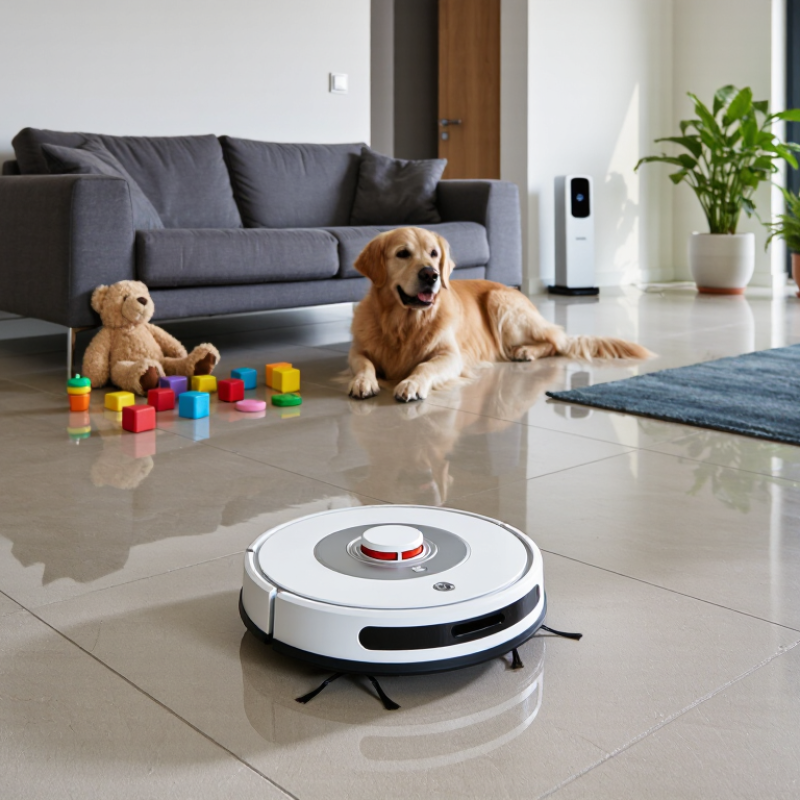
| 1 | Residential robot vacuum | Uses suction and a brush system to collect dust, hair, and loose debris. | Common systems combine wheel odometry with a camera, laser ranging, or other distance sensors. | Mapping and path-planning software can divide a home into rooms, plan routes, and avoid detected obstacles. | Homes with hard floors, rugs, and everyday dry debris. | Check threshold clearance, dust-bin capacity, carpet handling, map support, and availability of replacement filters and brushes. |
| 2 | Robot vacuum-and-mop combination | Vacuums debris and uses a water-fed pad or mop assembly for light wet cleaning. | Typically uses mapping sensors and contact or proximity sensors; some systems add floor or carpet detection. | Software can schedule room-by-room cleaning and adjust routes or mop behavior based on mapped areas and detected surfaces. | Mixed hard-floor homes needing routine vacuuming and light mopping. | Confirm whether vacuuming and mopping can run together, how carpets are protected, and how the mop pad and water system are maintained. |
| 3 | Robot mop | Wets and moves a reusable or disposable pad across hard flooring; some designs use oscillating or rotating pads. | Uses navigation sensors to follow mapped routes and obstacle sensors to reduce collisions. | Route planning can provide systematic coverage and help the robot avoid restricted or carpeted zones when those are mapped. | Sealed hard floors such as tile, vinyl, and finished wood. | Check water control, pad washing requirements, edge coverage, and whether the manufacturer permits use on the intended floor finish. |
| 4 | Self-emptying robot vacuum | Performs robotic vacuuming and transfers collected debris to a dock-mounted dust container. | Uses the navigation and obstacle-detection approaches found in mapped robot vacuums. | Automated docking and scheduled cleaning reduce routine user involvement; mapping supports targeted room cleaning. | Busy homes, larger floor areas, and households with frequent dry debris. | Account for dock dimensions, noise during emptying, bag or bin upkeep, and the extra floor space required near a power outlet. |
| 5 | Robot vacuum with an automatic mop-service dock | Combines vacuuming with wet mopping; a compatible dock may refill water and wash or dry mop pads. | Mapping sensors guide cleaning, while the dock handles selected maintenance tasks automatically. | Room maps and programmed routines coordinate cleaning; some systems can vary mop use by zone or floor type. | Homes with extensive hard flooring and users seeking less frequent manual pad maintenance. | Review dock plumbing requirements, water-tank handling, cleaning-solution restrictions, maintenance intervals, and consumable costs. |
| 6 | Commercial autonomous scrubber | Scrubs hard floors with rotating brushes or pads, dispenses cleaning solution, and collects dirty water with a squeegee and recovery tank. | May use laser scanners, cameras, odometry, and safety sensors to localize and detect people or objects. | Autonomous navigation can support repeatable routes, obstacle response, and scheduled cleaning in mapped areas. | Large facilities such as warehouses, airports, hospitals, and retail spaces. | Assess cleaning width, tank capacity, runtime, floor compatibility, site-mapping needs, operator training, and local service support. |
| 7 | Compact commercial scrubber robot | Uses powered brushes or pads with solution dispensing and dirty-water recovery in a smaller form factor. | Proximity and navigation sensors help it move through tighter spaces and detect obstacles. | Route automation can reduce repetitive manual operation while enabling consistent coverage of defined areas. | Restaurants, clinics, small shops, and other facilities with narrow aisles or limited storage. | Compare turning space, doorway clearance, tank size, charging time, noise level, and the amount of supervision required. |
| 8 | Autonomous dry-sweeping robot | Collects dust and loose debris with brushes and a debris hopper rather than applying water. | Navigation may combine laser or camera-based localization with obstacle and cliff sensors. | Mapping and path planning can automate repeatable sweeping routes and help avoid designated restricted areas. | Indoor commercial spaces where dry debris collection is the main daily task. | Check debris-hopper capacity, brush access, floor transitions, filtration needs, and whether the unit can operate safely around people. |
| 9 | Autonomous floor-cleaning platform for multi-shift facilities | Depending on configuration, supports vacuuming, sweeping, or scrubbing with task-specific cleaning modules. | Often uses a combination of localization sensors, cameras, and safety scanners to navigate a defined facility. | Fleet or task software can schedule jobs, report status, and coordinate routes when multiple units are deployed. | Distribution centers, campuses, and large facilities with recurring cleaning schedules. | Evaluate integration with site operations, network coverage, reporting, charging logistics, safety procedures, and long-term maintenance availability. |
| 10 | AI-assisted cleaning system with human oversight | Uses an automated cleaner for routine coverage while staff handle edges, spills, stairs, and other exceptions. | Sensor data and mapped routes support navigation; remote dashboards may show progress or alerts. | Automation prioritizes repeatable work, while human review helps respond to blocked paths, unusual messes, or changing site conditions. | Homes and businesses where full autonomy is impractical or cleaning needs vary by area. | Plan for clear escalation procedures, staff training, privacy rules for camera-equipped devices, and realistic expectations about unattended operation. |