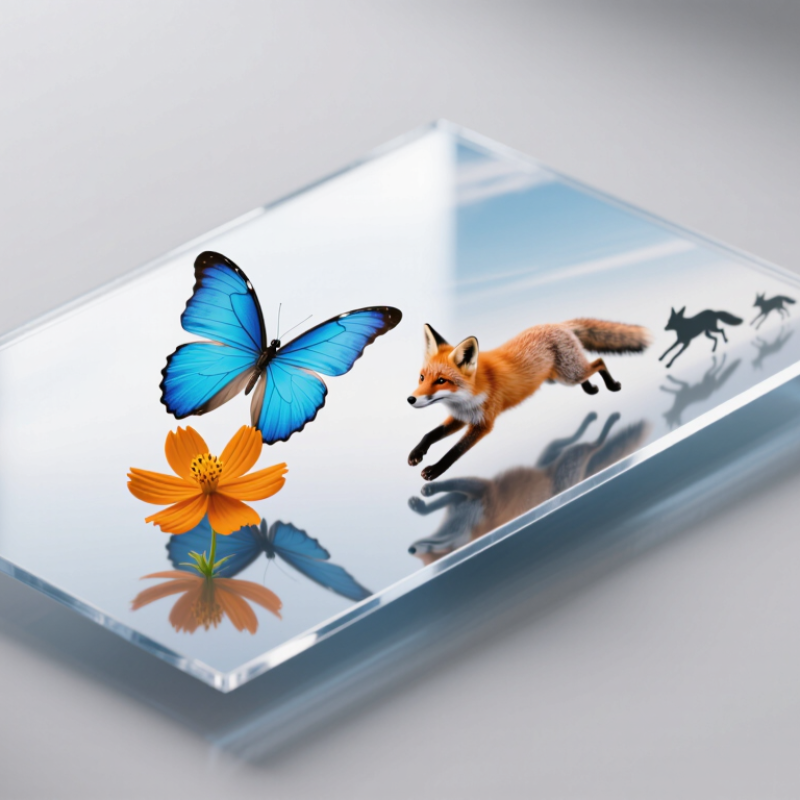
| 3D depth | Multiple images captured or rendered from slightly different viewpoints are interlaced beneath a lenticular lens. The changing views create perceived depth and parallax as the observer moves. | Often about 40–75 LPI for close-viewed sheet prints; larger lenses may be chosen for larger formats or longer viewing distances. | A common starting point is artwork prepared at about 300 PPI at final print size, with several aligned views. The image must be interlaced to match the actual lens pitch and print setup. | Usually designed for a frontal viewing position with a limited viewing zone. The usable angle depends on lens geometry, pitch, thickness, and viewing distance. | Posters, postcards, covers, display graphics, and images where dimensional depth is the main effect. |
| Flip | Two or more distinct images alternate as the viewing angle changes. A flip can use a simple two-image change or several sequential states. | Often about 40–75 LPI for small or medium prints; the final pitch is selected to suit the format and viewing conditions. | Prepare each image at the same final dimensions and resolution, then interlace the views for the selected lens. Clean alignment and adequate contrast help make the transition clear. | The transition is typically noticeable as the viewer moves across the viewing zone. Its width and smoothness are design- and lens-dependent. | Before-and-after graphics, product comparisons, promotional cards, and simple changing-image displays. |
| Motion or animation | Several frames are interlaced so that movement appears as the viewing angle changes. More frames can create a smoother sequence, but each frame receives a smaller share of the available image information. | Often about 40–75 LPI for close-viewed prints, subject to the selected lens and print size. | Use consistently sized frames and plan the frame count before production. More frames generally require careful control of source detail, alignment, and interlacing. | Movement is revealed by changing the viewer’s angle; it is not continuous video. The apparent sequence depends on lens pitch, angle, and viewing distance. | Action sequences, product demonstrations, character movement, and short visual loops on printed displays. |
| Zoom or morph | A zoom changes the apparent scale of an image, while a morph gradually changes one image into another across multiple interlaced views. | Often about 40–75 LPI for small and medium formats; larger formats may use a coarser pitch depending on viewing distance. | Build intermediate views or frames at the final output size. Smooth transitions depend on consistent composition and accurately matched interlacing. | The effect is most legible when viewed within the intended angle range. The transition may appear abrupt or uneven if the artwork or lens alignment is unsuitable. | Packaging, promotional graphics, visual transformations, and displays that combine changing scale with image transitions. |