| 1 | Vacuum Forming Machine | A heated thermoplastic sheet is positioned over a mold. Air is evacuated from beneath the sheet, and atmospheric pressure pushes the softened plastic against the mold surface. | Cut sheets or roll-fed web | ABS, HIPS, PVC, PET, PP, and acrylic | Trays, covers, packaging inserts, housings, and liners | Simple tooling, low equipment cost, and economical production for large shallow parts | Limited control of wall thickness and less definition on the side opposite the mold |
| 2 | Pressure Forming Machine | Vacuum is combined with compressed air above the heated sheet. The additional pressure forces the plastic more tightly against the mold, reproducing fine textures, ribs, lettering, and sharper edges. | Cut sheets or roll-fed web | ABS, HIPS, PET, PP, PVC, and engineering thermoplastics | Appliance panels, instrument bezels, equipment housings, and decorative components | Better detail, tighter radii, and improved cosmetic surface definition than standard vacuum forming | Requires pressure-capable tooling and a compressed-air system; tooling is generally more complex |
| 3 | Plug-Assist Thermoforming Machine | A heated sheet is first pushed into the mold by a shaped plug. Vacuum, pressure, or both then complete the forming operation. The plug pre-stretches the sheet before it contacts the mold. | Cut sheets or roll-fed web | PP, PET, HIPS, ABS, and multilayer packaging sheet | Deep trays, cups, containers, food packaging, and medical packaging | More uniform wall distribution and greater forming depth than vacuum alone | Plug design, temperature control, and timing must be carefully matched to the mold and material |
| 4 | Twin-Sheet Thermoforming Machine | Two separate sheets are heated and formed at the same time, usually in opposing molds. The mold halves close while the sheet edges are joined, creating a hollow part with an internal cavity. | Two cut sheets or two synchronized webs | HDPE, PP, ABS, HIPS, and PVC | Hollow pallets, ducts, tanks, air channels, containers, and double-wall covers | Produces hollow, lightweight structures and can integrate internal walls or air passages | Higher equipment and tooling complexity; joining areas and dimensional alignment require control |
| 5 | Matched-Mold Thermoforming Machine | A heated sheet or preform is placed between matching male and female molds. The molds close mechanically, shaping both surfaces and defining the final geometry. | Cut sheets or preforms | ABS, PC, PETG, PP, and reinforced thermoplastic sheets | Structural panels, precision covers, automotive interior parts, and technical enclosures | Good two-sided detail, repeatable dimensions, and improved control of part geometry | More expensive matched tooling and lower flexibility for large or highly undercut parts |
| 6 | Drape Vacuum Forming Machine | A heated sheet is mechanically draped over a positive mold. Vacuum is then applied between the sheet and mold so the plastic conforms to the mold contour. | Large cut sheets | ABS, acrylic, PVC, HDPE, and polycarbonate | Large equipment covers, vehicle body panels, display shells, and architectural components | Suitable for large parts and positive molds with relatively simple construction | Wall thickness can vary substantially, especially near deep corners and transitions |
| 7 | Cut-Sheet Shuttle Thermoforming Machine | Pre-cut sheets are loaded onto a shuttle or frame, heated in one station, and transferred to a separate forming station. Vacuum, pressure, plugs, or combinations of these methods form the part. | Individual cut sheets | ABS, PC, PMMA, PP, PETG, and engineering-grade sheets | Large housings, machine guards, medical covers, and low-to-medium volume technical parts | Flexible sheet handling, quick material changes, and compatibility with large or thick sheets | Manual or batch sheet loading can reduce throughput compared with fully continuous systems |
| 8 | Roll-Fed Inline Thermoforming Machine | Plastic web is unwound from a roll, heated continuously, formed in indexed or continuous molds, trimmed, and discharged in an integrated production line. | Continuous roll-fed web | PET, PP, PS, HIPS, PVC, and multilayer packaging webs | Food trays, blister packs, pharmaceutical packaging, lids, and disposable containers | High output, automated feeding, integrated trimming, and efficient material utilization | Less convenient for frequent product changes or very large thick-walled parts |
| 9 | Heavy-Gauge Oven-Forming Machine | A thick sheet is heated in an oven until softened, transferred to a mold, and formed using vacuum, pressure, plug assistance, or a combination of methods. | Large individual sheets | ABS, HDPE, PP, acrylic, polycarbonate, and PVC | Vehicle components, industrial covers, refrigerator liners, spas, and large containers | Handles thick material and very large parts that are difficult to process on thin-gauge lines | Longer heating and cooling cycles, higher material usage, and greater handling requirements |
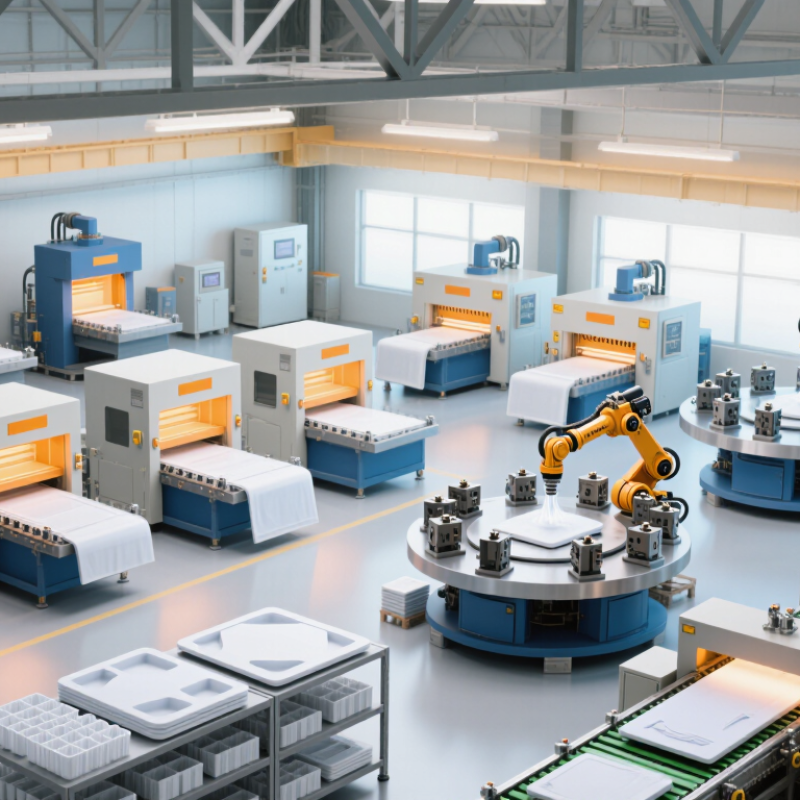
| 10 | Rotary Thermoforming Machine | A rotary indexing table moves sheet or preforms through multiple stations, such as heating, forming, cooling, trimming, and unloading. Different operations can occur simultaneously at separate stations. | Cut blanks or continuously supplied sheet | PP, PET, PS, HIPS, ABS, and PVC | Packaging components, disposable laboratory items, small containers, and repeated technical parts | Efficient use of floor space, parallel processing, and consistent cycle timing for repetitive production | Higher setup complexity and reduced economic efficiency for short runs or frequently changing designs |