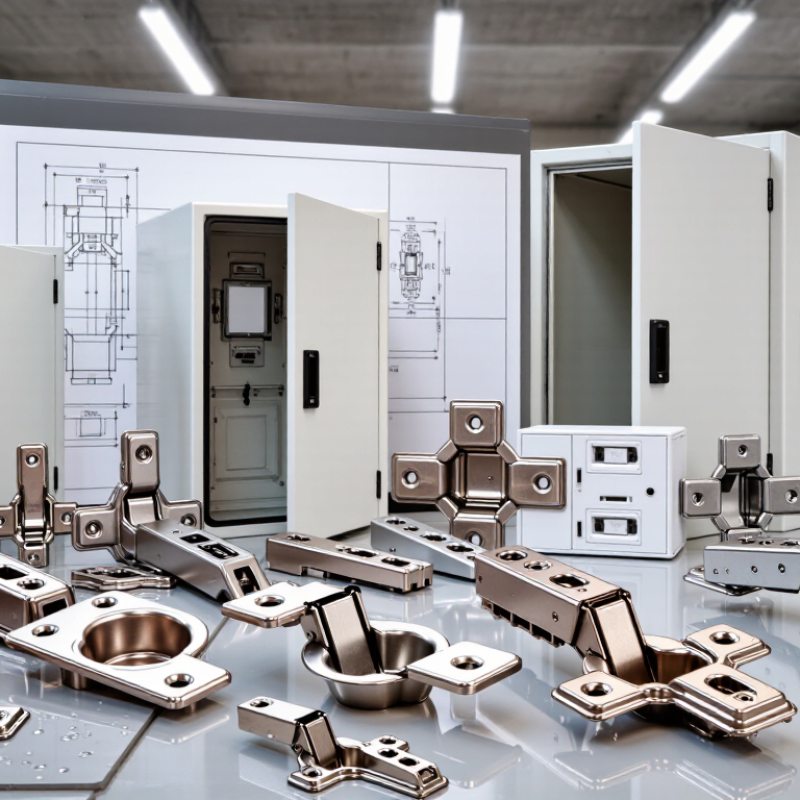
| 1 | Concealed Door Hinge | Zinc alloy, stainless steel, or coated steel | Usually 90°–120° opening | Electrical control cabinets, automation enclosures, and machine housings where the hinge should remain hidden. | Clean appearance Tamper resistance Limited visible hardware
Confirm door thickness, mounting clearance, load capacity, and required sealing space before selection. |
| 2 | Lift-Off Panel Hinge | Stainless steel, zinc-plated steel, or aluminum | Commonly 90°–180° | Removable electrical panels, industrial cabinets, test equipment, and service-access doors. | Fast maintenance access Detachable door Left/right versions
Check pin direction, door weight, hinge spacing, and whether the hinge permits door removal without tools. |
| 3 | Continuous Piano Hinge | Stainless steel, mild steel, or aluminum | Often approximately 180° | Long enclosure doors, machine guards, battery cabinets, distribution panels, and access covers. | Even load distribution Long doors Reduced door twist
Specify leaf length, knuckle diameter, pin diameter, material thickness, and corrosion requirements. |
| 4 | Adjustable Industrial Hinge | Steel, stainless steel, or reinforced polymer | Typically 90°–180° | Machine enclosures and cabinets requiring alignment correction after installation or repeated operation. | Door alignment Position adjustment Serviceability
Review adjustment range, locking method, fastener access, vibration resistance, and allowable door mass. |
| 5 | Spring-Loaded Hinge | Carbon steel, stainless steel, or zinc alloy | Self-closing within a specified angle range | Machine guards, safety covers, access doors, and panels that must return to a closed position. | Automatic closing Safety guarding Defined spring force
Match spring torque to door mass and center of gravity; verify cycle life and closing speed requirements. |
| 6 | Friction or Torque Hinge | Stainless steel, steel, or engineered polymer | Holds selected positions, often up to 180° | Operator interfaces, display covers, inspection windows, control panels, and adjustable machine screens. | Position holding Controlled motion Operator access
Select according to required torque, operating temperature, cycle frequency, panel weight, and opening angle. |
| 7 | Weld-On Hinge | Mild steel or stainless steel | Commonly 90°–180° | Heavy machine frames, steel cabinets, outdoor equipment housings, and fabricated industrial doors. | High structural strength Permanent installation Fabricated frames
Evaluate weld compatibility, hinge pin diameter, heat distortion, corrosion protection, and post-weld alignment. |
| 8 | Removable-Pin Butt Hinge | Steel, stainless steel, brass, or zinc alloy | Usually about 90°–180° | Compact cabinet doors, equipment access panels, instrument enclosures, and fabricated metal boxes. | Simple construction Replaceable pin Compact footprint
Check leaf dimensions, knuckle length, pin retention, mounting-hole pattern, and door-to-frame clearance. |
| 9 | 270-Degree Back-Mount Hinge | Zinc alloy, stainless steel, or coated steel | Up to approximately 270° when clearance allows | Network cabinets, automation enclosures, control cabinets, and panels requiring wide rear access. | Wide access angle Reduced obstruction Back-mounted
Verify the actual opening angle on the installed cabinet, nearby wall clearance, door swing path, and hinge-side load. |
| 10 | Sealed or Washdown-Rated Hinge | 316 stainless steel, 304 stainless steel, or corrosion-resistant polymer | Commonly 90°–180° | Food-processing equipment, pharmaceutical machinery, outdoor enclosures, and washdown environments. | Corrosion resistance Hygienic design Frequent cleaning
The hinge alone does not determine enclosure protection. Confirm the complete door assembly, gasket system, drainage design, and required IP rating. |