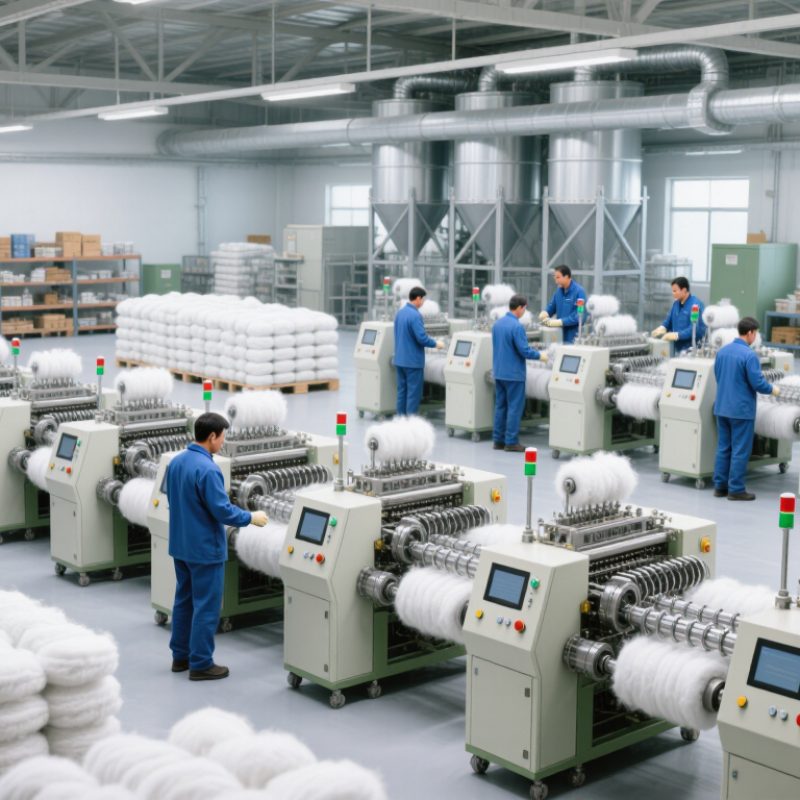
| 1 | Bale opener | Separates and loosens compressed fiber before downstream processing. | Feed method, opening action, usable fiber types, and consistency of output. | Request a trial using your supplied fiber; inspect for uneven feeding, fiber damage, and residual unopened clumps. |
| 2 | Coarse opener | Performs an initial opening step on fibers that need further separation. | Roller or beater arrangement, feed control, access for cleaning, and compatibility with the next stage. | Ask for a process-flow diagram and confirm that the machine is suitable for your fiber form and intended line speed. |
| 3 | Fine or secondary opener | Further separates opened fiber to support a more uniform feed for later processing. | Adjustability, fiber breakage, cleaning access, and performance with the specified fiber blend. | Compare before-and-after samples from a witnessed test; ask how settings are adjusted for different fibers. |
| 4 | Multi-stage opening line | Combines successive opening stages to process fiber from bulk feed toward a more open state. | Stage sequence, transfer between machines, control integration, footprint, and line balance. | Request the complete equipment list, layout, electrical requirements, and a full-line test rather than evaluating one unit alone. |
| 5 | Fiber blending or mixing unit | Combines fiber components to help produce a consistent blend before filling or further processing. | Batch or continuous operation, dosing method, mixing consistency, and cleanout between blends. | Confirm the intended blend ratios and ask how the unit controls or checks the feed proportions. |
| 6 | Dust extraction and filtration module | Collects airborne lint and dust generated during fiber handling, where included in the line. | Extraction points, filter access, cleaning method, and compatibility with the installation environment. | Request airflow and filter documentation for the proposed setup; confirm applicable workplace and local safety requirements. |
| 7 | Storage hopper with level control | Buffers opened fiber and supplies it to a downstream machine or filling station. | Hopper capacity, bridging prevention, level-sensing method, and feed consistency. | Check how the hopper handles your fiber’s bulk behavior and whether level controls are included in the quoted scope. |
| 8 | Weighing or dosing unit | Measures or meters fiber before it is delivered to a pillow-filling station, if precise dosing is required. | Target-weight range, repeatability, calibration procedure, and integration with the filling cycle. | Ask for test records at your target pillow weight and clarify how the stated weighing tolerance is defined. |
| 9 | Pneumatic pillow-filling machine | Uses an air stream to convey loose fiber through a filling tube into a pillow casing. | Air supply requirements, filling-tube design, operator controls, dust handling, and consistency between fills. | Test with the intended fiber and pillow casing; confirm compressor requirements and whether dust collection is included. |
| 10 | Mechanical or conveyor-assisted filling station | Feeds fiber mechanically to a filling point; the specific mechanism and workflow depend on the machine design. | Feed mechanism, casing handling, fill control, changeover time, and operator safety features. | Ask for a live demonstration using the required pillow dimensions and fiber type, and verify the actual staffing and handling steps. |