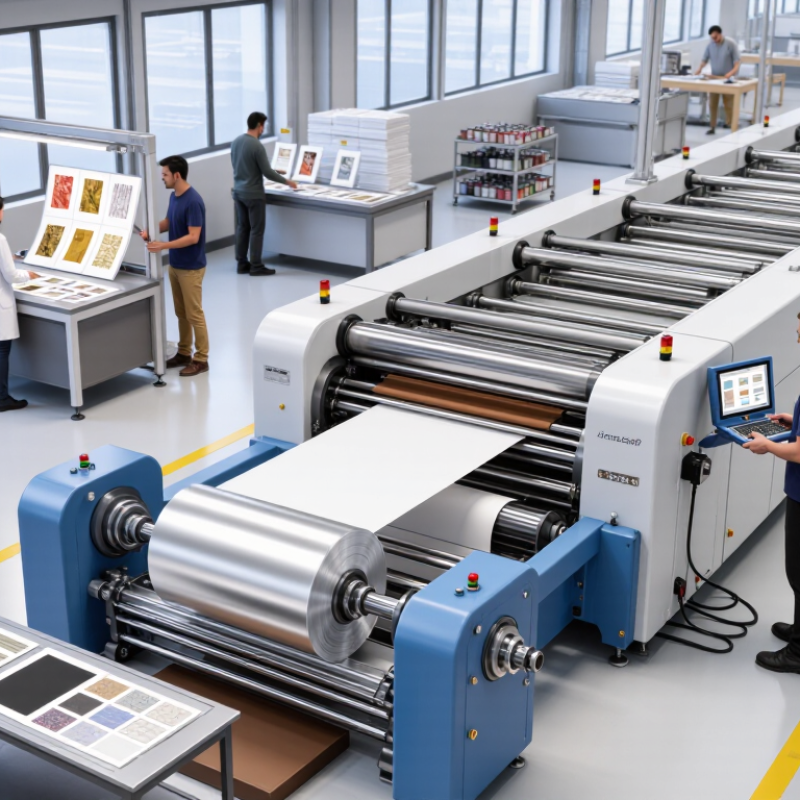
| 1. Compare sustained printing speed | Maximum rated speed and achievable production speed on your intended press, substrate, and job type. | Run a production-style trial and record stable output, stoppages, waste, and foil-transfer quality. Compare machines using the same job conditions rather than rated speed alone. | Actual throughput can be affected by substrate handling, adhesive curing requirements, job complexity, and the press configuration. |
| 2. Check registration performance | Foil-to-print registration accuracy, repeatability, and the available registration adjustment range. | Ask for measured registration results across a sustained run using your artwork and substrate. Set the acceptable tolerance according to the job’s design requirements. | There is no single registration tolerance suitable for every application; small misalignments are more visible on fine text, borders, and detailed graphics. |
| 3. Review tension and web-control features | Unwind and rewind tension control, web guiding, and stability across the machine’s supported material range. | Test representative materials and check for wrinkles, lateral drift, stretching, or breaks during acceleration, steady running, and stopping. | Stable web handling supports consistent foil placement and can reduce defects, particularly on thin or stretch-sensitive substrates. |
| 4. Assess operator controls | Control-panel clarity, recipe storage, access to key settings, alarms, and the visibility of operating status. | Have operators perform a setup, make a controlled adjustment, respond to an alarm, and recall a saved job during a demonstration. | Clear controls and repeatable job settings can simplify changeovers and help reduce setup variation between operators. |
| 5. Verify foil and adhesive compatibility | Supported foil types, adhesive systems, substrates, and any process-specific requirements. | Test the actual foil, adhesive, ink or coating, and substrate combination. Inspect transfer coverage, adhesion, and appearance after the agreed finishing or handling steps. | Cold-foil results depend on the complete material and process combination, not just the machine. Compatibility should be confirmed before purchase. |
| 6. Compare changeover and waste | Time and material required for foil changes, job setup, cleaning, and return to acceptable production quality. | Time a changeover between representative jobs and record setup waste, adjustment steps, and the number of trial runs needed. | Shorter, more predictable changeovers can improve productive time, especially when jobs are frequent or involve multiple foil designs. |
| 7. Evaluate inspection and support | Inspection options, fault and stop reporting, maintenance access, training, spare parts, and service response arrangements. | Confirm which defects or machine conditions can be monitored, what records are available, and how maintenance and technical support are provided. | Useful monitoring and dependable support can help identify process issues and maintain consistent operation over time. |