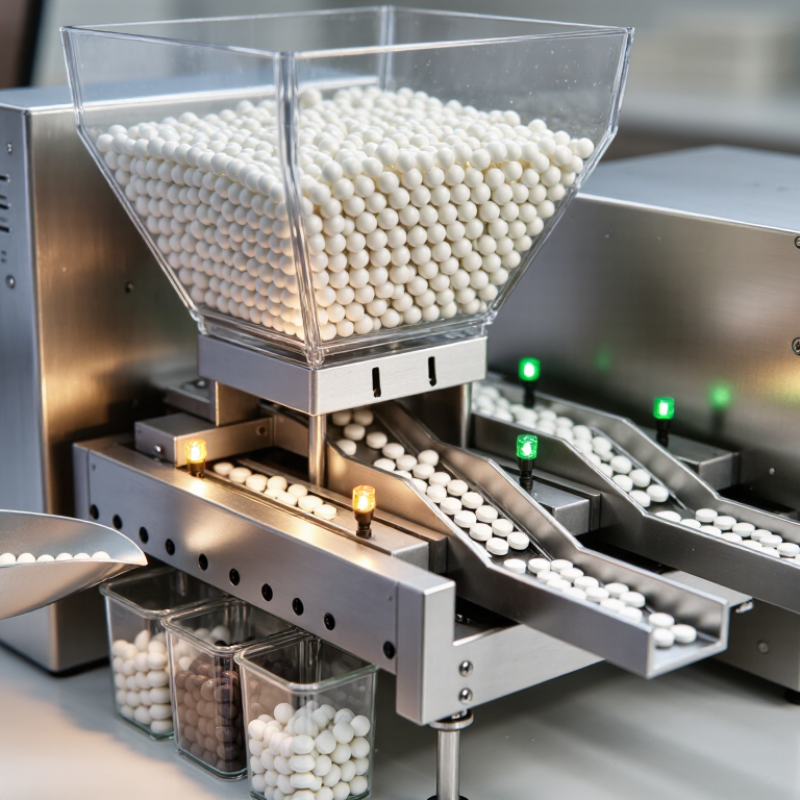
| 1 | Tablet Loading | Bulk tablets are placed into a hopper or infeed container. The product should be dry, intact, and suitable for the counter's feeding system. | Hopper, product chute, vibration tray or belt conveyor | Common batch flow: continuous feeding; tablet sizes often handled range from approximately 3 to 25 mm in diameter, depending on equipment design. | Check for broken tablets, excessive dust, foreign material, and product mix-ups before counting begins. |
| 2 | Tablet Separation | The feeding system spreads tablets into a controlled, single-file or separated flow so that individual tablets can pass the sensing point without overlapping. | Vibratory feeder, rotary disc, slotted belt, guide rails | Key requirement: stable spacing between tablets; excessive overlap can cause undercounting or double-counting. | Adjust vibration, belt speed, or guide width to prevent tablets from touching or stacking. |
| 3 | Detection | Each tablet interrupts or reflects a detection signal as it passes through the counting zone. The machine converts each detected event into an electronic pulse. | Photoelectric sensor, optical receiver, LED light source, or laser-based detector | Detection principle: one valid sensor event is normally assigned to one passing tablet. | Sensor alignment, light shielding, and clean optical surfaces help reduce missed counts and false signals. |
| 4 | Signal Processing | The control system filters the sensor signals, rejects abnormal pulses, and adds valid tablet events to the running count. | Controller, signal processor, encoder, touchscreen interface | Displayed value: running count = previously accepted tablets + newly validated sensor events. | Use an appropriate sensitivity and filtering setting for the tablet's color, shape, transparency, and surface finish. |
| 5 | Target Quantity Comparison | The running count is continuously compared with the programmed target quantity for the container or package. | Recipe settings, counter memory, operator control panel | Example target: 30, 60, 90, or another defined quantity per container; the target must be set before production. | Verify the target quantity against the approved packaging instruction before starting a batch. |
| 6 | Container Filling | When the target count is reached, the outlet directs the counted tablets into a bottle, pouch, tray, or other approved container. | Filling chute, container holder, indexing conveyor, discharge gate | Filling sequence: container positioned → counted tablets discharged → filled container released. | Confirm that the container is correctly positioned and that no tablets remain on the chute or conveyor. |
| 7 | Count Reset and Refill | After a successful discharge, the counter resets the count for the next container while the feeder continues or resumes tablet flow. | Reset logic, proximity sensor, conveyor control, discharge gate | Cycle principle: the counter returns to zero only after the programmed quantity has been discharged or the cycle is otherwise confirmed. | Check that the reset occurs once per container and that tablets are not carried over into the next count. |
| 8 | Reject or Alarm Handling | If a jam, sensor fault, missing container, abnormal flow, or count discrepancy is detected, the system may stop the line or activate an alarm. | Alarm indicator, reject mechanism, emergency stop, fault display | Typical response: stop feeding, identify the fault, clear the cause, and restart only after verification. | Investigate every alarm and document any rejected or manually checked container according to the applicable procedure. |
| 9 | Verification and Recordkeeping | Operators verify the count using an approved inspection method and record production, adjustments, stoppages, and deviations. | Checkweigher or manual count check, batch record, calibration reference | Verification frequency: determined by the site's quality procedure, product risk, and regulatory requirements. | Maintain traceable records and confirm that the machine remains within the approved operating settings. |