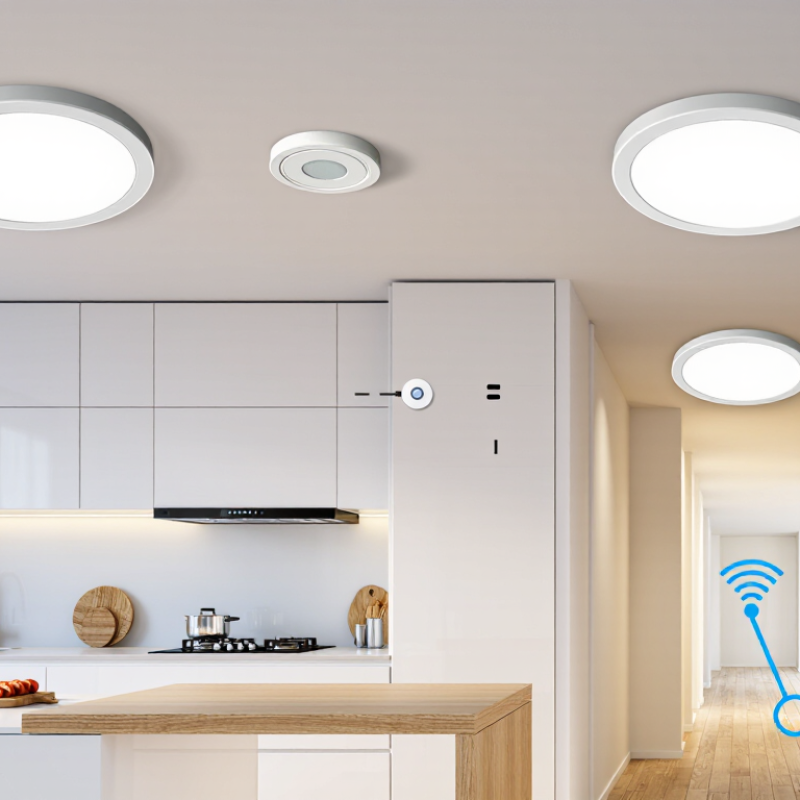
| Product Definition | Recessed LED luminaire with wireless control | A smart downlight combines an LED light source, electronic driver, communication module, and control software in a ceiling-mounted fixture. | Provides controllable general or accent lighting without requiring a separate smart bulb in many installations. |
| Light Source | Integrated LED module | Light-emitting diodes convert electrical energy into light through semiconductor materials. Most smart downlights use a permanently integrated LED board. | Supports compact designs, long service life, and efficient operation. |
| Rated Power | Approximately 5–15 W for common residential models | Rated power indicates the electrical energy consumed during normal operation at full output. | Helps users estimate electricity consumption and select an appropriate replacement for conventional recessed lighting. |
| Typical Brightness | Approximately 400–1,200 lumens | Lumens measure the total visible light produced by the fixture. Actual output depends on power, LED efficiency, optics, and dimming level. | Allows lighting levels to be matched to bedrooms, kitchens, offices, corridors, or living areas. |
| Color Temperature | About 2,700–6,500 K on adjustable models | Color temperature describes the visual appearance of white light, from warm white to cool or daylight white. | Enables atmosphere and visual comfort to be adjusted for relaxation, work, or task lighting. |
| Color Rendering | Commonly CRI 80 or higher; premium designs may exceed CRI 90 | The Color Rendering Index indicates how naturally the light reveals the colors of objects compared with a reference light source. | Higher color rendering is useful in kitchens, dressing areas, retail displays, and spaces where accurate color perception matters. |
| Dimming Capability | Software-based dimming, often from 1% to 100% | The control system adjusts LED current or uses pulse-width modulation to change light output. | Reduces glare, supports mood settings, and can lower energy use when full brightness is unnecessary. |
| Wireless Connectivity | Wi-Fi, Bluetooth, Zigbee, Thread, or another supported protocol | The communication module transfers commands between the downlight, a mobile device, a hub, or a wider smart-home network. | Enables remote control, grouping, automation, and integration with compatible home systems. |
| Control Methods | Mobile app, wireless switch, voice control, or automation | User commands are sent through a local wireless connection or cloud-connected service, then processed by the fixture or its gateway. | Offers more flexibility than a conventional wall switch and can support control from different locations. |
| Scenes and Presets | Multiple user-defined brightness and color settings | A scene stores several lighting parameters and recalls them together through one command or scheduled event. | Makes it easy to switch between activities such as reading, dining, relaxing, or nighttime movement. |
| Scheduling and Automation | Time-based, sunrise/sunset, occupancy, or condition-based routines | Automation rules trigger lighting actions according to time, sensor input, location, or another predefined condition. | Can improve convenience, security, and energy management by reducing unnecessary operating time. |
| Color Capability | Single white, tunable white, or RGB/RGBW depending on design | Single-white models provide one fixed color range, tunable-white models vary white temperature, and RGB/RGBW models add colored light channels. | Determines whether the fixture is intended mainly for functional illumination, ambiance, or decorative effects. |
| Beam Angle | Approximately 30–120 degrees | The beam angle describes how widely light spreads from the downlight. Optics, reflector shape, and diffuser design control the distribution. | Narrow beams emphasize objects, while wider beams provide more uniform general lighting. |
| Input Voltage | Typically low-voltage LED electronics supplied by an external or integrated driver | The driver converts building power into the regulated current and voltage required by the LED module and control electronics. | Provides stable operation and protects the LEDs from electrical fluctuations. |
| Energy Efficiency | Often approximately 60–100 lumens per watt, depending on the design | Lighting efficacy is calculated by dividing light output in lumens by power consumption in watts. | Higher efficacy can provide the same brightness with lower electricity use. |
| Rated Lifetime | Commonly 25,000–50,000 operating hours | LED lifetime is generally based on gradual light depreciation rather than sudden failure. Thermal management strongly affects actual performance. | Reduces the frequency of replacement compared with many traditional lamp technologies. |
| Installation Format | Recessed ceiling installation with a compatible cutout and mounting clips | The fixture is inserted into a ceiling opening and secured using spring clips, brackets, or other mounting hardware. | Creates a low-profile appearance, but the ceiling cutout, depth, wiring, and insulation conditions must be checked first. |
| Ingress Protection | Often IP20 for dry rooms; higher ratings for damp locations | An IP rating indicates protection against solid particles and water. The required rating depends on the installation environment. | Helps determine whether the downlight is suitable for areas such as bathrooms or covered outdoor spaces. |
| Heat Management | Aluminum heat sink or thermally conductive housing | Heat generated by the LED and driver is transferred away through the housing and surrounding air. Excessive heat can reduce output and service life. | Effective thermal design supports consistent brightness and longer component life. |
| Smart-Home Compatibility | Depends on communication protocol, app ecosystem, and supported standards | Compatibility is determined by whether the downlight can communicate with the user’s hub, controller, voice platform, or automation system. | Users should verify protocol and platform support before purchase to avoid control limitations. |
| Local vs. Cloud Control | Local control may work without internet; cloud features require an online service | Local control processes commands within the home network or device, while cloud control routes some functions through remote servers. | Local operation can offer faster response and continued basic control during internet interruptions. |
| Standby Consumption | Low power draw while connected and waiting for commands | Smart electronics may continue using a small amount of electricity even when the light is switched off through software. | Important for evaluating long-term energy use, especially when many fixtures remain connected continuously. |