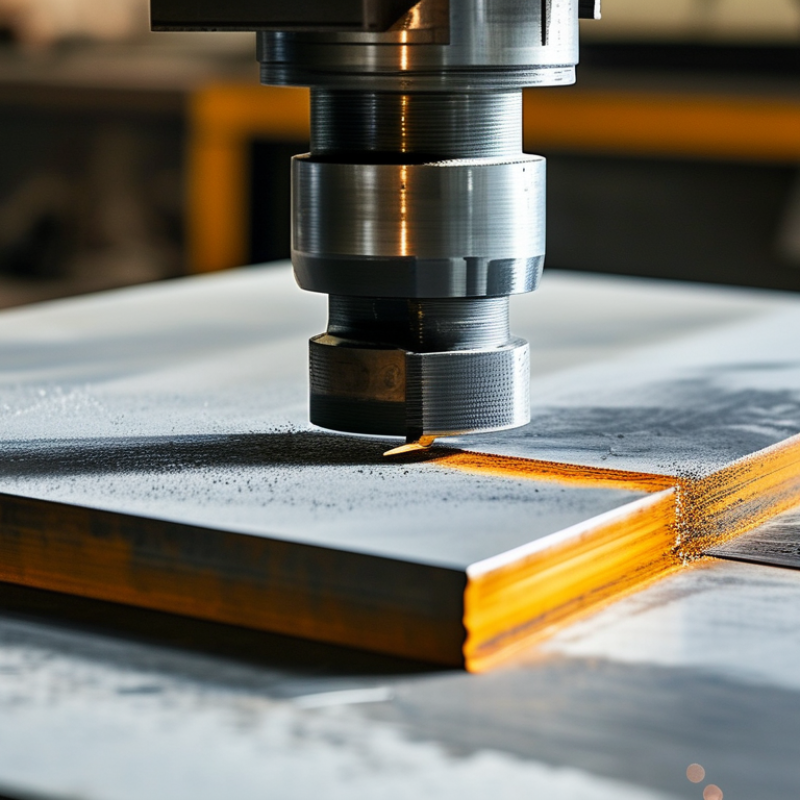
| Machine Component | Upper Blade | Moves against the lower blade to apply the shearing force and separate the sheet. | Usually mounted in a reciprocating, swinging, or guillotine-style cutting system. | Requires correct alignment, secure clamping, and suitable edge clearance. |
| Machine Component | Lower Blade | Provides the fixed or counter-cutting edge that supports the material during cutting. | Often positioned on the cutting table or lower blade holder. | Its edge condition directly affects burr formation and cut quality. |
| Machine Component | Blade Holder | Secures the blade and transfers cutting loads from the machine structure. | Must resist vibration, deflection, and loosening during repeated cycles. | Incorrect mounting can cause uneven wear or blade damage. |
| Machine Component | Blade Edge | The sharpened contact area that initiates penetration and fracture of the sheet. | May be straight, segmented, or specially profiled depending on the machine design. | Sharpness, edge geometry, and surface finish influence cutting force and burrs. |
| Machine Component | Blade Clearance | Controls the gap between the upper and lower blades as they pass each other. | The correct value depends on material type, thickness, and hardness. | Too little clearance may increase force and wear; too much may produce burrs or distortion. |
| Machine Component | Hold-Down Device | Clamps the sheet near the cutting line to reduce movement and vibration. | May use mechanical, hydraulic, or other powered clamping systems. | Proper pressure helps maintain dimensional accuracy and a clean cut. |
| Blade Material | High-Carbon Tool Steel | Provides a practical combination of hardness, toughness, and sharpening capability. | Suitable for general-purpose cutting when impact loads are moderate. | Often selected for mild steel and other routine sheet-metal applications. |
| Blade Material | Alloy Tool Steel | Improves resistance to wear, deformation, and repeated mechanical loading. | Alloying elements may include chromium, molybdenum, vanadium, or tungsten. | Used when longer service life and more stable edge performance are required. |
| Blade Material | Cold-Work Tool Steel | Maintains high hardness and wear resistance during room-temperature cutting. | Can provide a durable edge for demanding production environments. | Appropriate selection depends on material hardness, thickness, and impact risk. |
| Blade Material | High-Speed Steel | Offers high hot hardness and strong resistance to edge wear. | Retains useful hardness at elevated temperatures generated by heavy cutting. | May be chosen for high-wear applications, although cost and toughness must be evaluated. |
| Blade Material | Stainless Tool Steel | Combines cutting performance with improved corrosion resistance. | Useful where moisture, corrosive residues, or frequent cleaning are present. | May require balancing corrosion resistance against toughness and sharpening needs. |
| Operating Principle | Shearing Action | The blades first deform the sheet, then create cracks that meet and separate the material. | The process is primarily a controlled cutting and fracture operation rather than melting. | Cut quality depends on blade condition, clearance, alignment, and material properties. |
| Performance Factor | Blade Hardness | Resists edge deformation and abrasive wear. | Higher hardness can improve wear resistance but may reduce impact toughness if excessive. | Must be matched to the workpiece and machine operating conditions. |
| Performance Factor | Blade Maintenance | Preserves edge sharpness, dimensional accuracy, and safe machine operation. | Includes inspection, cleaning, correct tightening, alignment checks, and timely sharpening or replacement. | Worn or damaged blades can increase burrs, cutting force, noise, and operating risk. |