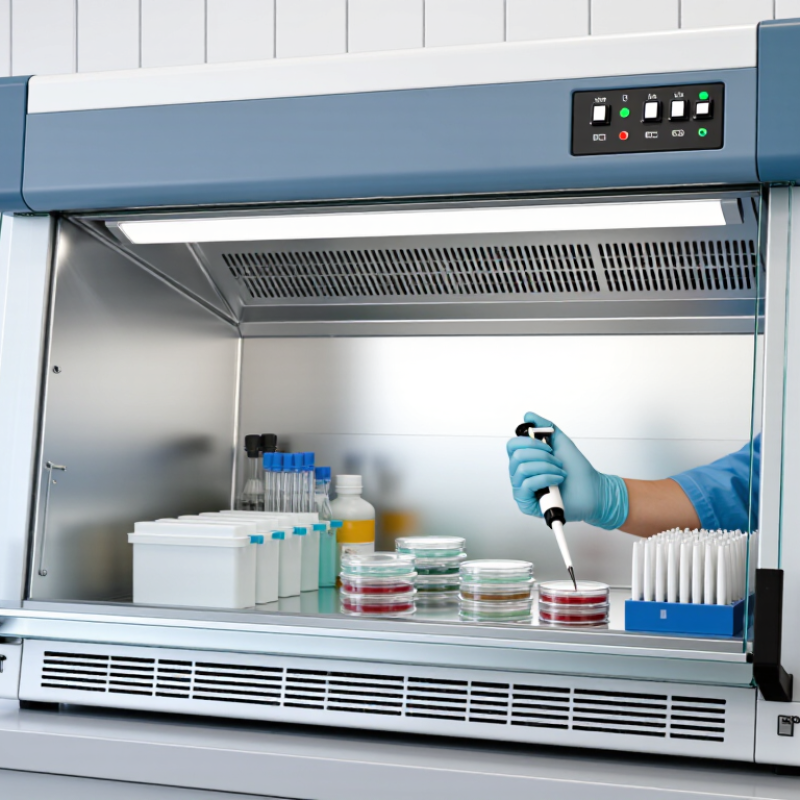
| Airflow and Containment System |
| Front Inlet Grille | Draws room air into the cabinet and helps maintain the protective air barrier across the front opening. | Located at the front edge of the work zone; must remain unobstructed during operation. | Reduces the chance that aerosols generated inside the cabinet escape into the laboratory. |
| Blower or Fan | Moves air through the cabinet, filters, and internal air pathways. | Designed for continuous airflow and controlled pressure loss as filters load with particles. | Stable airflow is essential for both personnel protection and product protection. |
| Supply HEPA Filter | Cleans air directed downward into the work area. | A high-efficiency particulate air filter typically removes at least 99.97% of particles measuring 0.3 micrometres under the applicable test method. | Provides a clean, low-particle work zone and helps protect cultures, samples, and sterile materials. |
| Exhaust HEPA Filter | Filters air before it is recirculated into the room or discharged through an exhaust connection, depending on cabinet design. | The filter rating is generally equivalent to the supply HEPA filter; performance must be verified by certification testing. | Helps prevent biological aerosols from being released into the laboratory or exhaust system. |
| Vertical Downflow Air Stream | Directs filtered air downward across the work surface and toward the front and rear grilles. | The airflow is designed to be uniform and non-turbulent; exact velocity depends on the cabinet class and manufacturer specification. | Supports aseptic handling while carrying airborne contaminants away from the work area. |
| Airflow Plenum | Distributes and collects air between the blower, work zone, and filters. | Usually located above, behind, or beneath the work chamber and designed to maintain balanced airflow. | Improves airflow uniformity and helps prevent dead zones where contaminants could accumulate. |
| Work Area and Physical Protection |
| Work Surface | Provides a cleanable area for manipulating microbiological materials. | Typically made from corrosion-resistant stainless steel or another smooth, non-porous material; often removable for cleaning. | Supports effective disinfection and minimizes areas where microorganisms can remain hidden. |
| Front Sash or Viewing Window | Provides operator access and a transparent barrier between the user and the work zone. | The sash must be positioned at the marked operating height or opening specified for the cabinet. | Correct sash position is necessary to preserve the designed air barrier and containment performance. |
| Side and Rear Walls | Enclose the work chamber and guide airflow through the intended path. | Constructed with smooth, sealed interior surfaces and minimal crevices. | Makes the cabinet easier to decontaminate and limits uncontrolled air movement. |
| Electrical Outlets and Service Ports | Supply power or provide access for approved equipment and services inside the cabinet. | Must be positioned so that cords, tubing, and equipment do not block front or rear grilles. | Improperly placed items can disrupt airflow and create contamination or containment risks. |
| Monitoring, Controls, and Safety Features |
| Airflow Monitor | Measures or indicates whether airflow remains within the acceptable operating range. | May use a pressure sensor, airflow sensor, or electronic display; the alarm set point is cabinet-specific. | Warns users when reduced airflow may compromise containment or clean-air protection. |
| Audible and Visual Alarms | Alert the operator to unsafe sash position, insufficient airflow, filter loading, or other faults. | Alarm functions vary by cabinet design and should be checked during routine certification. | Provides immediate warning so work can be paused and the problem investigated. |
| Control Panel | Controls the blower, lighting, alarms, and other installed functions. | Should display operating status clearly and prevent accidental changes during work. | Allows consistent startup, operation, and shutdown procedures. |
| Fluorescent or LED Task Lighting | Illuminates the work surface without significantly affecting the airflow pattern. | Lighting is integrated into the cabinet canopy and is separate from the primary containment system. | Improves visibility during precise handling, labeling, and inspection of specimens. |
| Ultraviolet Lamp, If Installed | May provide supplementary surface treatment when the cabinet is empty and the lamp is used under controlled procedures. | UV light is not a replacement for chemical disinfection, cleaning, or HEPA filtration; exposure can damage skin and eyes. | Requires strict safety controls and should never be operated while personnel are exposed. |
| How the Cabinet Works |
| Personnel Protection | Uses inward airflow at the front opening and HEPA-filtered exhaust to limit exposure to biological aerosols. | Most commonly associated with Class II biological safety cabinets used for microbiological work. | Protects laboratory personnel when appropriate procedures, cabinet selection, and certification are maintained. |
| Product Protection | Uses HEPA-filtered downflow air to reduce contamination entering open samples or cultures. | Requires correct work practices, suitable materials, and avoidance of rapid movements or blocked grilles. | Helps preserve sample integrity and supports aseptic technique. |
| Environmental Protection | Filters contaminated air before recirculation or exhaust, depending on the cabinet configuration. | Protection level depends on cabinet class, installation, use, and successful certification testing. | Reduces the release of potentially hazardous biological material into the surrounding laboratory. |
| Certification and Maintenance | Verifies airflow, filter integrity, alarms, sash position, and other performance requirements. | Certification is required after installation, relocation, major repair, or filter replacement, and at scheduled intervals required by applicable rules or institutional procedures. | A cabinet should not be assumed to be protective solely because its blower and lights are operating. |