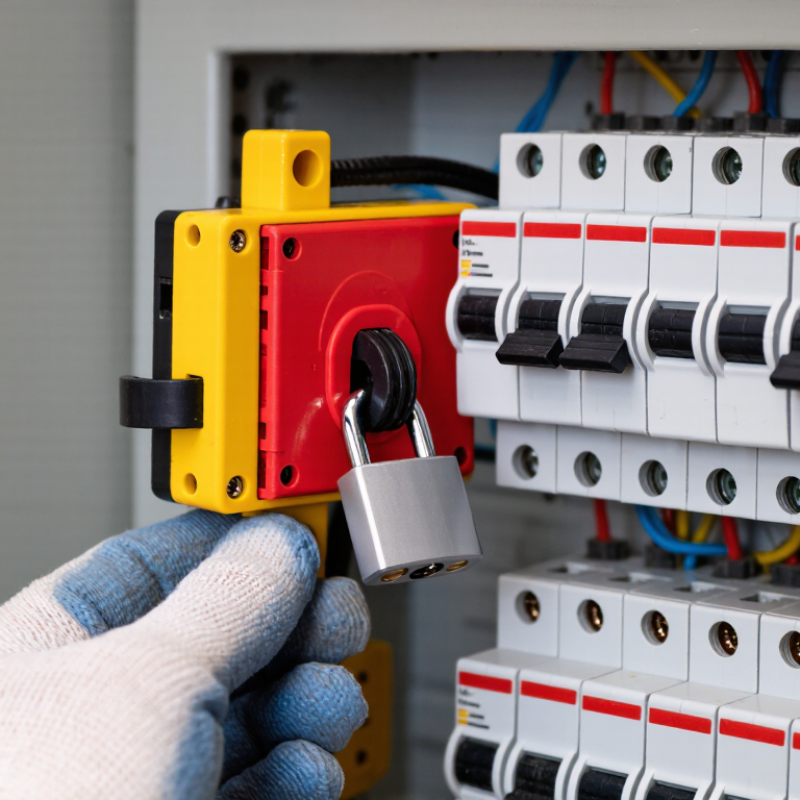
| What it is | A lock-off kit is a lockout device, usually used with a personal safety padlock and tag, to secure a miniature circuit breaker (MCB) in its OFF position. | It helps prevent someone from switching the breaker back on; it does not itself prove that the circuit is electrically safe. |
| How it works | The device is fitted to the breaker or its toggle using a method designed for that breaker style. A padlock secures the device, and a tag can identify who applied it and why. | Fit it only as instructed for the specific device. Confirm it is secure and the breaker cannot be moved to ON without removing the lockout. |
| Before isolation | Identify the correct circuit and the equipment it supplies. Check for drawings, labels, other supply sources, and any equipment-specific isolation requirements. | Labels and circuit schedules can be inaccurate. Do not rely on a label alone to establish which circuit has been isolated. |
| Apply the lockout | Switch the identified breaker OFF, fit the compatible lock-off device, apply a personal lock, and attach a clear tag where the procedure requires one. | A tag is a warning, not a physical restraint. Use a lockout arrangement that prevents unauthorized operation. |
| Verify dead | A competent person should verify the relevant conductors are de-energized at the point of work using a suitable tester and an appropriate safe-isolation procedure. | Prove the tester on a known source or proving unit before and after the test. A breaker in OFF, even when locked, is not a substitute for testing. |
| Compatibility | Lock-off devices are made for different breaker shapes, toggle designs, and panel arrangements. Compatibility depends on the actual breaker and available clearance. | There is no guarantee that one device fits every MCB. Do not force, modify, or use a loose-fitting device; select a suitable alternative isolation method if needed. |
| Electrical scope | The lockout secures the breaker control; the electrical isolation achieved depends on the circuit design and the switching arrangement. | It may not isolate every conductor or eliminate backfeed, alternate supplies, or stored energy. Check the installation and isolate all relevant sources. |
| During work | Keep the lock and tag in place while work is in progress. Follow site procedures for control of keys and communication with affected people. | Do not remove another person’s lock except under a formally controlled procedure. Recheck isolation if conditions change or the work is interrupted. |
| Common limitations | A lock-off kit is a physical control against operating a breaker. It does not detect voltage, confirm circuit identity, or assess the condition of wiring or equipment. | Use it as one part of a safe-isolation process, not as a replacement for risk assessment, competent work, suitable test equipment, or applicable electrical procedures. |
| Return to service | Before restoring supply, check that work is complete, covers and barriers are in place, and people are clear. Each worker should remove their own lock according to the site procedure. | Restore power only when authorized and safe to do so; notify affected people as required. |