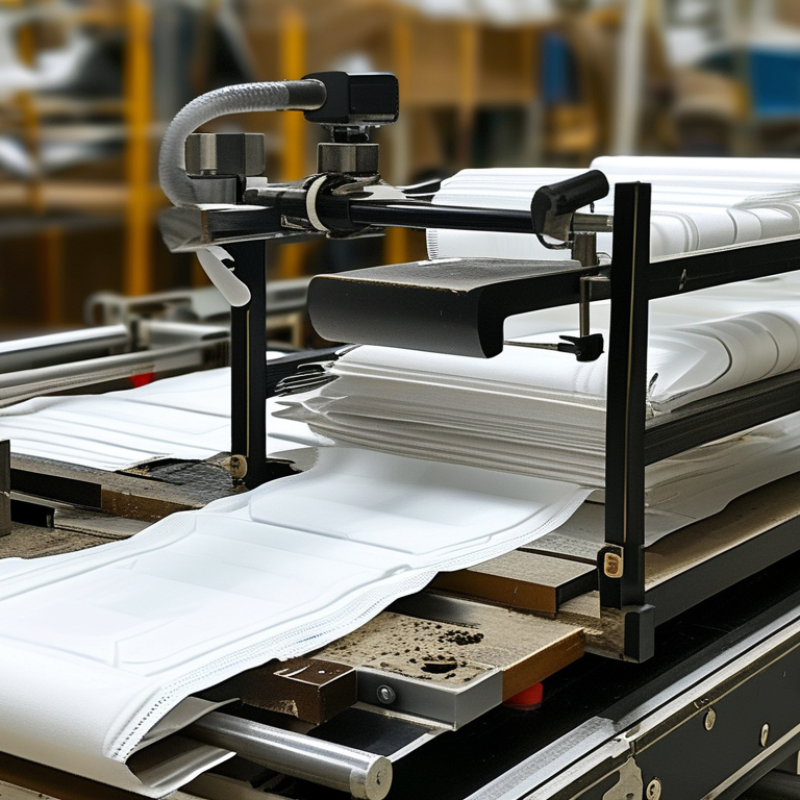
| 1. Material unwinding | Rolls of nonwoven fabric and filter media are released through controlled rollers and guided into the forming section. | Common material width: approximately 160–220 mm per web, depending on mask design. | Stable, aligned layers ready for forming. | Check web alignment, wrinkles, tension, and material damage. |
| 2. Layer alignment | Guide rollers and tension controls keep the outer layers, filter layer, and inner layer positioned correctly. | Usually 3–5 functional material layers for many disposable or filtering face-mask constructions. | Uniform multilayer mask web. | Verify layer sequence, lateral position, and continuous material feed. |
| 3. Nose-wire insertion | A feeder places a flexible metal or plastic nose strip between, or along, designated mask layers before sealing. | Typical strip length: about 80–120 mm, depending on mask size and design. | A mask body with an adjustable nose area. | Check position, continuity, and secure enclosure of the strip. |
| 4. Pleat or panel forming | Folding plates, rollers, or forming guides create pleats in flat masks or the main panels in cup-shaped and three-dimensional folding masks. | Flat disposable masks commonly use 2–3 horizontal pleats; panel masks use pre-defined fold lines. | Consistent mask geometry and expanded coverage area. | Measure fold position, depth, symmetry, and surface appearance. |
| 5. Ultrasonic edge sealing | Ultrasonic vibration generates localized heat and bonds thermoplastic nonwoven layers without liquid adhesive. | Common operating frequency: approximately 20–35 kHz; actual pressure and energy depend on material construction. | Sealed side edges and stable material layers. | Check seal width, continuity, strength, and absence of burn-through. |
| 6. Ear-loop or headband attachment | Elastic loops or headbands are positioned and bonded to the finished mask body using ultrasonic welding or another compatible joining method. | Elastic length is commonly about 150–180 mm for adult ear loops, but varies by product design. | Wearable mask with attached restraint system. | Test attachment strength, position, symmetry, and elastic continuity. |
| 7. Cutting and separation | Rotary knives, die cutters, or servo-driven cutters separate individual masks from the continuous web. | Typical output range: approximately 40–120 masks per minute, depending on configuration and mask type. | Individual finished mask units. | Check dimensions, cut edges, burrs, deformation, and missing components. |
| 8. Folding and stacking | A folding guide closes the mask along its designed centerline or panels, after which a conveyor or stacker organizes the products. | Fold accuracy is normally controlled by mechanical guides, sensors, and adjustable conveyor speed. | Compact, aligned masks ready for inspection or packing. | Check fold location, flatness, orientation, and stack count. |
| 9. Automatic inspection | Photoelectric sensors or vision systems detect missing ear loops, incorrect positioning, material breaks, and abnormal dimensions. | Inspection coverage depends on the installed sensors and software configuration. | Rejected defective units and a more consistent product flow. | Confirm sensor response, reject timing, and traceable inspection results. |
| 10. Packing preparation | Accepted masks are counted and transferred to manual or automated packaging equipment. | Pack quantity is set by the packaging specification; common retail quantities include 10, 20, or 50 units. | Counted products ready for packaging and labeling. | Verify quantity, packaging integrity, lot identification, and product orientation. |