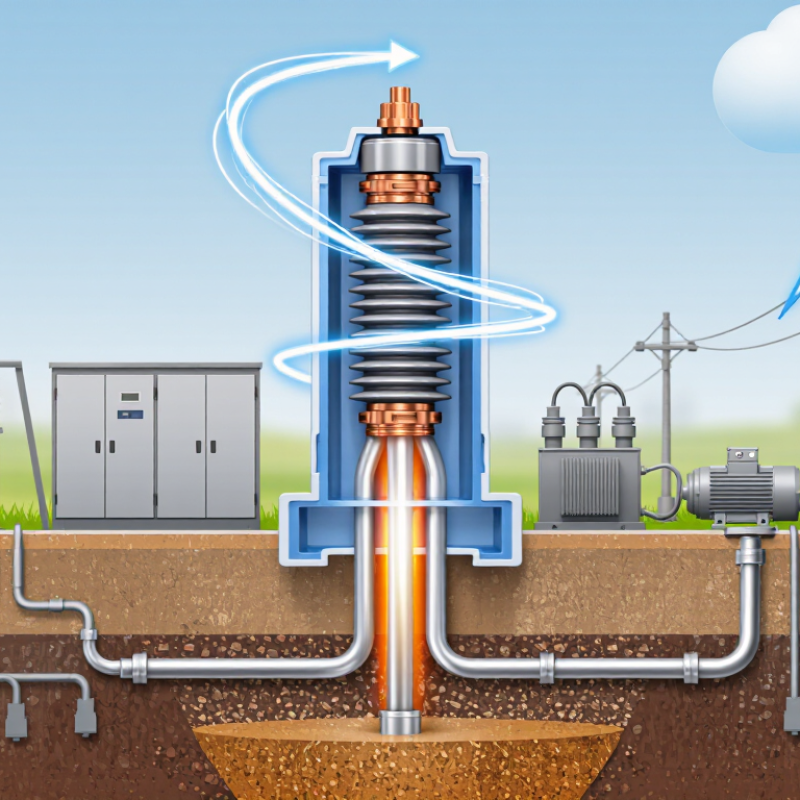
A lightning arrester protects electrical equipment from sudden overvoltage caused by lightning or switching events. It does not stop lightning. Instead, it redirects excess energy safely toward ground. Under normal voltage, the arrester acts almost like an open circuit. During a surge, its resistance drops sharply, limiting the voltage across transformers, cables, and switchgear.
The main type used in modern power systems is the metal-oxide arrester. It contains zinc-oxide varistor blocks, which respond quickly without needing a series gap. Older designs may use rod gaps or expulsion chambers. These types can still appear in simpler distribution systems, although their performance depends more heavily on spacing, weather, and maintenance. Station-class arresters usually provide stronger energy handling for substations and large transformers.
A complete arrester includes an insulating housing, metal terminals, sealing parts, varistor blocks, and often a pressure-relief device. The housing must resist moisture, ultraviolet exposure, and mechanical stress. The grounding connection matters just as much. A long or damaged ground conductor can reduce protection during a fast surge. Field inspections often reveal loose terminals, cracked housings, or water ingress. Small defects matter.
Selection requires more than checking the system voltage. Engineers consider continuous operating voltage, temporary overvoltage, discharge current, energy capability, and installation location. Relevant technical standards, such as IEC 60099-4 and IEEE C62.11, provide testing guidance. Still, no arrester lasts forever. Age, repeated surges, contamination, and heat gradually change its behavior. One practical mistake is assuming a correctly sized arrester needs no later inspection.