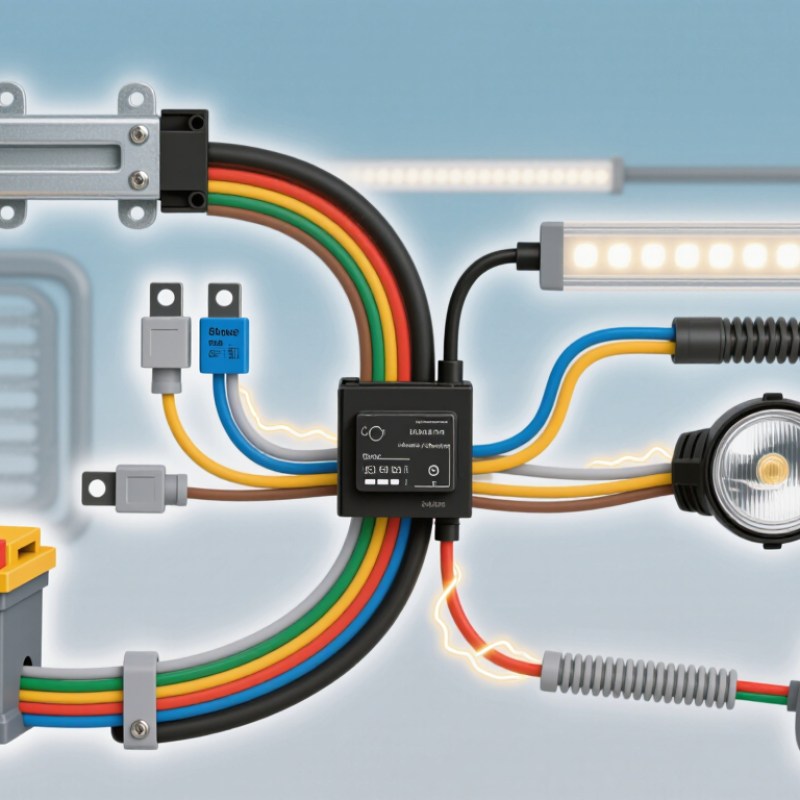
| Definition | An LED harness is an organized set of wires, connectors, terminals, fuses, relays, switches, and sometimes control modules used to supply power and control signals to LED lighting. | It provides a structured connection between the vehicle power source, control switch, and one or more LED lamps. |
| Primary Function | The harness delivers electrical power from the battery or auxiliary power distribution point to the LED lighting system while providing circuit protection and switching control. | Commonly used when the original vehicle wiring is not designed for additional auxiliary lights or when a separate controlled circuit is preferred. |
| How It Works | When the switch is activated, a low-current control signal energizes the relay. The relay then connects the fused battery supply to the LED lamps through the output wiring. | This arrangement allows a relatively small dashboard or accessory switch to control a higher-current lighting circuit. |
| Main Electrical Path | Battery positive terminal → fuse → relay → LED lamp positive terminal; the lamp negative terminal returns to the chassis ground or battery negative terminal. | All power connections should be secure, correctly polarized, and protected from abrasion, moisture, and excessive heat. |
| Voltage Compatibility | Most automotive LED harnesses are designed for low-voltage direct-current systems, commonly nominal 12-volt or 24-volt vehicle systems. | The harness, fuse, relay, connectors, and LED lamps must be matched to the vehicle’s actual system voltage and the lamp manufacturer’s requirements. |
| Typical Harness Components | Power cables, ground cables, inline fuse holder, fuse, relay, rocker or push-button switch, crimp terminals, sealed connectors, wire loom, and mounting hardware. | More advanced systems may include dimmers, flash controllers, CAN-bus interfaces, or dedicated lighting control modules. |
| Role of the Fuse | The fuse interrupts the circuit when current exceeds a safe level, helping protect the wiring from overheating and reducing the risk of electrical damage. | The fuse should be installed close to the battery or power source and sized according to the circuit’s normal operating current and wire capacity. |
| Role of the Relay | A relay uses a low-current control circuit to switch a higher-current load circuit. | Relays are useful for auxiliary light bars, driving lights, work lamps, scene lights, and other LED systems that draw more current than a small switch should carry directly. |
| Vehicle Electrical Systems | LED harnesses can be used with conventional alternator-based electrical systems and vehicles equipped with electronically managed body-control systems. | Vehicles with sensitive electronic controls may require a compatible interface, load management device, or installation method that avoids warning signals and communication errors. |
| Passenger Cars and SUVs | These vehicles commonly use LED harnesses for auxiliary driving lights, fog lamps, grille lights, reverse lights, and off-road lighting. | Installation should account for limited engine-bay space, existing safety systems, and the intended use of the lighting. |
| Pickup Trucks and Utility Vehicles | Harnesses are frequently used for bed lights, work lights, trailer-related lighting, grille-mounted lamps, and auxiliary forward lighting. | Additional protection may be needed where wiring passes near suspension components, cargo areas, or exposed underbody sections. |
| Off-Road and Recreational Vehicles | Off-road vehicles commonly use harnesses for light bars, rock lights, scene lights, rear work lights, and dust or fog lighting. | Water-resistant connectors, abrasion-resistant sleeving, and secure cable routing are important because of vibration, mud, water, and debris. |
| Motorcycles and Powersports Vehicles | Compact LED harnesses can support auxiliary fog lamps, daytime visibility lights, accent lights, and small work lights. | Because charging capacity is limited on some motorcycles and powersports vehicles, the total LED load should be checked before installation. |
| Commercial Trucks and Buses | Commercial vehicles may use harnesses for marker lights, work lamps, warning lights, rear-area illumination, and auxiliary road lighting. | Many heavy vehicles use 24-volt systems, so all harness components must be rated for the vehicle voltage and operating environment. |
| Agricultural and Construction Equipment | Tractors, loaders, excavators, and other equipment use LED harnesses for work lights, perimeter lighting, cab lights, and maintenance-area illumination. | Harnesses should be routed away from hydraulic lines, hot exhaust components, moving linkages, and areas exposed to heavy vibration. |
| Marine and Outdoor Equipment | Low-voltage LED harnesses may be used for deck lights, navigation-related auxiliary illumination, storage-area lighting, and equipment lighting. | Marine installations require corrosion-resistant materials, sealed connections, suitable grounding practices, and protection from continuous moisture. |
| Lighting Systems Using LED Harnesses | Common systems include driving lights, fog lights, light bars, work lights, reverse lights, marker lights, scene lights, warning lights, and interior or cargo lights. | The harness design depends on whether the lamps operate continuously, momentarily, independently, or as part of a synchronized flashing pattern. |
| Single-Light Configuration | A single LED lamp normally uses one fused power path, one ground path, and one control switch or relay circuit. | This configuration is relatively simple and is suitable for small auxiliary lamps or a single work light. |
| Multiple-Light Configuration | Several LED lamps may be connected in parallel so each lamp receives the intended system voltage. | The total current draw must be calculated so the fuse, relay, wire gauge, connectors, and switching device can safely handle the combined load. |
| Current Calculation | For a direct-current lighting circuit, approximate current can be calculated using the formula: Current (A) = Power (W) ÷ Voltage (V). | For example, a 120-watt lighting load on a nominal 12-volt system requires approximately 10 amperes before accounting for system variation and design margin. |
| Wire Selection | Wire size should be selected according to current demand, circuit length, allowable voltage drop, insulation temperature rating, and installation conditions. | Longer circuits generally require larger conductors to limit voltage drop and maintain consistent LED brightness. |
| Grounding Method | LED lamps may be grounded to a clean, corrosion-free chassis point or returned directly to the battery negative terminal. | A poor ground can cause flickering, dim output, intermittent operation, or unwanted electrical noise. |
| Connector and Environmental Protection | Connectors should be appropriate for the expected exposure to water, dust, chemicals, vibration, and temperature changes. | Sealed connectors, heat-shrink protection, flexible conduit, and cable ties help improve long-term reliability in outdoor installations. |
| Integration With Factory Lighting | An LED harness can operate independently or connect to an existing lighting control signal, depending on the vehicle and intended function. | Factory circuits should not be overloaded. A separate fused relay circuit is often preferred for higher-power auxiliary lighting. |
| Installation Safety | Disconnect the battery before making electrical connections, protect all positive conductors, and keep wiring clear of heat sources and moving parts. | After installation, inspect the harness for secure fastening, correct polarity, proper fuse placement, and adequate clearance. |
| Common Failure Symptoms | Typical symptoms include no light output, intermittent operation, flickering, a blown fuse, warm connectors, dim illumination, or relay clicking without lamp activation. | Possible causes include loose terminals, undersized wiring, poor grounding, water intrusion, incorrect fuse sizing, damaged insulation, or excessive circuit load. |
| Key Advantages | A properly designed LED harness improves circuit organization, protects wiring, simplifies troubleshooting, supports reliable switching, and enables flexible auxiliary lighting installation. | It is especially useful when adding lighting to vehicles or equipment that require separate control and protection from the original lighting circuit. |