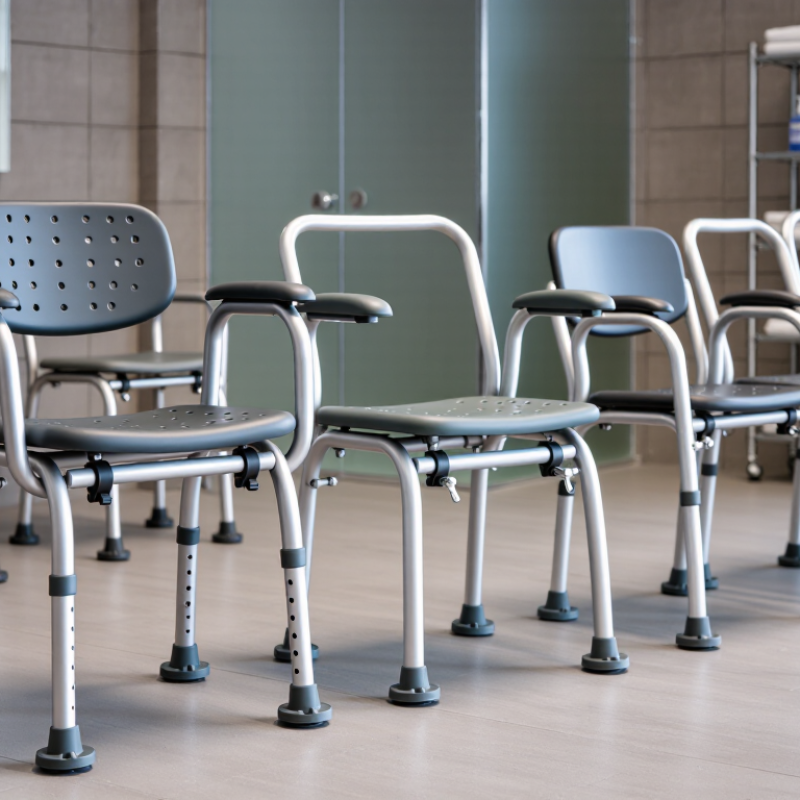
| Frame Material | Aluminium alloy designation, tubing diameter, wall thickness, surface treatment and corrosion-resistant hardware. | Common product specifications use lightweight aluminium tubing with stainless-steel or corrosion-resistant fasteners. The exact alloy and wall thickness should be confirmed through technical drawings or material certificates. | Material selection affects chair weight, structural strength, corrosion resistance and service life in humid bathroom environments. |
| Maximum User Weight | Rated safe working load, proof-load method, test sample size and whether the rating includes accessories. | Commercial bath chairs are commonly specified in load classes such as 100 kg, 120 kg, 150 kg or 180 kg. The load rating must be supported by a documented test method rather than a marketing statement. | A clear load rating helps buyers select suitable products and reduces safety, liability and regulatory risks. |
| Seat Height Adjustment | Minimum and maximum seat height, adjustment increments, locking-pin design and adjustment-hole spacing. | Many adjustable bath chairs provide a multi-position height range of approximately 400–550 mm, although the actual range varies by design. Buyers should compare usable adjustment positions, not only the maximum height. | Correct seat height improves transfer safety, comfort and compatibility with different bathroom layouts. |
| Seat Dimensions | Seat width, seat depth, usable sitting area, drainage-hole layout and edge profile. | Typical compact bath-chair seats are approximately 400–500 mm wide and 350–450 mm deep. These dimensions should be checked against the target user group and available shower space. | Seat dimensions influence stability, comfort, accessibility and the ability to fit inside standard shower areas. |
| Product Weight | Net weight, packed weight, carton dimensions and weight with or without armrests or backrests. | Lightweight aluminium bath chairs often weigh approximately 2.5–6.0 kg, depending on the frame, seat structure and accessories. | Lower net weight can reduce freight cost and make the product easier for users or caregivers to handle. |
| Slip Resistance | Foot-cap material, anti-slip pattern, wet-surface performance and stability test results. | Rubber or elastomer foot caps should remain stable on wet, smooth bathroom floors. The supplier should provide test conditions, floor type, slope and applied load when claiming slip resistance. | Foot stability is a primary safety factor because bath chairs are used in wet areas where slipping hazards are increased. |
| Structural Stability | Static-load test, lateral-stability test, front-to-back stability, weld inspection and fastener torque control. | Request a written test report identifying the applied load, loading position, test duration, deformation limits and pass/fail criteria. EN 12182 can be used as a relevant reference for general requirements and test methods for assistive products. | Independent or documented testing provides stronger evidence than a general statement that the chair is “heavy duty.” |
| Corrosion Protection | Aluminium surface finish, coating or anodizing specification, stainless-steel grade and corrosion-test records. | Corrosion performance should be evaluated according to the intended environment and the buyer’s specification. If salt-spray testing is used, the report should state the test standard, exposure duration and acceptance criteria. | Bathrooms expose the product to water, cleaning chemicals and humidity, which can accelerate corrosion at joints and fasteners. |
| Quality Management | Quality-management certificate, certificate scope, factory address, audit date and control plan. | ISO 9001 certification is a widely recognized quality-management reference. The certificate should be current and should cover the manufacturing activities relevant to the product. | A valid quality system supports consistent incoming inspection, production control, traceability and corrective action. |
| Regulatory Documentation | Declaration of conformity, risk assessment, technical file summary, labeling and destination-market classification. | Regulatory requirements depend on intended use, claims and destination market. Where the product is marketed as a medical device in the European Union, applicable requirements under Regulation (EU) 2017/745 should be confirmed before placing it on the market. | Correct classification and documentation reduce customs delays, marketplace rejection and compliance exposure. |
| Biocompatibility and User Contact | Material information for the seat, backrest, armrests, rubber caps and other skin-contact components. | For products with prolonged or clinically relevant skin contact, buyers may request an assessment based on the ISO 10993 series. Applicability depends on contact type, duration and intended use. | Material safety is important for elderly users, users with sensitive skin and healthcare procurement programs. |
| Production Capacity | Monthly output, number of assembly lines, production lead time, peak-season capacity and subcontracted processes. | Capacity figures should be supported by recent production records or an auditable capacity plan. Compare normal lead time with peak-season lead time instead of relying on a single estimate. | Reliable capacity planning helps global buyers maintain inventory and avoid delays in seasonal or contract-based programs. |
| Minimum Order Quantity | MOQ for standard products, MOQ for color changes, MOQ for custom tooling and sample-order policy. | MOQ is commercially negotiated and varies by frame finish, packaging, customization and production process. It should be stated separately for samples, trial orders and regular production. | A transparent MOQ structure helps importers manage cash flow and test market demand before placing large orders. |
| Customization Capability | Available options for seat size, frame finish, accessories, labels, packaging, tooling and private specifications. | Ask for engineering drawings, revision control, prototype approval procedures and a defined process for engineering-change notifications. | Controlled customization allows buyers to meet local accessibility requirements without creating uncontrolled product variations. |
| Packaging and Shipping | Carton dimensions, units per carton, gross weight, drop-test method, pallet configuration and shipping marks. | Packaging should protect the frame, plastic components and foot caps from scratching or deformation. Final shipping data should be based on an approved production sample. | Accurate packaging data supports freight calculations, warehouse planning and lower damage rates during international transport. |
| Warranty and After-Sales Support | Warranty duration, covered components, exclusions, spare-parts availability, response time and claim procedure. | Compare written warranty terms rather than verbal promises. Spare parts commonly include foot caps, adjustment pins, screws, seat components and armrest fittings. | Accessible replacement parts can extend product life and reduce total ownership cost for distributors and care facilities. |
| Traceability | Batch number, production date, inspection record, raw-material traceability and complaint-handling system. | At minimum, the supplier should be able to link a finished product or carton label to a production batch and final inspection record. | Traceability supports targeted recalls, warranty investigation and compliance audits. |
| Independent Verification | Third-party factory audit, product inspection, test-laboratory report and sample-to-bulk production comparison. | Use an inspection scope covering dimensions, load-bearing parts, surface finish, hardware, accessories, packaging and labeling. The inspection criteria should be agreed before production. | Independent verification reduces the risk of receiving products that differ from approved samples or technical specifications. |