What Is a Large Pivot Door and How Does It Work?
A Large Pivot Door can transform an entrance into a defining feature. Its broad panel turns on pivot hardware rather than conventional side hinges. The result is a clean, dramatic opening. But the door’s appearance is only part of the story. Its weight, dimensions, and surrounding structure all affect how it performs.
A pivot system typically uses a floor-mounted pivot and a matching point near the top of the door. These components carry and guide the panel as it swings. Unlike a standard hinged door, the pivot may sit some distance from the door’s edge. This creates a balanced movement and a distinctive reveal on both sides. Smooth operation depends on accurate alignment, suitable hardware, and a frame or wall capable of supporting the load. Small installation errors can cause rubbing, uneven gaps, or a door that feels harder to move than expected.
Materials and site conditions matter, too. A solid timber panel, a metal-framed glass door, and a composite design place different demands on the pivot set. Thresholds, weather seals, floor finishes, and clear opening space should be considered before choosing a model. A large door can feel effortless when properly specified. It can also disappoint. That is worth remembering, especially when appearance dominates the early design conversation. The sections ahead explain how pivot doors work, what affects their performance, and which details deserve careful attention before installation.
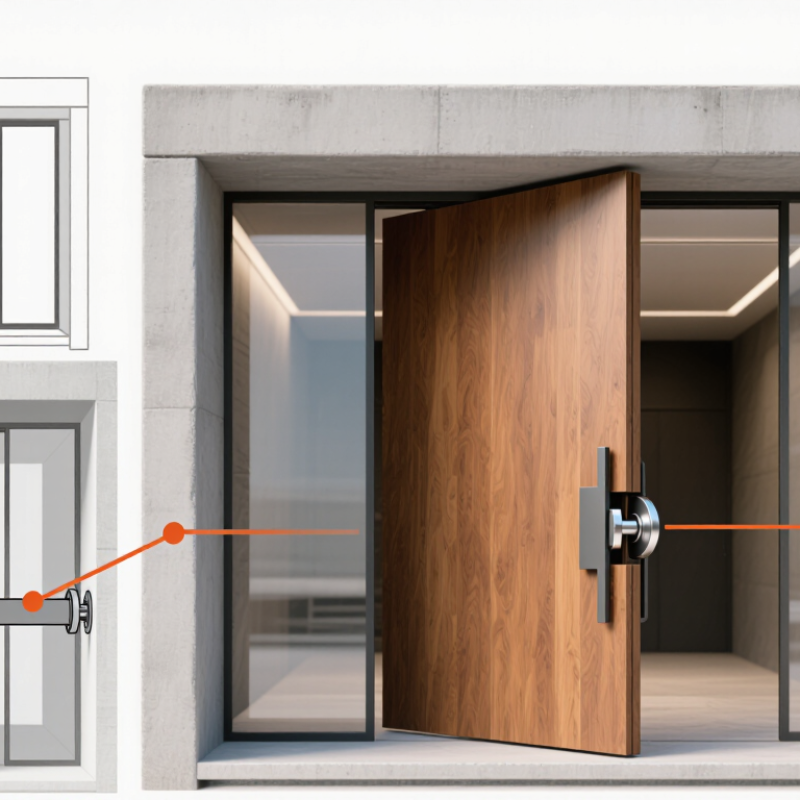
Defining a Large Pivot Door by Its Size, Weight, and Opening Type
A large pivot door is defined less by a universal measurement than by its proportions, mass, and hardware. No fixed cutoff exists. A door around 2.4 metres tall may feel oversized in a modest hallway, while a wider entrance can make the same panel seem ordinary. The term is a little slippery. In practice, designers assess the opening, the panel’s dimensions, and how much clear floor space it needs.
Weight matters because a pivot system carries the panel at points near its top and bottom, rather than along a full side edge. A solid timber slab, for example, can become heavy quickly as its width and thickness increase. Glass and metal panels bring different weight and support needs. The pivot set must be rated for the actual door, with the surrounding floor and header able to support the loads. Guessing is risky.
Opening type shapes daily use. A pivot door may swing inward, outward, or, with suitable hardware, in both directions. Its rotation can feel smooth and dramatic, but the moving edge needs room to clear walls, furniture, and nearby people. Measure the swing in the real space, not only on a plan. Small details matter. The pivot position also affects the usable opening: an offset axis can leave part of the panel projecting into the room.
What Is a Large Pivot Door and How Does It Work?
Defining a Large Pivot Door by Its Size, Weight, and Opening Type
There is no universal size threshold for a “large” pivot door. The examples show increasingly oversized panels and their estimated weights, calculated for a 50 mm thick solid-wood panel at an assumed density of 600 kg/m³. Actual weight varies with the wood species, construction, glazing, and hardware. A pivot door rotates on top and bottom pivot hardware, usually set in from the frame edge, rather than on conventional side hinges.
Key Components: Door Leaf, Pivot Hardware, Frame, and Seals
What Is a Large Pivot Door and How Does It Work?
A large pivot door rotates on pivot hardware near its top and bottom, rather than hanging from side hinges. This shifts the door’s balance and lets a broad, heavy leaf swing with less visible hardware. The pivot position affects the opening arc, clearance, and how the door feels in use.
The door leaf is the moving panel. Its core, facing materials, and internal reinforcement influence weight and stiffness. Pivot hardware carries that load and guides rotation; it must be selected for the leaf’s dimensions and weight. A small mismatch can cause rubbing or uneven movement. The frame keeps the opening square and gives the pivots stable fixing points. Check floor levels carefully, since even a slight change can affect alignment.
Seals sit around the frame or along the leaf’s edges to limit drafts, dust, and noise. They work best when the gaps are even, but they should not press so tightly that the door becomes difficult to move. A soft seal can compress over time. That detail is easy to overlook. In practice, installation tolerances matter as much as the door’s appearance, and adjustments may be needed after the building settles.
How the Offset Pivot Axis Lets the Door Rotate
A large pivot door turns around a vertical axis set inward from its edge, rather than swinging on hinges fixed to the jamb. The offset creates a short section that moves outward and a longer section that sweeps across the room. At the floor, a pivot bearing carries much of the leaf’s weight; a top pivot keeps the panel aligned. The exact load capacity depends on the door’s weight, width, and hardware specification.
That geometry can make a broad, heavy door feel surprisingly controlled. It also changes the clearance needed: the door’s long edge traces a wide arc, so furniture and nearby walls need careful checking. This is where drawings can mislead. A small change in pivot position can affect the usable opening and the sweep path. The U.S. Department of Energy reports that windows account for about 25–30% of residential heating and cooling energy use; this is not a pivot-door figure, but it underlines why exterior-door seals and installation deserve attention.
Tips: Mark the full swing arc on the floor before ordering. Check floor level, head clearance, and the finished wall thickness. Ask the installer how the pivot will be anchored, especially with stone or tile flooring. A beautiful rotation is not enough. The seal still matters.
Hardware Capacity: Some Pivot Systems Support Door Leaves up to 500 kg
A large pivot door turns on a vertical axis instead of hanging from side hinges. A pivot near the floor carries much of the leaf’s weight, while a top pivot keeps it aligned. Some engineered systems support door leaves up to 500 kg. That rating applies to a specified hardware setup, not every door or opening. Leaf dimensions, pivot position, floor construction, and the door’s center of gravity all affect performance. At this scale, small alignment errors matter.
Tips: Check the complete door assembly, not just the pivot’s maximum load. Confirm the floor and overhead structure can take the forces, and ask for installation tolerances and maintenance requirements. A heavy door can feel smooth at first, then bind as alignment shifts.
The European standard EN 1154:1996+A1:2002 sets durability requirements for controlled door closers, including a top grade tested to 500,000 cycles. This is not a pivot-load rating, but it shows why cycle testing matters alongside a static weight limit. A 500 kg figure sounds definitive; in practice, the supporting structure and correct installation can be just as decisive.
Installation Factors: Floor Clearance, Alignment, and Load-Bearing Support
A large pivot door turns on a vertical pivot rather than conventional side hinges. Its weight is carried at the floor and head, so installation details matter from the start. Measure the finished floor, not just the subfloor. Even a small change in flooring thickness can reduce the gap beneath the door. Allow enough clearance for rugs, seasonal movement, and a clean sweep; too much space can look awkward and admit drafts.
Alignment needs careful checking. The pivot points must sit on the same vertical line, and the frame should be square and plumb. A laser level helps reveal small errors before the door is hung. With a tall, heavy panel, a few millimeters of misalignment may cause rubbing, uneven gaps, or a door that drifts open. Test the swing slowly. Then test it again. Site conditions can be less tidy than drawings suggest.
Load-bearing support is just as important. The floor beneath the lower pivot must resist concentrated weight, while the head connection needs secure backing rather than only a thin finish layer. Confirm the door’s weight and pivot specifications with the installer or structural professional before cutting or fastening. Check nearby heating lines and floor systems, too. A detail sometimes missed. If the support is uncertain, pause and investigate; adjusting hardware cannot make a weak substrate reliable.
