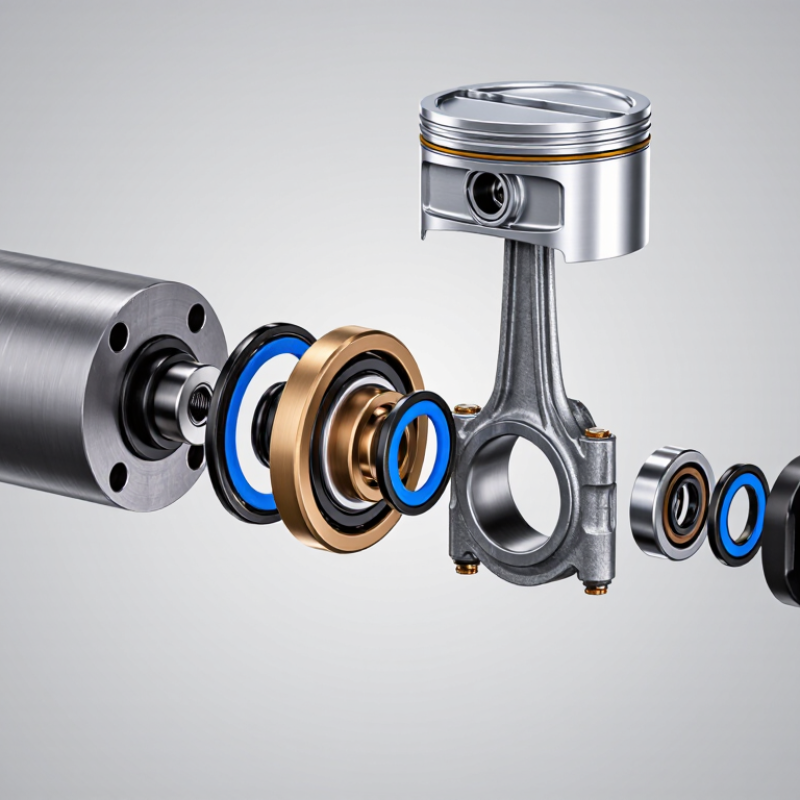
| Cylinder Barrel | Contains the pressurized fluid and provides the bore in which the piston travels. | Typically honed steel tubing; the bore surface is finished to support sealing and smooth piston movement. | Confirm bore diameter, stroke, pressure rating, straightness, and internal surface finish. |
| Piston | Separates the two working chambers and transfers hydraulic force to the piston rod. | Commonly steel or ductile iron, with grooves for piston seals and wear rings. | Check bore compatibility, seal-groove dimensions, fit, and attachment method to the rod. |
| Piston Rod | Transmits force from the piston to the connected machine or load. | Often high-strength steel with a ground, polished, and corrosion-resistant surface treatment. | Verify rod diameter, stroke, end-thread or mounting details, surface finish, and corrosion protection. |
| Rod Gland (Cylinder Head) | Closes the rod end of the barrel, guides the rod, and houses rod-side seals and bearings. | Usually steel or iron; may be threaded, bolted, or retained by another cylinder-specific design. | Check rod clearance, seal arrangement, mounting style, and serviceability. |
| End Cap (Base) | Closes the barrel at the base end and supports the cylinder’s base-side mounting arrangement. | Commonly steel or ductile iron; may be welded, bolted, or mechanically retained. | Confirm mounting dimensions, port location, connection method, and pressure suitability. |
| Piston Seal | Limits fluid bypass between the piston’s two pressure chambers. | May use polyurethane, nitrile rubber, or PTFE-based materials, depending on fluid, pressure, and temperature. | Match the seal profile and size to the piston groove, fluid, operating temperature, and pressure. |
| Rod Seal | Controls leakage where the piston rod exits the cylinder and helps retain hydraulic fluid. | Typically an elastomeric or polymer seal selected for the cylinder’s operating conditions. | Check rod size, gland groove dimensions, fluid compatibility, pressure, and expected motion speed. |
| Wiper (Rod Scraper) | Removes dust, moisture, and debris from the rod as it retracts, helping protect internal seals. | Often made from polyurethane or another wear-resistant polymer; some designs include a metal case. | Consider exposure to dirt, water, temperature, and the rod’s size and surface condition. |
| Wear Rings (Guide Rings) | Guide the piston and/or rod, control side loading, and help prevent metal-to-metal contact. | Typically low-friction polymer or fabric-reinforced material, selected for load and wear requirements. | Check ring location, dimensions, clearance, load conditions, and compatibility with the seal system. |
| Hydraulic Ports | Provide fluid passages into and out of the cylinder chambers to extend or retract the rod. | Machined into the barrel, head, or end cap; thread and port standards vary by application and region. | Verify port thread standard, size, location, flow requirements, and connection compatibility. |