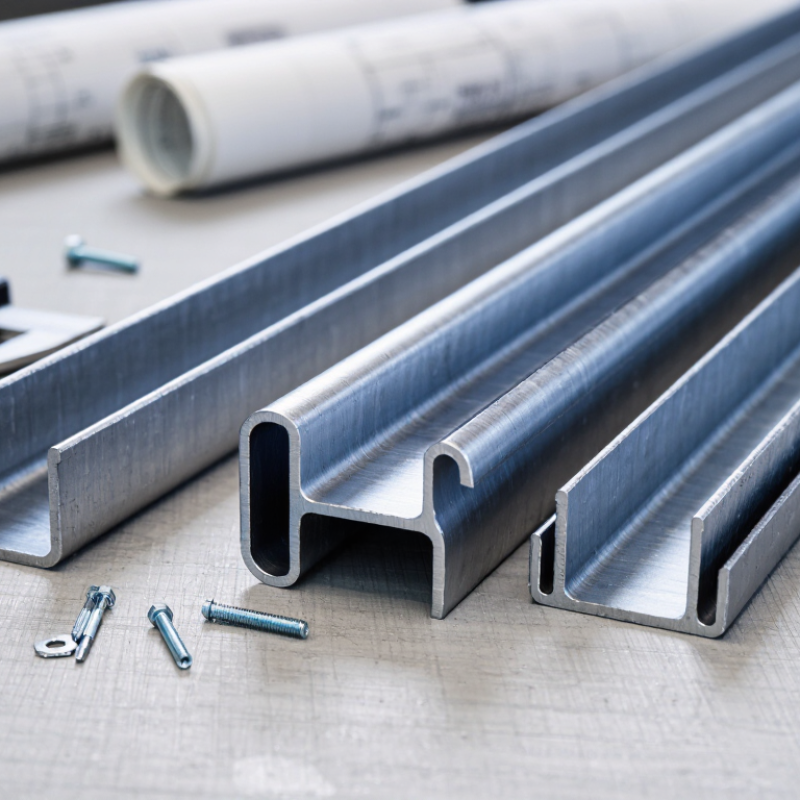
| High load capacity and controlled deflection | Building frames, supports, lintels, or equipment bases | Hot-rolled structural steel channel, such as a C-channel or American Standard channel | Calculate loads, span, bending, shear, deflection, lateral stability, connections, and applicable building-code requirements. Confirm section dimensions and steel grade. | Structural channels are available in different depths, flange widths, and weights. A qualified engineer should size the member for the actual loads and support conditions. |
| Light-duty, adjustable support | Pipe, conduit, cable tray, and mechanical or electrical service supports | Slotted strut channel or back-to-back strut channel | Check the manufacturer-independent load tables for the exact channel profile, support spacing, cantilever length, fittings, and fasteners. Consider concentrated loads and vibration. | Strut systems are convenient for modular installations, but should not be assumed to replace a structural channel in a building frame without engineering verification. |
| Outdoor exposure and periodic moisture | External equipment supports, frames, and service racks | Hot-dip galvanized carbon-steel channel or a channel with a specified corrosion-protection system | Assess exposure, drainage, cut edges, drilled holes, coating damage, and compatibility with connected metals. Specify the required coating standard and thickness for the environment. | Galvanizing can improve corrosion resistance, but the appropriate coating depends on exposure severity, maintenance plans, and project specifications. |
| Humid, washdown, or chemically aggressive conditions | Food-processing areas, water-treatment facilities, and corrosive service environments | Stainless-steel channel or another corrosion-resistant material selected for the specific environment | Identify chemicals, concentration, temperature, cleaning agents, chloride exposure, and crevice conditions. Verify grade suitability and galvanic compatibility. | “Stainless steel” is not a single corrosion-performance category. Select the grade based on the actual service environment and applicable project requirements. |
| Known structural steel strength requirements | Load-bearing components where the project specifies a minimum yield strength | Structural channel supplied to the required material specification and grade | Verify the mill certificate, grade, applicable standard, section properties, thickness, and fabrication requirements. ASTM A36 and ASTM A572 Grade 50 are examples of structural steel specifications. | ASTM A36 commonly has a 36 ksi (about 250 MPa) minimum yield strength for relevant product forms; ASTM A572 Grade 50 specifies 50 ksi (about 345 MPa). Confirm product-form and specification applicability. |
| Limited clearance or a specific connection layout | Retrofits, machinery frames, brackets, and compact supports | Channel chosen to match the available depth, flange width, and connection orientation | Measure the installation envelope. Check bolt access, hole locations, edge distances, weld access, and whether the open section may twist under eccentric loading. | Channel sections are open sections and can be sensitive to torsion when loads are applied away from the shear centre. Include this effect in structural checks where relevant. |
| Frequent cutting, drilling, or field modification | Site-fabricated supports and assemblies with multiple connection points | Channel with a documented material grade and a finish suited to the fabrication sequence | Confirm weldability, cutting and drilling procedures, fastener compatibility, tolerances, and how protective coatings will be restored after fabrication. | Unprotected cut or drilled areas may corrode sooner in exposed service. Follow the project specification for repair of damaged coatings. |
| Project requirements not yet fully defined | Early design, budgeting, or comparison of potential channel options | Shortlist structural channel and strut channel options separately | Establish loads, span, support conditions, environment, design life, installation method, available space, applicable codes, and cost constraints before final selection. | Use this stage to identify candidate profiles only. Final sizing and material selection should be checked against approved calculations, standards, and project specifications. |
| Selection note: Channel dimensions, section properties, load capacity, and coating requirements vary by profile, steel grade, supplier specification, and jurisdiction. Confirm certified product data and have load-bearing applications reviewed by a qualified engineer. |