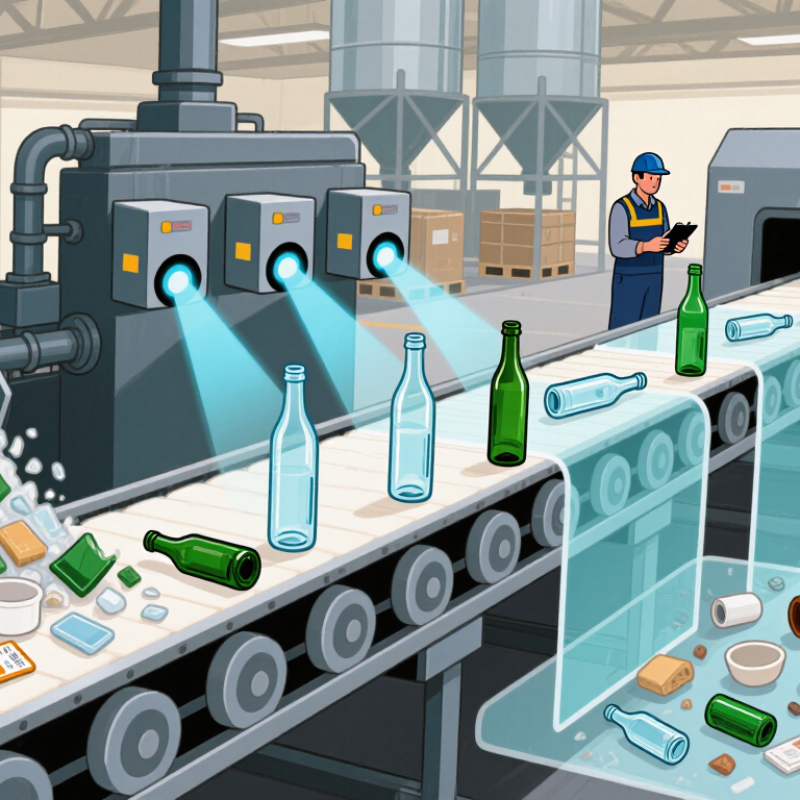
| RGB color camera sorting | Distinguishes visible glass colors, commonly clear, green, and amber, and can identify contrasting objects in the feed. | Directly addresses color separation; works at high throughput when material is spread into a consistent, visible layer. | Performance can be reduced by overlapping pieces, dirt, labels, variable lighting, and glass colors that are difficult to distinguish visually. | Color recovery from prepared, relatively clean mixed-color container glass. |
| Laser or fluorescence-based detection | Uses an optical response, such as reflected laser light or fluorescence, to distinguish certain non-glass contaminants from glass. | Can help identify contaminants such as ceramics, stones, and porcelain (CSP) that may look similar to glass in ordinary camera images. | Detection capability depends on the sensor design, contaminant type, surface condition, and how material is presented to the sensors. | Removing CSP from cullet when the selected system is specifically designed and tested for the target contaminants. |
| Near-infrared (NIR) spectroscopy | Identifies materials using their near-infrared spectral response; it is commonly used to distinguish many polymers and other material classes. | Useful as part of a broader recycling line for separating non-glass materials, depending on the materials and sensor configuration. | NIR is not a substitute for a glass-color camera and is not universally effective on dark, wet, dirty, or optically obscured items. Confirm performance for the intended target. | Applications where the line also needs material identification beyond glass color sorting. |
| Metal detection or electromagnetic separation | Detects or separates metal contaminants. Magnetic separators target ferrous metals; eddy-current separators are used for non-ferrous metals such as aluminum. | Provides a complementary way to remove metal pieces that can contaminate cullet or damage downstream equipment. | It does not sort glass by color or remove non-metal contaminants. Selection depends on the metal types, particle size, and feed arrangement. | Removing ferrous or non-ferrous metal before or alongside optical glass sorting. |
| X-ray transmission (XRT) | Measures how X-rays pass through objects, providing information related to their density and thickness. | Can distinguish some dense or compositionally different objects that are difficult to separate by visible color alone. | Results depend on the contrast between the target and surrounding glass. It should be validated for the specific contaminant and particle-size range. | Specialized applications where trials show useful X-ray contrast for the contaminants of concern. |
| Feed presentation and singulation | Controls how evenly material is spread and whether pieces are separated as they pass the sensors. | Consistent presentation helps sensors see individual pieces and supports more reliable sorting. | Overloaded belts, overlapping shards, excessive fines, and irregular feed can reduce detection and ejection performance. | Any optical or sensor-based sorter, especially where the feed varies in size or shape. |
| Air-ejection system | Uses timed air jets to divert detected target pieces into a reject or product stream. | Enables rapid, contact-free separation of pieces identified by the sensors. | Requires suitable compressed air, correct timing, and maintenance of valves and nozzles. Small or closely spaced pieces can be harder to eject individually. | High-speed sorting where detected pieces must be removed from a moving stream. |
| Throughput and particle-size range | Describes the amount of material processed and the size range the machine is designed to sort. | Matching capacity and size range to the plant can help avoid bottlenecks and improve feed consistency. | Rated throughput is not a guaranteed result for every feed; contamination, moisture, particle shape, and presentation can affect actual performance. | Comparing machines against measured plant flow and the real cullet size distribution. |
| Calibration, recipes, and data monitoring | Allows operators to adjust sorting settings and monitor operating conditions or sorting results. | Can simplify changeovers between feed types and help identify performance changes over time. | Controls cannot compensate for unsuitable sensor selection, poor feed preparation, or inadequate maintenance. | Facilities that process different glass streams or need routine performance checks. |