| Typical application | Laboratory development, sample preparation, pilot trials, and low-volume production. | Small-batch production and manufacturing lines requiring operator loading with automated cutting. | Medium- to high-volume production with repeatable positioning and recipe-based operation. | Continuous mass production integrated with forming, sealing, inspection, and packaging equipment. |
| Typical output rate | Approximately 20–80 cells per hour, depending on loading and inspection time. | Approximately 120–300 cells per hour. | Approximately 300–900 cells per hour. | Approximately 900–2,400 cells per hour, depending on cell size, trim path, and line balance. |
| Operator involvement | Manual loading, alignment, cutting, and part removal. | Manual loading and unloading; cutting cycle and clamping are automated. | Operator loads material or uses an automatic feeder; motion, clamping, and cutting are recipe-controlled. | Minimal direct handling; transfer, positioning, cutting, and discharge are coordinated with the production line. |
| Suitable pouch-cell formats | Best for frequent format changes and experimental cells with varying dimensions. | Small and medium pouch cells with moderate variation in length and width. | Repeated production formats requiring stored recipes and accurate positioning. | Stable, standardized formats with high annual volumes and controlled upstream tolerances. |
| Typical cell-size range | Small laboratory cells up to approximately 300 × 200 mm, subject to fixture design. | Approximately 100–400 mm in length and 60–250 mm in width. | Approximately 150–600 mm in length and 80–350 mm in width. | Commonly configured for approximately 200–800 mm in length and 100–450 mm in width. |
| Positioning repeatability | Typically about ±0.5–1.0 mm, mainly dependent on the operator and fixture. | Typically about ±0.2–0.5 mm with a dedicated locating fixture. | Typically about ±0.05–0.20 mm using servo axes, sensors, and controlled clamping. | Typically about ±0.05–0.15 mm when upstream web and cell positioning are stable. |
| Typical trim-width control | Approximately ±0.5–1.0 mm. | Approximately ±0.3–0.5 mm. | Approximately ±0.1–0.3 mm. | Approximately ±0.1–0.2 mm with closed-loop alignment and maintained tooling. |
| Cutting method | Hand-operated guillotine, punch, or guided blade fixture. | Pneumatic or electric blade, punch, or shear activated after manual loading. | Servo-driven rotary knife, shear blade, or programmable punch with controlled motion. | Integrated rotary knife, die-cutting, or continuous shear system synchronized with line speed. |
| Material compatibility | Aluminum-plastic laminate pouch film and sealed edge areas; blade selection is application-specific. | Aluminum-plastic laminate with common sealant layers such as PP or PE-based structures. | Multilayer pouch films with different thicknesses, provided the tool pressure and blade geometry are qualified. | High-volume pouch-film structures requiring validated tooling, dust control, and continuous scrap removal. |
| Format changeover | Usually 5–15 minutes with interchangeable fixtures and manual adjustment. | Usually 10–30 minutes, depending on fixture and blade replacement requirements. | Usually 5–20 minutes with stored recipes and quick-change tooling. | Usually 15–45 minutes because tooling, conveyors, sensors, and line parameters may require coordinated setup. |
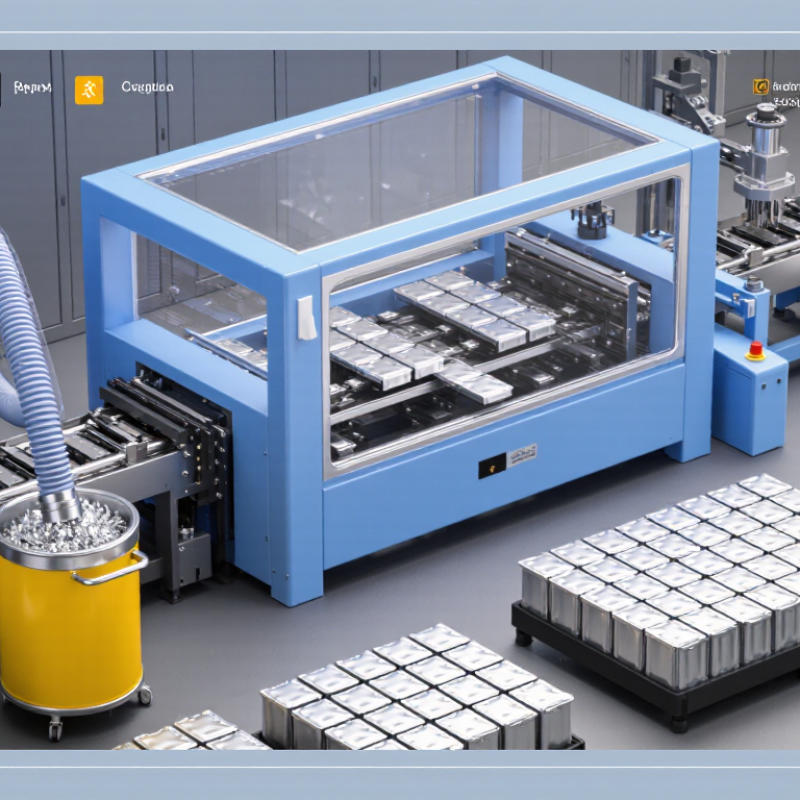
| Scrap handling | Manual removal and collection. | Basic chute or collection tray; manual emptying is common. | Powered scrap conveyor or vacuum extraction with bin-full detection. | Continuous scrap conveying or vacuum extraction with centralized collection and monitoring. |
| Quality-control capability | Visual inspection and manual measurement. | Basic presence sensors and optional dimensional checks. | Recipe verification, barcode or QR-code reading, edge-position detection, and optional vision inspection. | Integrated vision inspection, traceability, reject handling, process data collection, and line-level statistical monitoring. |
| Recommended controls | Simple electrical controls with guarded cutting area. | PLC control, two-hand start or light curtain, and emergency-stop circuit. | PLC with servo motion control, HMI recipes, safety doors, light curtains, and interlocked tooling. | Line PLC or industrial network communication, safety-rated motion control, access guarding, and MES-compatible data exchange. |
| Approximate equipment footprint | About 0.5–1.5 m². | About 1.5–4 m². | About 3–8 m², excluding external material handling. | About 8–25 m², depending on conveyors, feeders, inspection, and scrap systems. |
| Utility requirements | Electrical power; compressed air may not be required. | Electrical power and commonly 0.5–0.7 MPa compressed air for clamping or actuation. | Electrical power, compressed air, and optional vacuum extraction or dust collection. | Electrical power, compressed air, vacuum or dust extraction, network connection, and coordinated line utilities. |
| Main advantages | Lowest initial cost, simple operation, and maximum flexibility for development work. | Improved consistency and productivity without the complexity of a fully automated line. | High repeatability, recipe management, reduced labor, and strong adaptability to multiple formats. | Highest productivity, labor efficiency, traceability, and consistent integration with mass production. |
| Main limitations | Low throughput, operator-dependent quality, and limited process data. | Higher labor requirement and lower line efficiency than fully automatic equipment. | Higher investment, greater controls complexity, and need for trained maintenance personnel. | Highest capital cost, longer commissioning, stricter upstream quality requirements, and more complex maintenance. |
| Best choice when | Annual volume is low, cell designs are changing frequently, or the machine is mainly for R&D. | Production is growing and consistent trimming is needed, but full automation is not yet justified. | Multiple qualified formats must be produced with stable quality and medium-to-high utilization. | Demand is high, product formats are stable, and the trimming process must operate as part of an automated line. |
| Key questions before purchase | What is the largest cell, required edge geometry, and acceptable operator-dependent tolerance? | How many formats are required, and how frequently will fixtures or blades be changed? | What are the target takt time, trim tolerance, traceability requirements, and future format plans? | What are the line takt time, upstream and downstream interfaces, uptime target, reject strategy, and data-integration requirements? |