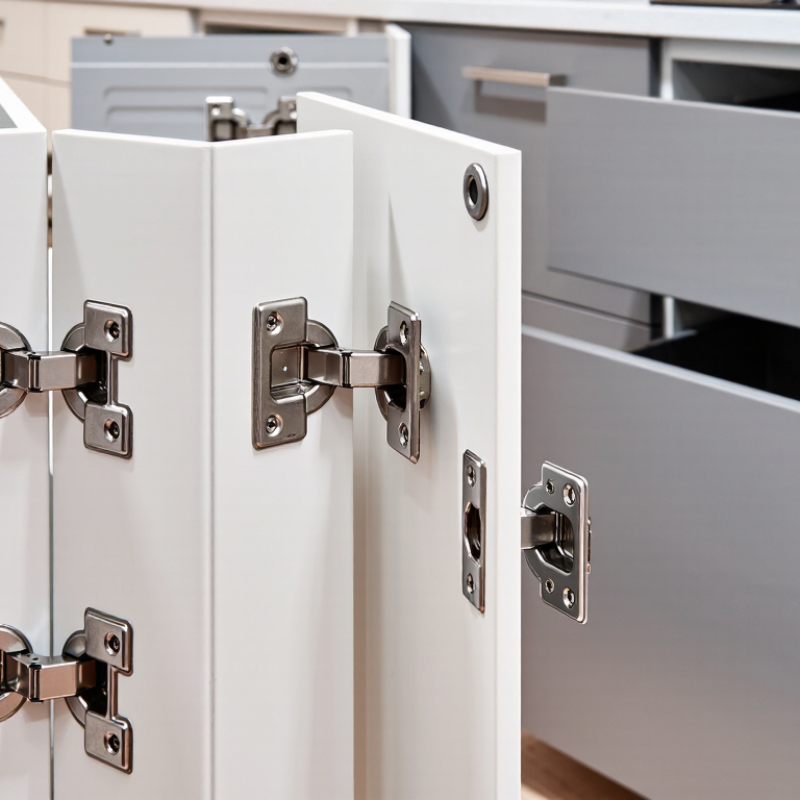
| Full-Overlay Concealed Hinge | Doors covering the full cabinet side panel | Commonly uses a 35 mm cup hole; cup depth is usually about 11–13 mm. Requires accurate drilling and a mounting plate. | Usually provides side-to-side, height, and depth adjustment. Typical adjustment is approximately ±2 mm per direction, depending on the hinge design. | Commonly 100°–110° | Often suitable for approximately 15–24 mm doors; confirm the hinge cup and screw clearances. | Steel construction, plated surfaces, secure screw fixing, and a tested soft-close mechanism improve service life. | ★★★★★ |
| Half-Overlay Concealed Hinge | Two doors sharing one cabinet partition | Uses a 35 mm cup hole and a special crank or offset arm to reduce the overlay on the center partition. | Generally offers three-way adjustment, but the available overlay range depends on the crank and mounting plate combination. | Commonly 100°–110° | Typically used with standard cabinet door thicknesses of about 15–24 mm. | Check the load rating per pair and the strength of the center-partition fixing points. | ★★★★☆ |
| Inset Concealed Hinge | Doors fitted inside the cabinet opening | Needs precise door and cabinet alignment. A 35 mm cup hole is common, although compact models may use different drilling dimensions. | Three-way adjustment is highly desirable because small errors are visible around the door gap. Typical movement is about ±2 mm per direction. | Commonly 95°–110° | Usually suitable for approximately 15–24 mm doors; verify the hinge arm geometry and door-edge clearance. | Precise installation, a rigid cabinet box, and stable mounting plates are essential for maintaining even reveals. | ★★★★☆ |
| Compact Concealed Hinge | Small doors, narrow frames, and lightweight furniture | May use a smaller cup or a screw-on construction. Installation is easier when drilling depth is limited. | Adjustment may be limited to two directions; some compact models provide only basic position correction. | Commonly 95°–110° | Often intended for lighter doors or thinner panels; check the stated door-weight limit before use. | Best for low-to-medium duty. Avoid exceeding the manufacturer’s load rating or using one hinge on a tall door. | ★★★☆☆ |
| Wide-Angle Concealed Hinge | Corner cabinets and doors requiring broad access | Uses a 35 mm cup in many designs, but the extended arm requires adequate clearance from adjacent doors and walls. | Usually includes three-way adjustment; depth and side adjustment are especially important for preventing door interference. | Commonly 155°–170° | Often suitable for standard 15–24 mm cabinet doors, subject to the selected mounting plate and overlay. | High opening angles increase mechanical movement, so robust arms, accurate fixing, and suitable door support are important. | ★★★★☆ |
| Soft-Closing Concealed Hinge | Kitchens, bathrooms, bedrooms, and other noise-sensitive interiors | Available in full-overlay, half-overlay, and inset configurations. The damper may be integrated or attached to the hinge body. | Normally offers the same three-way adjustment as the corresponding concealed hinge type. Some dampers include an on/off switch. | Commonly 100°–110° | Usually fits approximately 15–24 mm doors, but the closing force must match the door size and weight. | Look for corrosion-resistant finishes, a replaceable or protected damper, and documented cycle testing. Cycle claims vary by model. | ★★★★★ |
| Piano or Continuous Hinge | Long, narrow, lightweight doors and utility cabinets | Surface-mounted along most or all of the door height. Does not require a 35 mm cup hole, but accurate screw spacing is important. | Offers little built-in adjustment after installation; alignment depends mainly on the mounting position and cabinet construction. | Commonly about 180° | Useful when the door edge can accept a continuous hinge leaf; confirm the leaf width and screw clearance. | Continuous support distributes the load along the door edge, while corrosion resistance and screw quality determine long-term performance. | ★★★☆☆ |
| Surface-Mount Butt Hinge | Traditional furniture, face-frame cabinets, and visible-hardware designs | Mounted directly to the door and cabinet surface or in shallow mortises. Does not require concealed cup drilling. | Limited adjustment after installation; shims, elongated holes, or repositioning may be needed to correct alignment. | Commonly 90°–180°, depending on the leaf and stop design | Suitable for a broad range of door thicknesses when the leaf size and screw length are correctly selected. | Thick steel or stainless-steel leaves resist deformation. Proper screw engagement is critical for heavier doors. | ★★★☆☆ |